
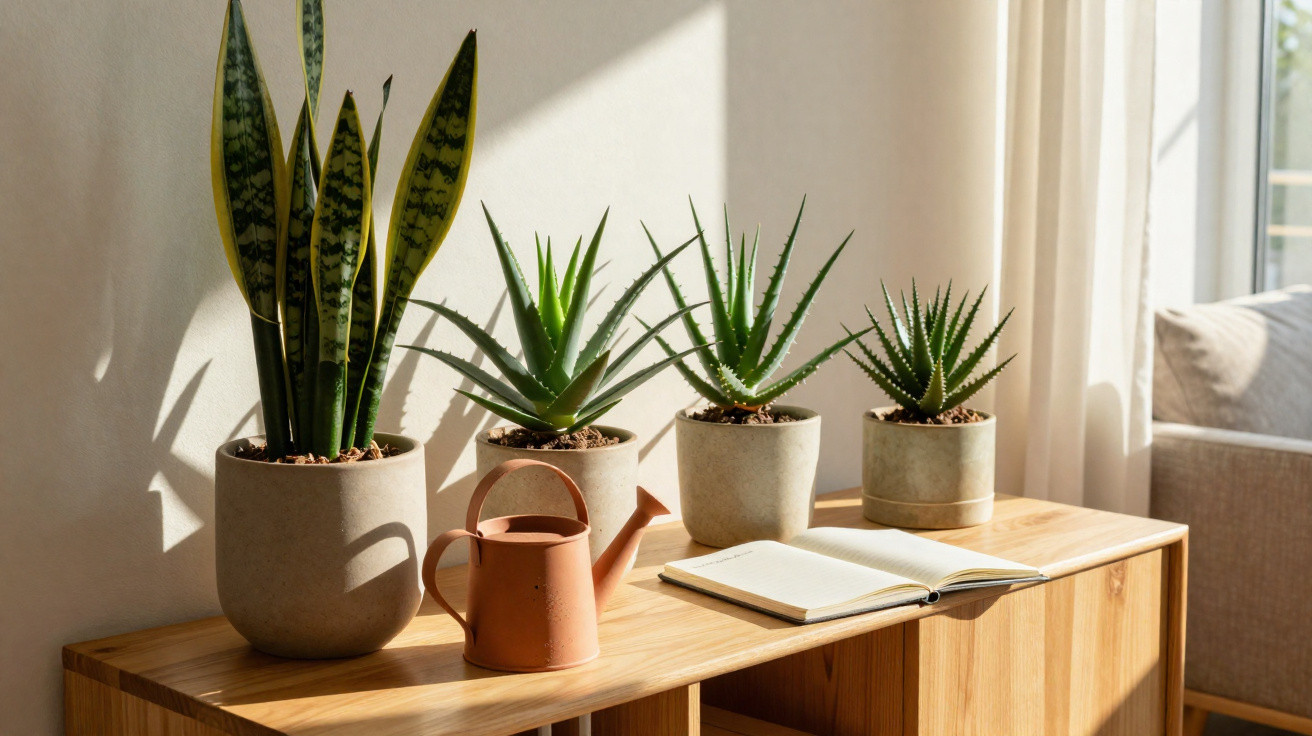
In many urban homes, indoor plant décor must fit around fast-paced routines and limited time for daily care. In this setting, hardy species that withstand dry spells and missed watering are increasingly popular, offering a straightforward way to create a greener home without demanding maintenance. They minimise plant losses and suit the schedules of people who spend the day away from home.
What makes indoor plants resistant to lack of water?
Certain indoor plants have features that retain water, including thick leaves, succulent stems or sturdier root systems. Others have evolved ways to limit moisture loss, such as waxy or narrow leaves, or slower growth.
Many originate in arid or semi-arid areas, where rainfall is irregular and soil drains freely. As a result, they grow well in pots filled with a light potting mix and cope with longer gaps between watering, making them ideal for people seeking convenience and minimal everyday care.
Which 5 indoor plants survive well with little watering?
Of the many species available, some stand out for their resilience, easy cultivation and ability to adapt well to flats. Below are five popular choices for anyone who regularly forgets to water, perfect for creating a low-maintenance green space.
ZZ plant (Zamioculcas zamiifolia)
The ZZ plant copes well with little water and indirect light because its firm leaves retain moisture. Water it only once the potting mix feels dry to the touch, taking care not to overwater. It adapts well to living rooms, offices and moderately lit corridors.Snake plant (Sansevieria trifasciata)
The snake plant is among the most drought-tolerant indoor plants. Its upright, succulent leaves hold water, allowing it to go for extended periods without watering. It tolerates anything from indirect light to filtered sunlight, requiring only occasional watering once the soil is dry.Cylindrical snake plant (Sansevieria cylindrica)
A relative of the snake plant, this cylindrical variety has thick, rod-shaped leaves with a high water-storage capacity. Commonly used in minimalist interiors, it prefers freely draining soil, pots with drainage holes and widely spaced watering.Pothos or devil's ivy (Epipremnum aureum)
Devil's ivy is a climbing plant widely used as a trailing indoor plant. While it prefers moderate moisture, it can tolerate some time without water, especially in partial shade. Its aerial roots help it use moisture in the surrounding environment between waterings.Indoor cactus (various species)
Cacti store water in their tissues and are renowned for their ability to withstand infrequent watering. Indoors, they favour bright conditions, such as those near windows or in glazed balconies. They are generally watered every two or three weeks, always avoiding excess water.
How to care for indoor plants when you forget to water
Even when choosing resilient species, a few simple measures can greatly improve your chances of success. The best approach is to pair a suitable pot with drainage holes with a light potting mix that allows air to circulate and prevents root rot.
To simplify the routine and avoid common issues, it is worth adopting a few practical day-to-day habits. These work as “smart shortcuts” for keeping plants healthy:
- Test the soil with your finger: if the potting mix is still damp, postpone watering to prevent excess water.
- Do not leave saucers full of water: standing water encourages fungal growth and root rot.
- Adjust the position: places with consistent indirect light tend to provide more stable conditions for indoor plants.
- Use simple reminders: notes in a calendar or alerts on your phone can help you remember the occasional watering.
What extra care helps these plants stay healthy?
Small details can make a real difference to the health of hardy indoor plants. Wiping dust from the leaves, turning the pot regularly for even growth, and checking for signs such as yellowing or wilting can help address problems early.
It is also helpful to adapt watering frequency to the season. In winter, many species need longer intervals, whereas in summer they may require slightly more regular attention, although still in moderation.
Comments
No comments yet. Be the first to comment!
Leave a Comment