
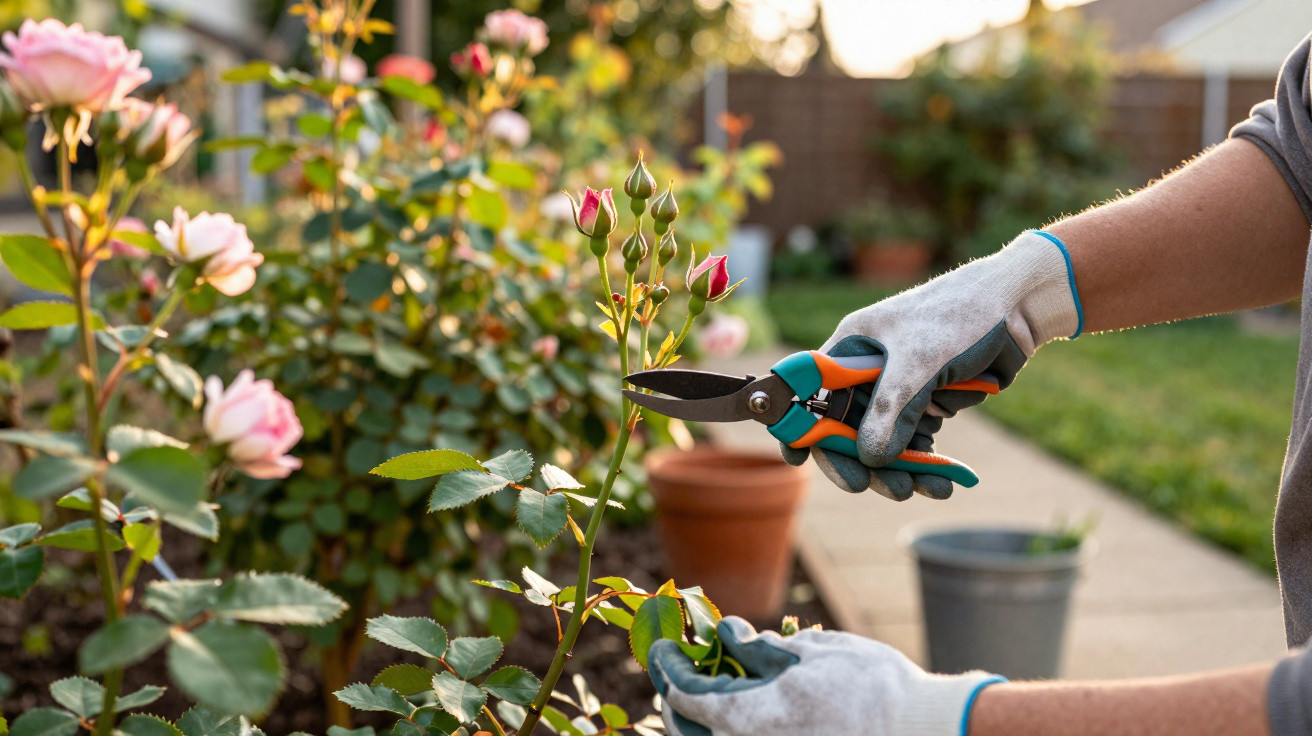
The bed looks bare, winter still clings to the branches, and your gaze lands on the secateurs: cut everything back “nice and tidy” now and the rose bush will bloom all the more - that’s what many people assume. In spring, that exact impulse is often why whole borders produce disappointingly few flowers in summer. The reason comes down to a small detail on the shoots that is ignored surprisingly often.
Why a close crop in March holds your roses back
A walk through the outdoor displays at a garden centre shows immaculately groomed rows of roses: every stem cut to the same level, no unruly tips, everything neat. It’s easy to want to copy that look at home. The problem is: roses are not hedges.
Each cane on a rose stores energy and carries the beginnings of later flowering. If, in March, you chop everything down to one very low, uniform height, the plant loses a large share of those reserves. That matters most because the rose is only just waking from dormancy and is already mobilising energy to push new growth.
Last year’s growth is particularly important. Think of it as the season’s flowering capital: most buds form there. If you shorten those canes drastically - or remove them altogether - you force the plant to rebuild wood first instead of setting flowers. The rose pours its effort into producing stems, while flowering becomes sparse or starts noticeably later.
There is also a health downside: lots of large pruning wounds at once make it much easier for fungal diseases to get established. Common issues include:
- Powdery mildew (white coating on young leaves and shoots)
- Black spot (black marks followed by leaf drop)
- Rose rust (rust-coloured pustules on the underside of leaves)
If infections like these hit a rose that has already been weakened by hard pruning, the whole plant suffers. Then a late cold snap with frost can finish the job, because the rose no longer has the reserves to direct energy into protected buds.
"Anyone who cuts roses back too hard in March strips the plant of its built-up reserves and sacrifices precisely the shoots that would produce the most abundant display."
The overlooked key: the “eyes” rule when pruning roses
The real deciding factor sits right on the cane: the buds, often referred to in rose-growing as “eyes”. These are small swellings beneath the bark that later produce new shoots and flowers. They determine both how strongly the rose grows and the direction it takes.
Before you make a cut, it pays to pause and locate these eyes. For bush roses and standard roses, a simple rule of thumb works well: on each strong cane, usually leave three to five eyes, counted up from the base.
- Weak canes: keep closer to three eyes
- Strong, well-developed canes: leave four to five eyes
- Thin, exhausted or diseased canes: remove entirely, right back to the base
This stops the shrub looking “shaved” while still maintaining good airflow. The rose keeps enough structure to push sturdy, flowering new shoots, rather than wasting itself on lots of thin, reluctant-to-bloom twigs.
How to place the cut correctly above an eye
What matters isn’t only the number of eyes you leave, but also exactly where you cut:
- Find an eye that points outwards.
- Position the blades about 5 mm above it.
- Cut at a slight angle, sloping away from the eye so rainwater can run off.
An outward-facing eye directs new growth away from the centre of the plant. That creates an open, airy framework where foliage dries faster and fungal problems have fewer opportunities.
"A quick check of the eyes before every cut prevents a well-meant tidy-up from turning into a complete flowering failure."
Before you prune: identify the rose type precisely
Not every rose tolerates the same pruning approach. Treat all varieties alike and you will lose flowers - especially on once-flowering roses.
Repeat-flowering roses (remontant varieties)
These roses flower more than once, often from June into autumn. They are typically pruned in late winter or early spring, once hard frosts have passed and the buds begin to swell.
- Remove old, dead wood completely.
- Cut out shoots that cross or grow inwards.
- Shorten the remaining strong canes to three to five eyes.
This keeps the plant renewed, and it focuses energy on vigorous, well-positioned growth that flowers freely.
Once-flowering roses
Many old-fashioned varieties and some climbing roses flower only once each year, but often spectacularly. They form blooms exclusively on last year’s wood. If you cut these roses back hard in March, you remove exactly the shoots that matter - and the display can all but disappear.
Prune these types only after flowering in summer. At that point you can shorten spent shoots a little or remove them entirely, making room for young, strong long canes that will carry next year’s blooms.
Treat climbing roses properly: keep the framework, direct the side shoots
With climbers there is an extra layer to consider: the main framework. The thick, load-bearing canes are the backbone of the plant and, as long as they are healthy and green, should be kept for several years.
For repeat-flowering climbing roses:
- Select three to five strong, well-ripened framework canes and tie them to a trellis or arch.
- Shorten side shoots on these framework canes to two to three eyes.
- Remove old, weak or very woody framework canes close to the ground, gradually replacing them with young long canes.
Handled this way, each short side shoot becomes a small garland of flowers instead of forming a dense, misshapen lump of wood. One key point: climbers flower most generously when the main canes are trained slightly horizontally or in a fan shape. That encourages many eyes along the cane to form flowering shoots.
"If you only 'take the top off' climbing roses instead of separating framework canes from side shoots, you throw away enormous flowering potential."
Practical extra tips for healthy, free-flowering roses
The right timing in your garden
The often-quoted “March prune” is only a rough guide. A better cue is an obvious sign outdoors: once the forsythia is in bloom in your area, most places are usually mild enough for the main prune.
In exposed, colder spots, it’s wiser to wait a week rather than sending freshly cut growth into a late frost. Open cuts react more sensitively to cold.
Tools, hygiene and wound care
A clean, sharp pair of secateurs matters more than many people realise. If the blade crushes the wood, wounds seal more slowly and pathogens have an easier route in. Before you start, give the tool a quick clean with alcohol or hot water - especially if you’re working through several roses.
For very thick canes, use sharp loppers or a pruning saw rather than forcing a cut. In damp climates with high fungal pressure, large wounds on old plants can be treated with a wound sealant; in airy gardens, a neat, clean cut is usually sufficient.
Why a considered prune pays off over time
Roses may look tough, but they respond sensitively to the wrong care. If, each year in March, you take time to assess which canes are young and vigorous, where the eyes sit, and which rose type you have in the bed, you gradually build a stable collection that flowers generously.
The benefit isn’t limited to more blooms: correctly pruned roses break evenly, stay better ventilated, and cope far more calmly with weather extremes or disease pressure. Your workload drops too, because fewer diseased shoots need removing and fewer plants have to be replaced outright.
If you’re unsure, try a simple comparison on one shrub: prune one section in the traditional “short” way, and the other strictly by rose type and the eyes rule. By June at the latest, the side-by-side difference in bud count, flower size and overall plant health becomes unmistakable.



Comments
No comments yet. Be the first to comment!
Leave a Comment