
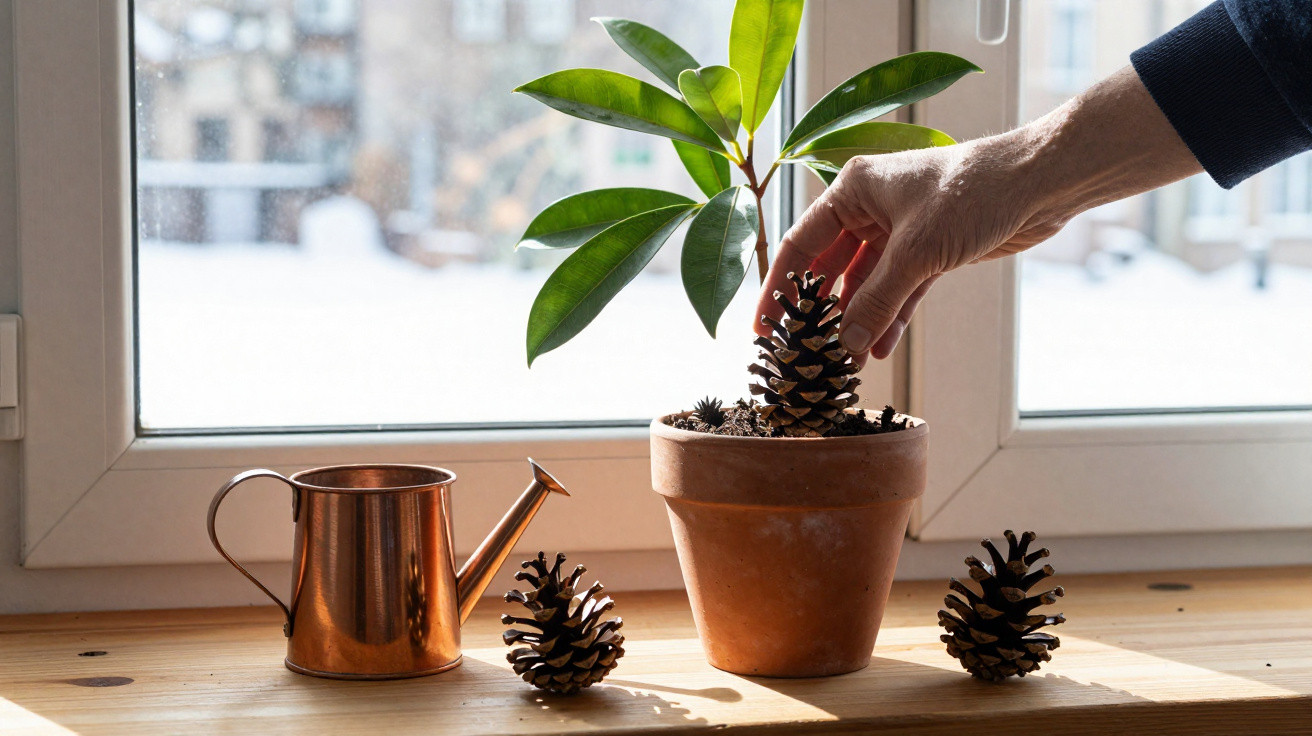
Many keen home gardeners reach for the watering can on autopilot in winter the moment the compost looks dry. That’s often where the trouble starts: roots sit in wet compost, fungi take hold, and leaves begin to drop. An old household trick is bringing a surprisingly simple aid back into view: a dry fir cone placed directly on the surface of the compost - with a remarkably effective result.
Central heating and winter dormancy: why houseplants struggle right now
In January, the heating is usually on full blast and the windows stay shut. It’s comfortable for people, but it piles stress onto plants. Warm, dry indoor air makes the top layer of compost dry out quickly. It looks like “thirst”, so people water again - and often far too often.
What happens underneath is easy to miss: water collects deeper in the pot. The roots then get too little oxygen, and the compost stays damp inside even though the top looks dusty-dry again. Fungi and bacteria thrive, and roots can start to rot.
"The visible problem is rarely the dry surface, but the invisible swamp around the roots."
Stagnant air makes things worse. With little ventilation and hardly any air movement, moisture builds up right above the compost. That creates ideal conditions for mould, fungus gnat larvae and other unwanted visitors. Many plants slowly decline - even though they don’t actually lack water, they’re receiving far too much.
The fir cone as a natural moisture brake
This is exactly where a fir cone can help. Its woody structure is highly responsive to moisture. When dry, cones are open, with scales that resemble small wooden scoops. That structure allows it to act like a natural sponge.
If you place a dry fir cone on the compost, it takes on several jobs at once:
- It absorbs excess moisture from the top layer of compost.
- It lightly dries the critical area at the base of the stem - where rot often begins.
- It stops a constantly damp surface film that mould fungi love.
- It improves the microclimate just above the compost because moisture is bound rather than lingering in the air.
In practice, it works like surface drainage - with no chemicals, no specialist garden-centre products, and effectively at zero cost.
The cone as a mini gauge: open or closed?
The most interesting part is that a fir cone isn’t just absorbent - it also doubles as an indicator. Its scales react mechanically to humidity in the air.
When the cone is wide open
If the scales are clearly spread, and the cone looks loose and airy, that’s a positive sign. The immediate environment is on the dry side and the compost surface isn’t overly wet. The plant can “breathe”, and rot isn’t an urgent risk.
"Open scales mean: the compost can be watered again if needed - but without rushing."
In typical indoor conditions, the cone may remain open for days. During this period, the risk of overwatering is low - as long as there isn’t leftover water sitting in the saucer.
When the cone closes
As soon as humidity rises directly above the compost, the scales gradually draw together. The cone then looks like a compact, smooth unit. That is a clear warning sign.
A closed cone signals: the compost is still very wet. Watering again at this point risks waterlogging in the pot. In that situation:
- Don’t add water until the cone opens again.
- Lift the pot briefly: if it feels heavy, there is enough water in the compost.
- If needed, increase air movement, for example by briefly opening the windows wide.
For many hobby gardeners, this “wooden barometer” proves much more dependable than the popular finger test. The cone is checking exactly where mould and rot tend to gain a foothold first: right at the surface.
How to use a fir cone correctly day to day
Preparation is straightforward, but a few details are worth getting right. This simple routine helps avoid mistakes:
- Collect cones: On a walk in the park or woodland, look for dry, already-open cones.
- Clean them: At home, brush off loose dirt and remove needles and bits of compost.
- Dry thoroughly: Leave the cone for a few days somewhere warm and dry until it opens widely.
- Check it: No sticky resin layer, and no visible insects or larvae.
- Place it: Set it directly on the compost, as close to the stem as possible without touching it.
For larger containers such as troughs or long window boxes, it can be worth using several cones. That makes it easier to judge moisture across the whole surface.
Which plants benefit most from the trick
Species that dislike waterlogging in particular tend to respond well to the fir-cone method. Common examples include:
- Succulents and cacti
- Ficus varieties (e.g. rubber plant, weeping fig)
- Monstera and other popular large-leaf houseplants
- Windowsill herbs such as rosemary and thyme
- Orchids in pots without a transparent outer sleeve
Especially for anyone who tends to water too generously out of care, the cone provides a visible “stop” signal. That reduces stress - for the plant owner and for the roots.
Winter protection without chemicals: less fungus, fewer pests
Persistently wet compost doesn’t just encourage mould; it also attracts fungus gnats. Their larvae feed on fine roots and weaken the plant further. By reducing surface moisture, the fir cone removes a key habitat these pests rely on.
"If you keep the surface dry, you take away much of the area fungi and fungus gnats use to attack."
In situations like this, many people immediately reach for fungicides or pest sprays. The cone method targets the cause: less moisture, more air, and steadier roots. For households with children or pets, that is a clear advantage because no risky products are involved.
Typical winter watering mistakes - and how the cone helps
Three misconceptions show up in living rooms year after year:
| Misconception | What’s actually true |
|---|---|
| Dry surface = the plant is thirsty | Inside, the compost is often still wet; the cone shows this by closing. |
| More light means more water | In winter, many plants grow more slowly, so water demand drops. |
| A bit of moisture on the compost won’t hurt | A permanently damp surface encourages mould and root rot. |
The cone gently guides you out of these traps: if it closes, the watering can stays put. If it remains open, you can water carefully - ideally less, but more deliberately.
How to boost the effect even further
A fir cone works best alongside a few simple care habits:
- Tip away water from saucers after 15–20 minutes.
- Regularly lift the pot: if it feels very heavy, it’s usually still well supplied.
- Move plants slightly away from direct heat sources.
- Use lukewarm water to avoid chilling the roots.
If you have lots of houseplants, choosing cones in different sizes can help. Smaller ones suit herb pots or mini succulents; larger cones work well for big container plants.
A small natural tool with a big impact
This isn’t just a decorative novelty. The cone gives a practical signal for when the compost truly can handle water again. That helps plants make it through the cold season far more calmly. Instead of dealing with soggy roots and yellow leaves in March, they head into spring with better reserves.
Once people have tried a fir cone as a quiet little guard on top of the compost, they often keep several to hand. They cost nothing, look attractive, and provide reliable day-to-day feedback - without an app, a sensor, or any tech.



Comments
No comments yet. Be the first to comment!
Leave a Comment