
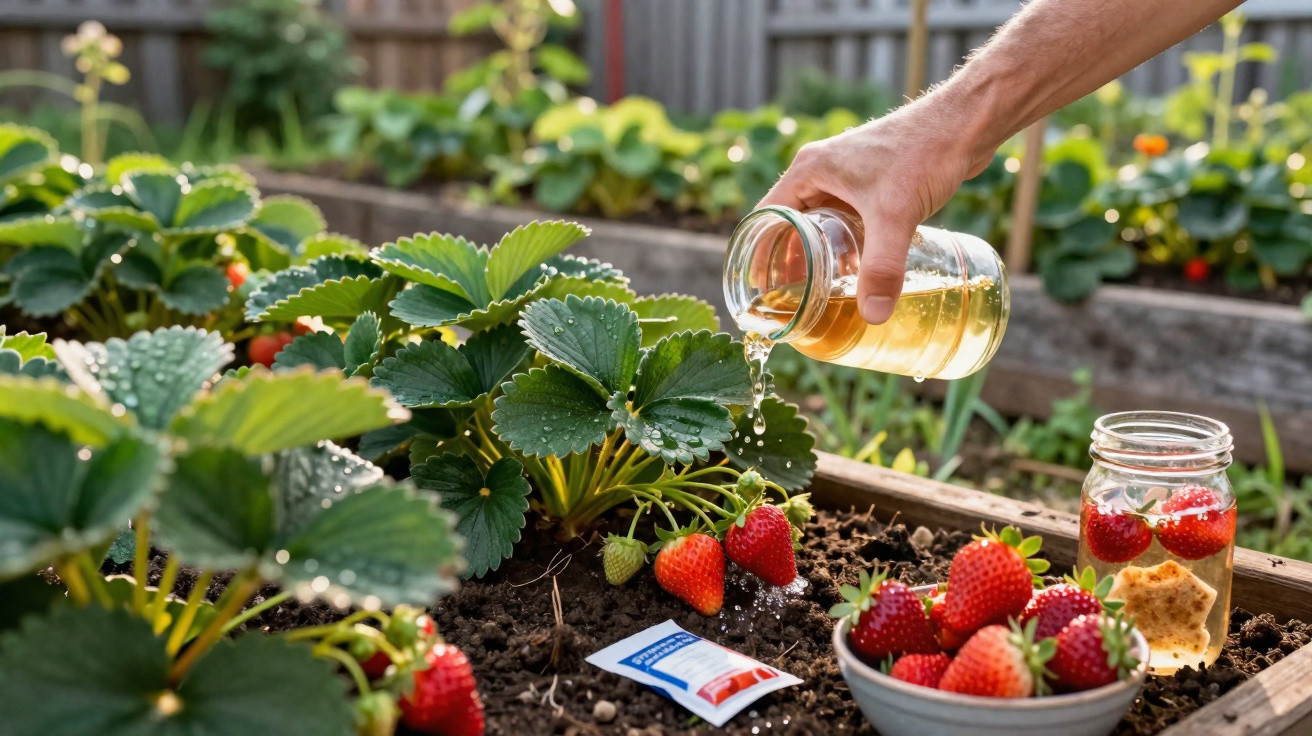
Strawberries grown in your own garden often taste better than supermarket fruit, yet they can still turn out small and underwhelming. A straightforward homemade liquid feed, based on a yeast fermentation, is designed to change that: sturdier plants, plumper berries and a fuller aroma - using ingredients most people already have at home.
The basic recipe for yeast fertiliser
At the heart of this trick is a liquid fertiliser made from yeast and sugar. The blend stimulates soil life and provides strawberry plants with readily available nutrients.
"If you apply this recipe consistently, you create a kind of ‘turbo breakfast’ in the bed for the strawberries’ root system."
For roughly ten plants you will need:
- 50 g fresh baker’s yeast or 1 teaspoon dried yeast
- 1 litre lukewarm water
- 1 tablespoon sugar
Step by step:
- Dissolve the yeast thoroughly in the lukewarm water.
- Stir in the sugar until the crystals have completely dissolved.
- Pour the mixture into a bowl or a large jar and cover loosely (not airtight).
- Leave it at room temperature for 24 hours, until it froths lightly and smells clearly fermented.
- Dilute the fermented liquid with water at a ratio of 1:5 (one part starter to five parts water).
Then water each strawberry plant with around 0.5 litres of the diluted solution, applying it directly to the root zone. Keep the leaves as dry as possible to reduce the risk of fungal diseases.
Why yeast makes strawberries grow so strongly
Yeast is useful not only in the kitchen but in the strawberry bed as well. This fungus naturally contains B vitamins, protein and a wide range of minerals. For strawberries, the most relevant are:
- Nitrogen - drives leafy growth
- Phosphorus - supports root development and flower formation
- Potassium - helps with fruit set and aroma development
The sugar in the mix matters just as much. It gives soil microorganisms a quick source of energy. Those bacteria and fungi transform organic material and make nutrients accessible to plant roots.
"A living soil with plenty of microorganisms works like an invisible supply network, transporting water and nutrients to the plant."
Soil specialists have pointed out for years that soil biology plays a key role in yield and plant health. By feeding microorganisms, you strengthen your strawberry plants indirectly: they form more robust roots, cope better with dry spells and often produce larger fruit.
How often to give strawberries yeast fertiliser
As with any fertiliser, the amount is what counts. Too much can upset the soil’s balance.
- Start: Apply the first feed shortly after strong spring growth begins.
- Main season: Repeat every 3–4 weeks until the end of peak flowering.
- Stop: Stop no later than when most fruits have set, so the plants are not overburdened.
If your soil is already very nutrient-rich, or you are using another organic fertiliser, you can extend the interval to five to six weeks. Important: the soil should be moist before you apply it; otherwise fine roots are more likely to scorch.
Additional natural fertilisers for those who like to experiment
Yeast fertiliser combines well with other household options. That makes it possible to tailor nutrients to what your soil needs, almost like building blocks.
Soaked bread as a nutrient boost
Stale bread does not have to go in the bin. Soaked in water and fermented, it becomes a potent liquid feed.
- Put dry bread into a bucket.
- Cover with water and leave for a week.
- Dilute the mixture at a ratio of 1:10 with water.
- Use sparingly, as the solution is very strong.
This mixture contains carbohydrates and minerals from the grain and stimulates soil life in a similar way to the yeast version.
Nettle feed for stronger leaves
Nettles are a classic ingredient in homemade garden brews. They provide plenty of nitrogen and trace elements.
- Roughly chop fresh nettles and put them into a bucket.
- Add water until everything is covered.
- Leave to ferment for several days up to two weeks, stirring daily.
- When fermentation slows, dilute at a ratio of 1:20.
It smells pungent, but it can be highly effective: tougher leaves, a deeper green and more leaf mass. For strawberries, an occasional application is enough to give growth a push.
Sour milk leftovers for stable cell walls
Out-of-date milk can serve as a calcium source. Mixed with compost, it creates a substrate that supports plant structure. Calcium helps keep cell walls stable and can help prevent fruit rot. This approach is better used as a spring soil improver than as a frequent feed during the season.
Highly diluted chicken manure
If you have access to chicken droppings, they can be used - but they are too strong on their own. Always dilute heavily with water (around 1:10) and apply only before flowering starts. If you feed too late, it mainly pushes leaf growth and can reduce fruit size.
Key conditions for an XXL strawberry harvest
Even the best fertiliser achieves little if the site and general care are wrong. The most important factors at a glance:
| Factor | Recommendation |
|---|---|
| Sunlight | 6–8 hours of direct sun per day |
| Watering | Keep soil evenly moist; avoid waterlogging |
| Soil reaction (pH) | Between 5.5 and 6.8 for good nutrient uptake |
| Plant spacing | 30–45 cm between plants |
If strawberries are planted too close together, you increase the risk of fungal problems and smaller berries. With a bit of airflow between plants, leaves dry faster and each plant can spread its roots more effectively.
Common mistakes when fertilising strawberries
Many issues in strawberry beds can be avoided once you know the usual pitfalls:
- Too much nitrogen: Huge leaves but few fruits. Do not use yeast fertiliser every week.
- Wrong timing: Heavy feeding late on drives leaf growth when the plant should be forming fruit.
- Waterlogging: Never apply liquid feeds to beds that are already sodden; roots can rot.
- Undiluted brews: Concentrated ferments or yeast mixes must always be mixed with water.
"If you watch your plants closely, you soon notice: very dark, over-lush foliage tends to point to overfeeding rather than deficiency."
Background: why microorganisms matter so much
Many amateur gardeners focus mainly on NPK values printed on fertiliser packaging. The life in the soil is at least as important. Billions of microorganisms break down organic matter, create humus and release trace elements. Yeast-and-sugar solutions speed up these processes because they provide easily usable food.
Soil with an active microflora holds water better, stays crumbly for longer and can retain nutrients like a sponge. Strawberries with a strong root system cope better in hot spells and deliver more reliable yields - even in difficult years.
Practical example: what a season plan could look like
If you want to test the idea in your own garden, you can set up a small trial area:
- Treat one part of the bed with yeast fertiliser using the recipe above.
- Feed a second section with standard compost only.
- Keep site conditions as identical as possible.
Over the season you can compare leaf colour, root development (by lifting a few individual plants) and, of course, fruit size. Simple trials like these in your own garden often provide more convincing evidence than any set of instructions.
Anyone who has seen how a basic mix of yeast, water and sugar visibly boosts strawberry plants may look at shop-bought fertiliser differently afterwards. And with a bit of luck, summer will bring a bowl of berries that feel closer to professional-grown varieties than something from your own patio.

Comments
No comments yet. Be the first to comment!
Leave a Comment