
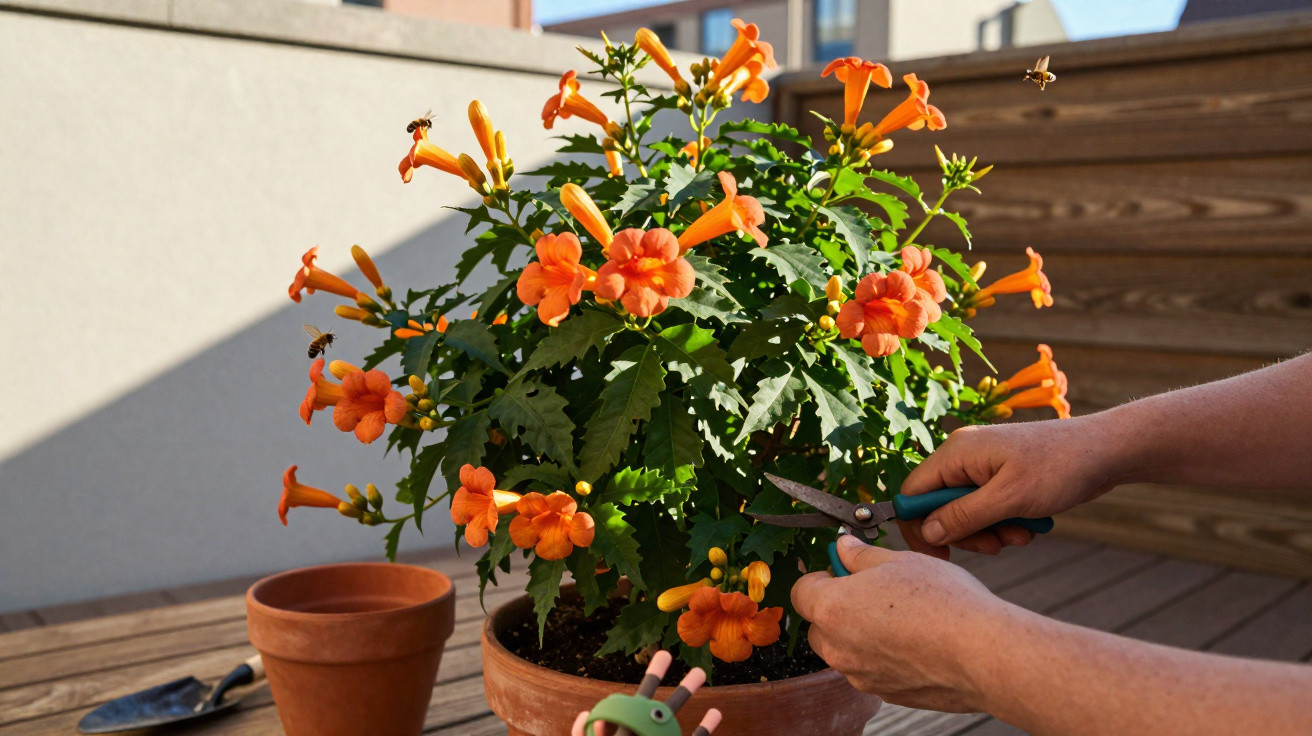
There is, however, a way to keep the garden glowing with colour for months.
Many keen gardeners know the dilemma: you’d love a proper shrub, but you hesitate because it might end up dominating everything. So, once again, you resort to pots of annuals and a few low perennials in the border - and by high summer the garden can start to look tired. One particular flowering shrub, still used surprisingly rarely, can solve this problem in a remarkably elegant way.
The star for small gardens: Tecomaria with bright orange flowers
Tecomaria ‘Cape Town Orange’ is a compact selection of the Cape honeysuckle. Rather than turning into an unruly monster, it stays impressively restrained - while still delivering the look of a tropical dream garden right outside your patio doors.
From May right through into autumn it produces orange trumpet flowers - on a shrub that stays to around 1.50 metres tall.
Where the original species can easily exceed 2 metres in height and spread, this variety typically tops out at about 1.50 metres high and roughly 1.80 metres wide. In a small city garden, on a patio, or in a narrow terraced-house garden, that scale feels far more balanced.
Its growth is dense, well-branched and bushy. That quickly creates a kind of green cushion that shapes borders, softens awkward corners, or acts as an eye-catcher at the edge of a seating area. Unlike many perennials, the shrub’s woody framework also adds structure in winter - even if, in colder regions, the foliage is knocked back by frost.
Flowers like a non-stop display - and a haven for insects
Its biggest advantage is the exceptionally long flowering period. From around May, Tecomaria keeps pushing out fresh clusters of strong orange, trumpet-shaped blooms. In mild areas, flowering can continue into October - and in some spots even into winter.
The showy tubular flowers are packed with nectar, so bees, bumblebees and butterflies seek them out. If you want an insect-friendly garden but don’t have much space, this plant gives you a strong argument in its favour.
Tecomaria brings both colour and food: it brightens the patio and supports pollinators in built-up areas.
Provided harsh frost doesn’t damage it, the foliage remains attractive for most of the year. And there’s another practical bonus where browsing is an issue: this shrub is among the plants that deer tend to avoid. For gardens on the edge of woodland, that can be a compelling plus.
Location and climate: where the shrub really thrives
This plant originates from warmer regions and, in international horticulture, is usually recommended for climate ranges comparable to zones 9 to 11. In central and northern European conditions, that means:
- Mild areas (wine-growing regions, sheltered urban locations): the shrub can remain in the ground for years and may occasionally flower in winter.
- Typical central European climate: the above-ground stems may die back in winter, but the base will reshoot from the roots in spring if it was well protected.
Ideally, the right spot offers the following:
- Light: full sun to light partial shade; in very hot regions, a few hours of afternoon shade can be beneficial.
- Soil: loose, free-draining and evenly, lightly moist - but never waterlogged.
- Winter protection: in colder regions, a thick mulch layer (for example bark compost or leaves) around the base, and possibly horticultural fleece during severe frost.
Once established, the shrub copes with relatively little water. During dry spells in summer, watering once a week is usually sufficient. If you grow it in a pot, you’ll need to water more often because compost dries out faster.
Planting in spring: how to get it off to a good start
The best planting window is in spring, once the risk of hard frosts has passed. The plant is commonly sold in a container. For planting into a border, the following approach works well:
- Dig a hole about twice as wide as the rootball.
- Remove the pot and gently tease the outside of the rootball so the roots are encouraged to branch.
- Set the plant so the transition between stem and root (the root collar) sits exactly at soil level.
- Backfill and firm lightly to remove air pockets.
- Water thoroughly.
- Add a 5–8 centimetre layer of mulch, keeping it from touching the stem directly.
For the first one to two years, don’t let the soil around the shrub dry out completely in summer. After that, it tolerates drought much better and is considered fairly undemanding.
Care and pruning: keeping the shrub compact and full
Many gardeners avoid shrubs because they worry they’ll “get out of hand”. With this variety, size and shape are easy to manage - as long as you prune regularly.
A confident cut-back after the main flush of flowers keeps Tecomaria small, bushy and well branched.
A simple care routine looks like this:
- Spring: feed lightly, for example with an organic general fertiliser or well-rotted compost. Cut frost-damaged shoots back to healthy wood.
- Summer after the first flowering wave: shorten overly long stems and remove dead or inward-growing branches.
- Autumn: thin only gently so the plant doesn’t produce soft new growth too late in the year.
If you prune more firmly, you’ll usually get stronger regrowth and a tighter, more compact habit. A practical tip: cut long shoots just above a well-positioned pair of leaves facing outwards - these points tend to encourage branching.
Pots, border edges, screening: ways to use it in a small garden
Because it stays a manageable size, Tecomaria fits neatly into spaces where there’s rarely room for woody plants. Here are a few good uses:
- A specimen in a pot on a sunny patio or roof terrace - ideal if you don’t have a border.
- A focal point by the seating area, paired with ornamental grasses, lavender or grey-leaved perennials.
- A lightly clipped mini screen along a fence or low wall.
- A burst of colour in the front garden, where depth is often limited.
In larger gardens, it combines well with Mediterranean-style plants such as rosemary, sage or coneflower. The orange flowers also sit particularly well with blues and purples.
What beginners should know: risks, benefits, alternatives
Despite its many strengths, it isn’t a miracle plant. In very exposed regions with long, severe winters, it can die back hard each year - or fail completely if the roots aren’t protected. If you live in such an area, it’s worth seriously considering pot culture and overwintering it frost-free, bright and cool (for example in an unheated conservatory).
On the plus side, it offers several clear advantages: few pest issues, a long flowering season, comparatively low water needs once established, and strong appeal for pollinators. In a small city garden, that combination is uncommon.
If you like the idea of a compact, summer-flowering shrub but your climate pushes Tecomaria to its limits, you can choose tougher alternatives - such as dwarf butterfly bush, low-growing Potentilla varieties, or compact panicle hydrangeas. They create a different colour effect, but they sit in a similar size bracket.
One more practical tip: if you’re unsure how vigorously it will grow in your own conditions, start with a single plant in a pot. If it performs well for a year or two, you can later set aside a space in the border. That way, confidence in using shrubs can build gradually - even in the smallest garden.
Comments
No comments yet. Be the first to comment!
Leave a Comment