
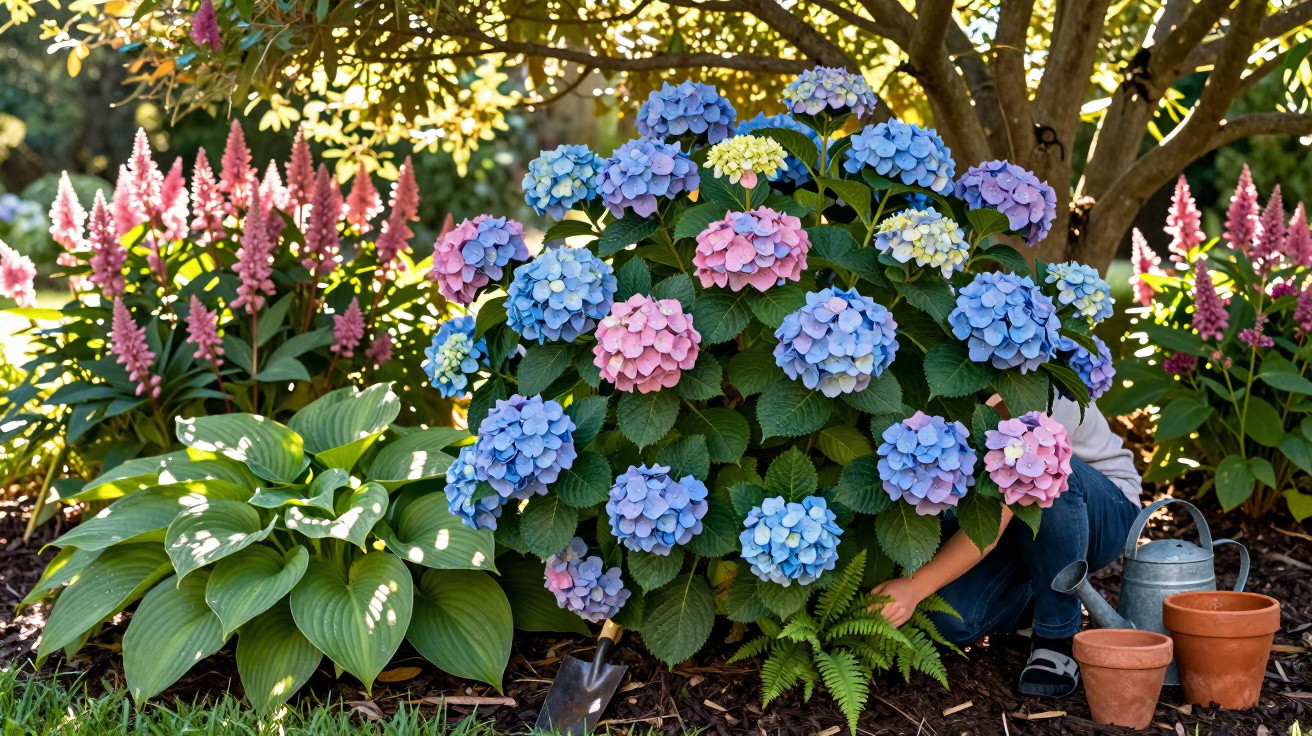
Plenty of amateur gardeners recognise the pattern: hydrangeas look glorious in spring, then in summer the leaves go limp and the flower heads stay smaller than you’d hoped. The usual response is simply to water and feed more. Yet the fix often isn’t in the watering can at all, but right next to the shrub in the border-specifically, the plants growing around it.
Why hydrangeas need strong partners in the border
Hydrangeas thrive under conditions that aren’t always easy to maintain in a garden over the long term: soil that’s rich in humus and slightly acidic, kept consistently moist but never waterlogged, plus a position in partial shade. They have a reputation as thirsty plants, but they don’t tolerate standing water-and they strongly dislike weed competition around their roots.
That’s exactly where companion plants come in. If you choose them well, they help manage the microclimate around the hydrangea: they conserve moisture in the soil, take the edge off the midday sun, and fill gaps in the border where weeds would otherwise shoot up.
"If you pair hydrangeas with the right neighbours, you create a natural climate-protection canopy-less stress over watering and more reliable flowering."
Three perennials stand out in particular because they’re widely available in garden centres and straightforward to look after:
- Ferns for cool, shaded ground
- Astilbes for long-lasting, colourful flower plumes
- Hostas as living sun protection
Together, they form a trio that reduces pressure on the shrub and noticeably extends the flowering period.
Ferns: living mulch for thirsty hydrangeas
Ferns match hydrangeas almost perfectly in terms of siting: they prefer humus-rich, moist soil and are happiest in partial shade. In a border, they also perform a very practical role. Their fronds spread over the ground like a green carpet, meaning far less moisture evaporates, the soil surface doesn’t heat up as much, and the ground stays pleasantly cool and evenly damp.
Because ferns tend to grow at a steady, unhurried pace, they don’t crowd out hydrangeas-yet they leave far less room for troublesome weeds. Anyone who has tried to hoe around a hydrangea’s dense branches will appreciate how valuable that is.
"Ferns act like a natural, self-renewing mulch layer that reduces watering and cushions plants against heatwave stress."
Suitable fern types for a hydrangea border
For typical garden beds, it’s worth choosing especially resilient varieties, such as:
- Lady fern - fine, delicate fronds; very adaptable
- Male fern - robust; quickly forms loose clumps
- Umbrella fern - adds a slightly exotic feel in shady corners
It’s best to plant fern clumps between and slightly in front of the hydrangeas. This both softens the overall look and cools the root zone at the same time.
Astilbes: colour extension for the flowering display
Astilbes enjoy much the same conditions as hydrangeas: fertile, moisture-retentive soil and sheltered spots away from harsh midday sun. Their big advantage is timing: in many gardens they flower for a little longer, bridging the period when large hydrangea heads begin to fade.
With their feathery flower spikes, astilbes add structure and a sense of movement to the border. Set among the rounded hydrangea blooms, they create upright accents in white, pink, red or purple. With thoughtful pairing, there’s colour somewhere in the hydrangea bed from early summer right through to late summer.
"Astilbes extend the flowering season and disguise the moment when hydrangea heads fade or are cut back."
How to grow astilbes successfully alongside hydrangeas
To make the partnership work well, a few practical points help:
- Don’t place astilbes in the hottest sun; position them to the side of, or slightly behind, the hydrangea.
- Keep the soil consistently moist; on sandy soils this may mean watering more generously.
- After flowering, cut off the dried plumes so the plant can put energy into next year’s growth.
If you plant in groups-so not single astilbes, but small clusters of three to five-you’ll get the strongest effect alongside the large, rounded hydrangea blooms.
Hostas: a leaf canopy against afternoon sun and heat stress
Hostas (also known as plantain lilies) are the third key support in a hydrangea border. Their thick, often broad, spreading leaves act like real umbrellas. They shade the hydrangea root area and keep the soil surface cooler. In locations that get more afternoon sun, this leafy canopy can make a very noticeable difference.
There’s another useful side effect: many slugs prefer hostas even more than hydrangea foliage. By planting hostas around the shrubs, you can divert some of the grazing away from the sought-after flower heads. It won’t stop slug damage entirely, but it can spread the pressure out.
"Hostas work like a green shade dome around the hydrangea and improve the microclimate with just a few plants."
Simple planting plan around the hydrangea
To get started, a straightforward layout works well in many gardens:
| Position in the border | Plant | Function |
|---|---|---|
| Centre | Hydrangea | Main focal point, large flower heads |
| Directly around it | Hostas | Sun protection, slug buffer |
| In between and in front | Ferns | Ground cover, moisture storage |
| Behind or to the side | Astilbes | Colourful height accents, longer flowering period |
With this clear structure, you get a border that feels full without looking chaotic. Watering intervals can usually be stretched, and hydrangeas often respond with stronger shoots and sturdier flower heads.
Practical care tips for the dream team in partial shade
To keep the combination working well year after year, it helps to stick to a few basics:
- Prepare the soil: work in plenty of compost or ericaceous compost before planting.
- Watering routine: water less often but thoroughly, rather than giving frequent small amounts.
- Add extra mulch: spread a thin layer of bark mulch or leaf mould between the perennials to boost the effect of the “living mulch”.
- Feeding: begin in spring with an organic slow-release fertiliser or a dedicated hydrangea feed.
If you garden in particularly hot areas, you can also use a light shading fabric on the hottest days until the hostas are large enough to take over the job on their own.
What many people still don’t know about hydrangeas and soil
Many hydrangea owners focus heavily on flower colour-especially with varieties that can shift between pink and blue. Soil pH plays a major part. More acidic soil encourages bluer tones, while neutral to slightly alkaline soil tends to push blooms towards pink. The trio of fern, astilbe and hosta suits a mildly acidic setting and helps smooth out fluctuations.
If you want to influence colour more precisely, it’s worth avoiding too much chalky tap water. Rainwater is usually the better option. In addition, specialist aluminium salts or hydrangea colourants can be used if you’re aiming for the strongest possible blue.
Risks, limits and sensible additions
Despite the advantages, there are a few points to keep in mind. In dry summers, hostas and astilbes also need plenty of water themselves. If they’re planted tightly around a hydrangea, you’ll need to ensure there’s enough moisture for the whole planting. In very small beds, the planting can become so dense that air circulation is reduced. In that case, it’s sensible to lift and divide individual clumps and replant them elsewhere.
As extra plants, low woodland perennials such as barrenwort (Epimedium) or small coral bells (Heuchera) work well at the front of the border. They fill edge gaps without pushing out the main plants. If supporting insects matters to you, you can also add shade-tolerant flowering perennials such as hardy geraniums, which provide additional food for bees and bumblebees.
With just a few targeted additions, a struggling hydrangea bed can be turned into a stable, partially shaded garden space that stays attractive from June well into late summer-while causing far less stress when it comes to watering.
Comments
No comments yet. Be the first to comment!
Leave a Comment