
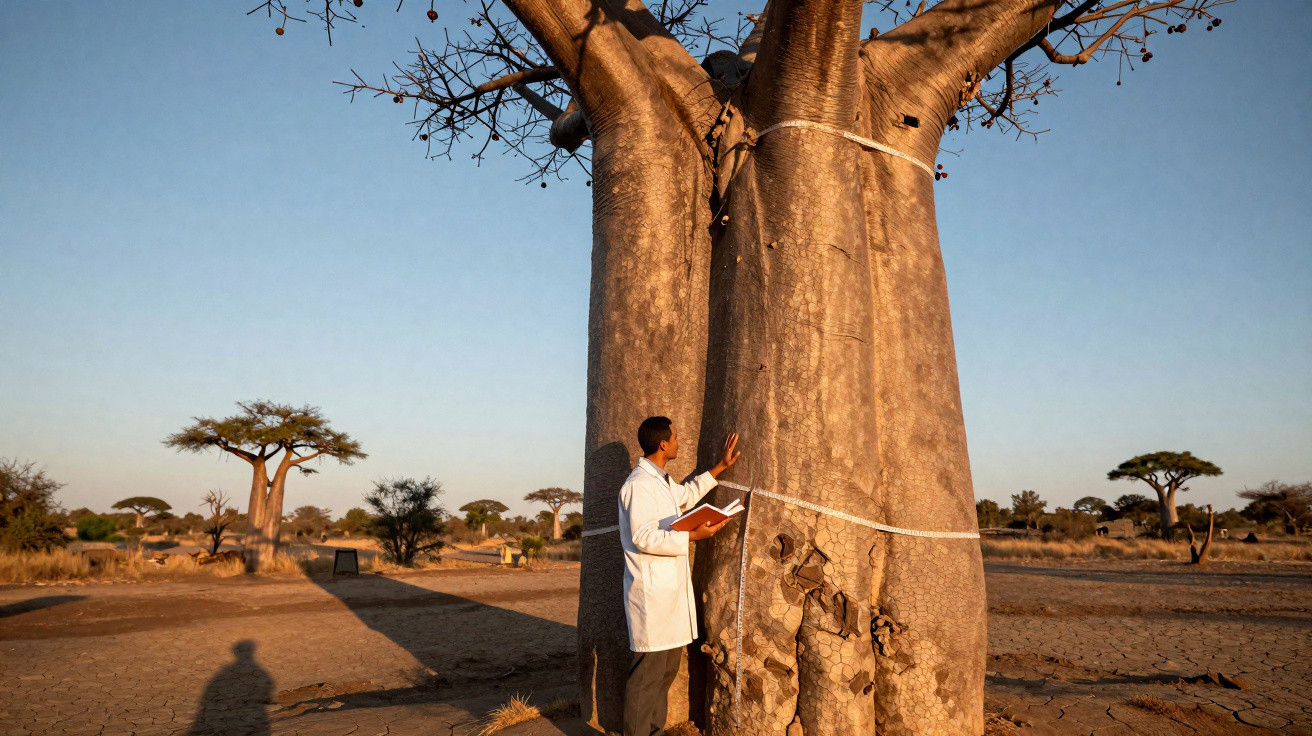
The baobab’s swollen trunk is far more than an exotic-looking feature. It is packed with living tissues that can hold vast quantities of water, enabling the tree to endure long droughts. This adaptation helps explain how certain specimens have lasted for over a thousand years, even though several giants have collapsed in recent years.
Why does the baobab look like a prehistoric tree?
In the dry season, when it sheds its leaves, the baobab reveals twisted branches that resemble roots reaching up towards the sky. That striking silhouette inspired the nickname “upside-down tree” and has strengthened its place in legends, traditions, and some of Africa’s most memorable landscapes.
The genus Adansonia includes eight recognised species. Six are native to Madagascar, one occurs naturally on mainland Africa, and another is found in north-west Australia. A study published in Nature in 2024 suggested this lineage first emerged in Madagascar around 21 million years ago.
How does the trunk help it cope with drought?
Baobabs have light wood that is rich in living cells capable of retaining water. As a result, the trunk can expand during the rainy period and then slowly shrink through the dry season, acting as a built-in reservoir in places where water is scarce.
This same structure also provides shelter and food for a range of animals. For human communities, the tree supplies fruit, leaves, and fibres, and often serves as a landmark for gathering and social life. Its wide-spreading roots also help limit erosion and support the recycling of nutrients in the soil.
What is the largest living baobab known?
The current record is held by the Sagole Big Tree, a specimen of Adansonia digitata in Masisi, Limpopo province, South Africa. According to Guinness World Records, the ranking is based on the total volume of wood and bark, rather than height alone.
- The estimated total volume reaches 414 cubic metres of wood and bark.
- The tree is about 19.8 metres tall and has a base area of 60.6 square metres.
- The above-ground dry mass is estimated at 54 tonnes due to the wood’s low density.
Despite looking extremely heavy, Sagole has a relatively low mass for such an enormous volume. Baobab wood has an average density of about 0.13 grams per cubic centimetre, even lower than woods known for being very light, such as balsa.
Watch the video shared by the YouTube channel Mundo Interessante to learn more about the millennia-old baobabs.
Which giants lost the record after collapsing?
Until 2018, the largest known living baobab was Tsitakakoike in Madagascar, with an approximate volume of 455 cubic metres. Part of the tree collapsed that year. South Africa’s Platland baobab also lost a large section in 2016 after centuries of growth.
Research published in Nature Plants in 2018 reported that nine of the 13 oldest African baobabs and five of the six largest had either died or lost their oldest stems. The researchers noted the unusual pattern, but did not identify a definitive cause for the collapses.
What does the fall of baobabs teach us?
Their great age does not mean these trees are unbreakable. Their form is made up of multiple stems that can fuse together, age at different rates, and suffer partial failures. Later studies also showed that some trees thought to be dead still retained living sections capable of continuing to grow.
Sagole’s record stands as both a celebration and a warning. Protecting baobabs means safeguarding their habitats, monitoring very old individuals, and avoiding hasty conclusions about their losses. Understanding these giants now is essential if they are to remain standing for many more generations.


Comments
No comments yet. Be the first to comment!
Leave a Comment