
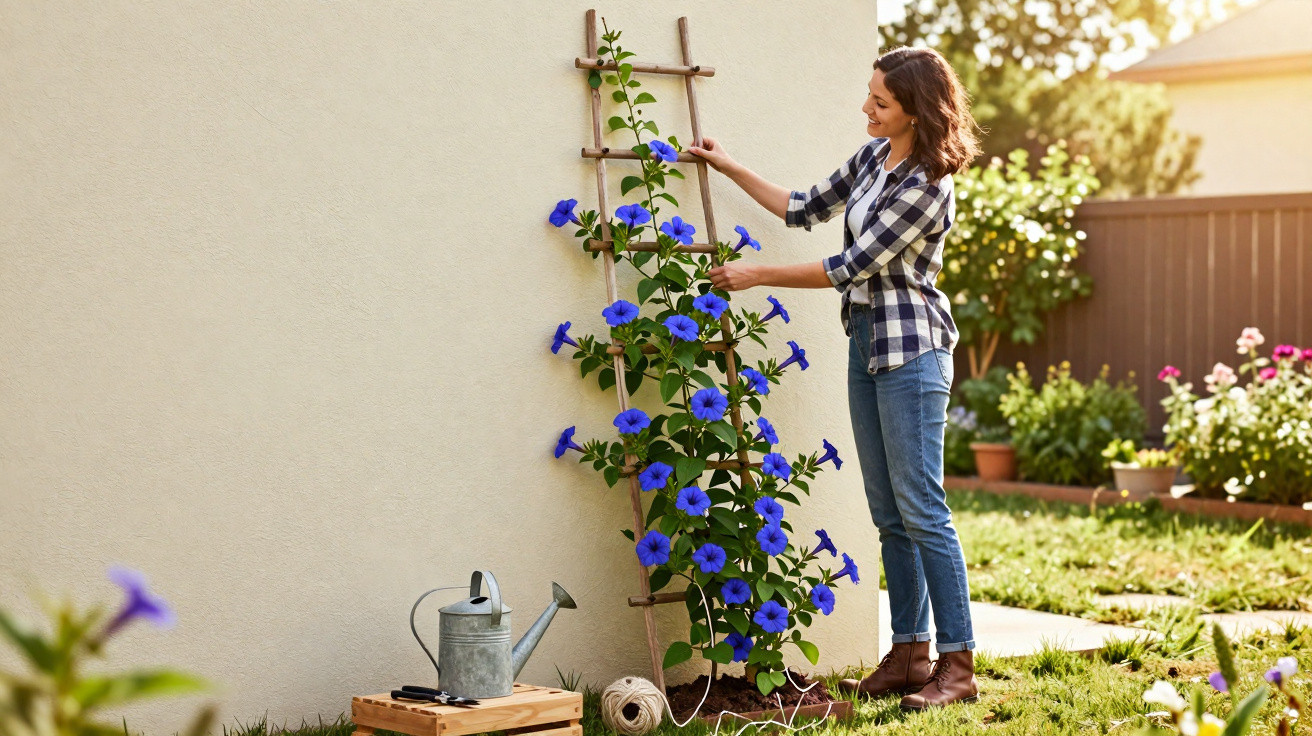
Blue thunbergia is a fast-growing climber that can create a leafy, flower-filled screen over railings, fences and trellis panels. Unlike ivy, its stems twist themselves around supports rather than producing clinging roots that stick straight to render or work into small cracks in a wall.
Why doesn’t blue thunbergia attach itself directly to the wall?
Thunbergia grandiflora grows by sending out long, flexible shoots that search for nearby structures to wrap around. In practice, this means it needs wires, railings, mesh or a trellis to climb, because it cannot scale a smooth wall without something to grip.
Ivy, by contrast, forms small adventitious roots that adhere to surfaces. Where render is loose, paint is flaking or there are cracks, these roots can leave marks and worsen existing damage. Blue thunbergia avoids that direct contact when it is trained onto a separate framework.
How can you make the climber cover a wall quickly?
In warm areas, with plenty of light and fertile soil, the shoots can extend noticeably within a few months. Coverage looks more even when young growth is guided across the support by hand:
- Fit a sturdy trellis before planting;
- Leave a little space between the support and the wall;
- Steer the shoots towards areas that are still bare;
- Tie in stems with soft, loose ties;
- Water regularly while the plant is establishing and filling out;
- Remove dry tips or any shoots that head beyond the intended space.
How much sun and water does the plant need?
Blue thunbergia flowers best when it receives a few hours of direct sun each day, although it will tolerate partial shade in very hot places. In darker positions, the foliage may still grow well, but the number of blue-lilac blooms usually drops.
During active growth, the soil should stay lightly moist rather than waterlogged. Adding organic matter and ensuring good drainage supports healthy roots, while excess water can lead to yellowing leaves and rot near the base.
What care keeps growth under control?
Because the stems lengthen quickly, maintenance pruning is important after the heaviest flushes of flowering. Cutting back helps prevent the plant reaching roofs, gutters, cables or neighbouring plants, and it encourages fresh shoots lower down:
- Remove dead, weak or tangled stems;
- Shorten any growth that extends beyond the trellis;
- Keep foliage away from roof tiles and gutters;
- Clear away fallen flowers and leaves around the base;
- Watch for aphids, scale insects and mites;
- Use clean, sharp tools when pruning.
A flowering cover for walls and fences
The tubular flowers, with their pale centres, can appear for much of the year in suitable climates and attract bees, butterflies and hummingbirds. For that reason, the plant works both as an ornamental screen and as a feeding stop for different garden pollinators.
Blue thunbergia is an alternative to wall-covering climbers with colourful flowers, provided it is given its own structure to climb. With sun, free-draining soil and regular pruning, its stems can form a living green wall without relying on clinging roots on the masonry.
Comments
No comments yet. Be the first to comment!
Leave a Comment