
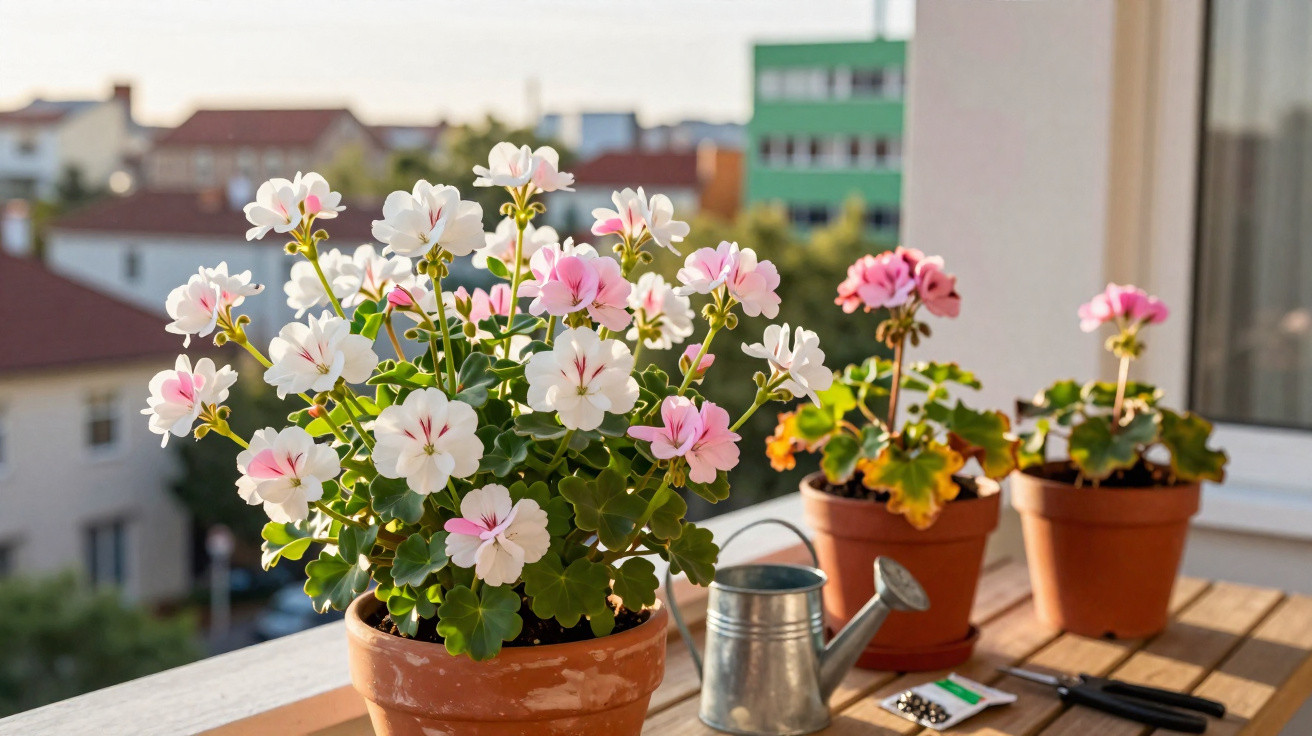
Summer after summer, dried-out balcony planters, bare patches in borders and the constant chore of watering cans need not be inevitable.
Many amateur gardeners know the situation well: geraniums look irresistible at the garden centre, yet demand daily attention at the height of summer and succumb with the first hard frost. During periods of heat and watering restrictions, the balance no longer adds up. One remarkably undemanding perennial offers a far more relaxed option - and flowers for almost half the year.
Why geraniums become a problem in many gardens
Geraniums - more precisely, balcony geraniums, botanically usually pelargoniums - are traditional choices for window boxes and containers. They add colour, tolerate quite a lot and are widely available. In practice, however, their drawbacks soon become clear:
- high water requirements in hot weather
- continual removal of faded flowers
- very little frost tolerance, so they are usually treated as annuals
- less suitable when strict summer watering restrictions apply
Anyone gardening in full sun who does not want to carry a watering can every day will quickly find geraniums limiting. The traditional balcony favourite now visibly struggles, particularly on south-facing balconies and in front gardens beside hot roads.
“Less watering, longer-flowering borders and planters - this is possible with a perennial that copes remarkably well with heat, dry spells and even frost.”
The surprise from Texas: Gaura lindheimeri
The alternative has a rather unwieldy name: Gaura lindheimeri, sometimes also listed as Oenothera lindheimeri. This perennial originates from Texas and Louisiana and belongs to the evening primrose family. Its presence in the garden is far more graceful than its name suggests.
Gaura is characterised by a cloud of countless small white or pink flowers dancing in the breeze on delicate stems. It has an airy, light appearance, almost like a veil floating over the border. Its key advantage is that flowering continues from early summer until late autumn.
- Planting period: chiefly April to May, with autumn as an alternative
- Flowering begins: from late May or June
- Plants often remain in bloom until November
- Frost tolerance: down to around –15°C
Gaura is appearing increasingly often in trials and recommendations from gardening associations when water-saving planting is discussed. The practical difference can be considerable.
Less watering, more flowers - a practical example
On a fully sunny slope where geraniums need around 10 litres of water per plant each week in July, Gaura presents a very different picture. Once established during its first year, this perennial requires virtually no additional watering. Its deep roots allow it to supply itself. The result is loose clouds of flowers throughout the summer, without a daily watering routine.
The secret of Gaura lindheimeri: a powerful taproot
The main reason for its exceptional toughness is its taproot. It grows deep into the soil, accessing water that is no longer available to shallow-rooted summer flowers. While the plant looks delicate above ground, it is firmly anchored below the surface.
“Gaura lindheimeri combines drought-tolerant taproots with a floral haze lasting for weeks - a rare combination for fully sunny positions.”
For this strength to be fully effective, the perennial needs suitable conditions:
- Position: as much direct, unshaded sunshine as possible
- Soil: well drained, preferably lean rather than overly rich
- Waterlogging: must be avoided, especially in winter
In heavy, clay-rich soil, work coarse sand or gravel into the planting hole. This improves drainage, prevents root rot and helps the plant survive wet periods too.
Planting Gaura in April: the right method
April is an ideal planting month because the perennial still has enough time before winter to establish its roots. Those who plant now can enjoy clouds of flowers in the same year.
- Water the plant: immerse the root ball in water for 10 to 15 minutes.
- Dig the planting hole: make it twice the size of the root ball and loosen the soil.
- Improve drainage: mix in gravel or coarse sand if the soil is heavy.
- Plant it: position Gaura so that the root crown sits level with the soil surface.
- Firm and water: gently press the soil down and water thoroughly at first.
Leave 40 to 50 centimetres between individual plants. This gives the clump-forming perennials room to spread without crowding one another. From their second year onwards, maintenance requirements fall sharply.
One annual cutback
Just one task is enough to keep Gaura long-lived and compact: cut the shoots back to around 10 centimetres above ground level in late winter or very early spring. The plant will then produce fresh growth, branch more effectively and once again create a dense display of flowering stems.
On balconies and terraces: can Gaura replace geraniums?
At first glance, Gaura may seem more like a conventional border perennial. In the right container, however, it can work extremely well as a geranium replacement on balconies and terraces.
Important requirements for growing it in containers:
- Deep containers: to give the taproot sufficient room
- Excellent drainage: holes in the base plus a drainage layer of gravel or clay pebbles
- Loose compost: mix potting compost with some sand or fine gravel
- Plenty of sunshine: a south-facing balcony or comparable position is ideal
Unlike geraniums, Gaura needs noticeably less water in a pot. Watering intervals can be extended significantly. In return, the plant provides a long, almost uninterrupted display of flowers over many months - without needing to be completely replanted every year.
“Anyone who plants Gaura in a window box gains time: less watering, less replanting, more flowers for bees and butterflies.”
Where Gaura reaches its limits
Although this perennial is robust, it is not suited to every situation. There are three things it dislikes completely:
- permanently wet, poorly drained soils
- deep shade beneath dense tree cover
- extended periods of frost far below –15°C
In areas with particularly severe winters, Gaura planted in borders benefits from light winter protection, such as a layer of leaves or twiggy branches. For container-grown plants, place the pot against a sheltered house wall or wrap it in horticultural fleece. Where winters are considerably harsher, other drought-loving perennials with even greater frost tolerance are the better choice.
How Gaura suits modern, low-maintenance gardens
Visually, Gaura is especially effective in naturalistic, airy planting schemes. It fits well with:
- prairie-style borders featuring grasses such as fountain grass or feather grass
- rock gardens and gravel areas with drought-tolerant perennials
- borders alongside sun-exposed house walls
- long driveways or roadside edges with limited maintenance capacity
Its loose, floating appearance allows Gaura to visually link different plants. It is also well suited to softening hard edges, such as walls or border edging. In containers, it combines attractively with fragrant lavender, thyme or ornamental sage.
Benefits for insects and the urban climate
One aspect is often underestimated: its ecological value. The many flowers provide food for bees, solitary bees and butterflies over many weeks - particularly in dry summers, when other plants begin to flag. Anyone looking to make a garden or balcony more insect-friendly makes a clear statement by planting Gaura.
At the same time, every water-saving planting scheme helps people cope better with longer dry spells. Favourite plants that demand water every day quickly become a problem in hot summers. Perennials such as Gaura lindheimeri are much better suited to a climate with more heat and less rain, while still providing colour for months.




Comments
No comments yet. Be the first to comment!
Leave a Comment