
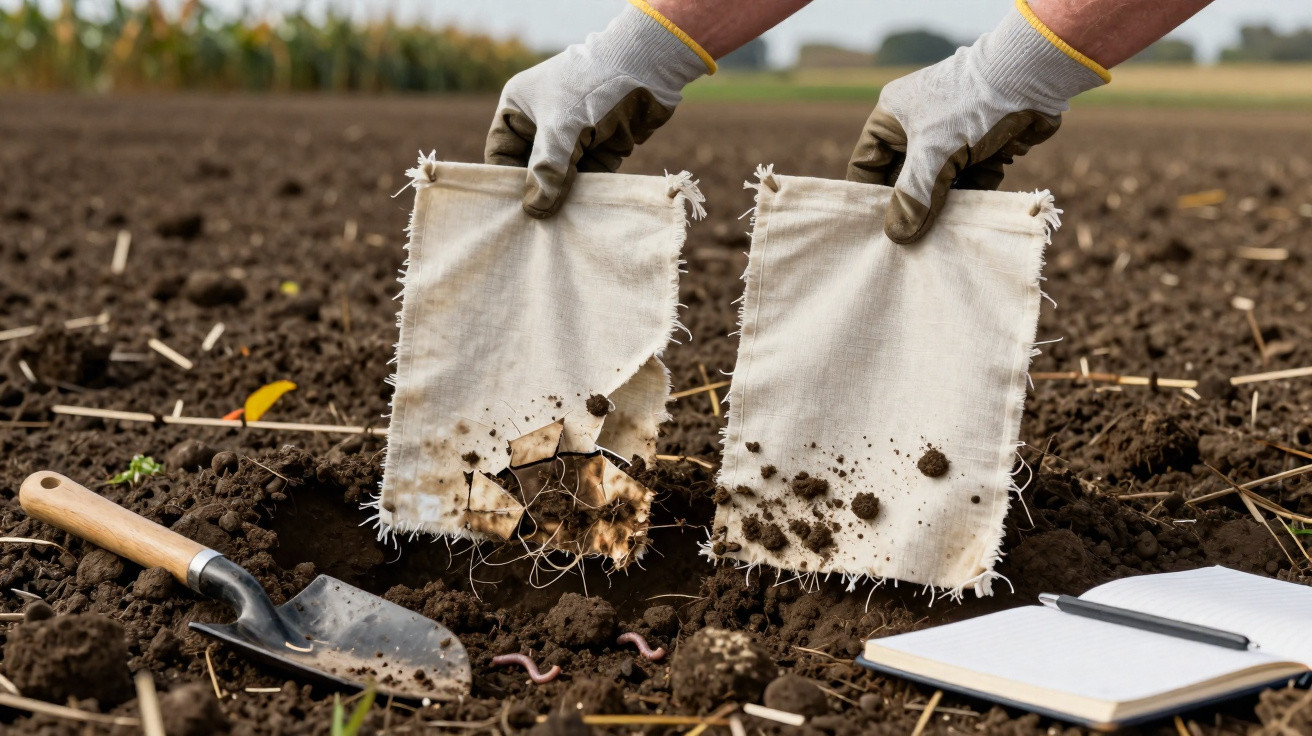
A pair of cotton pants disappearing underground is an eye-catching way to illustrate a familiar farming problem: soil condition is difficult to judge from the surface alone. Crops may establish poorly, water may sit in wheelings, or fields may dry and crack before it is obvious that something below ground needs attention.
The cotton underwear test offers a simple clue. Soil organisms can break down natural cotton fibres, so a garment that becomes thin, torn or largely disappears may indicate active decomposition. It is not, however, proof that a soil is ‘healthy’ or that one farming system is automatically better than another.
What a cotton burial test can show
Cotton is made mainly from cellulose, a natural material that many soil microorganisms can decompose. Fungi and bacteria do much of that work, while earthworms and other invertebrates help move plant material and create spaces in the soil.
Burying identical pieces of cotton in comparable places can therefore provide a rough visual comparison of decomposition activity. In warm, moist conditions, cotton may break down far more quickly than it does in cold, dry or compacted ground.
The test is useful because the result is easy to see. It can prompt better questions about cultivation, compaction, drainage, crop residues and living roots.
A disappearing cotton garment is a clue about decomposition, not a complete soil-health score.
It cannot identify a particular cause. A quickly degraded sample does not, by itself, measure nutrient levels, carbon storage, disease pressure, erosion risk or future crop yield.
The life beneath a field or allotment bed
Soil is not simply mineral particles mixed with organic matter. It is a habitat containing a complex food web, including:
- bacteria and fungi that break down organic material;
- earthworms and other invertebrates that mix soil and residues;
- microscopic organisms that feed on microbes;
- plant roots, which release compounds that support microbial life.
This activity contributes to nutrient cycling and can help form stable aggregates: small, crumb-like clumps of soil. Good aggregation can improve the movement of air and water, provided other issues such as compaction or poor drainage are also addressed.
In the UK, this matters particularly during periods of erratic weather. Bare or compacted soil can be more prone to runoff during heavy rain, while soils with poor structure may be less able to hold water through dry spells.
Organic matter, roots, residues and soil organisms all play a part, but results vary with soil texture, field history, weather and the crop rotation. There is no single management change that produces the same outcome everywhere.
Why cultivation can affect the result
Ploughing and other forms of cultivation have practical uses. They can help prepare a seedbed, deal with compaction in some circumstances and support weed management. Many growers use cultivation selectively according to the season, crop and soil conditions.
Repeated or intensive cultivation can also disturb the upper soil layers, where roots and biological activity are often concentrated. It may disrupt fungal networks, expose organic matter to more air and leave soil vulnerable if the surface is left bare.
Reduced-tillage and direct-drilling systems aim to limit disturbance. They are commonly combined with cover crops, varied rotations, residue management and controlled traffic where appropriate. Such approaches may support more stable soil habitat, but they require careful management and are not a shortcut.
Practical considerations for growers
Changing cultivation methods can bring challenges, including:
- weed control and herbicide planning;
- slug pressure beneath residues;
- colder, wetter seedbeds in some seasons;
- the need for suitable drilling equipment;
- dealing with existing compaction before reducing cultivation.
The appropriate approach depends on the soil, drainage, crop, rotation and local conditions. A shallow, well-timed cultivation may be sensible in one field and damaging in another.
How to carry out a fair cotton test
The test works best as a comparison between two areas, rather than as a pass-or-fail exercise. A square of verified 100% cotton cloth is often easier to use than underwear, especially for schools and community gardens.
1. Select comparable locations
Choose areas with broadly similar soil type, slope and exposure. Possible comparisons include:
- cultivated and minimally cultivated strips;
- ground with a cover crop and nearby bare soil;
- a grass margin and an arable area;
- different beds on an allotment managed in contrasting ways.
Try not to compare sites that differ in several major respects at once. For example, a compacted gateway and a sheltered grass verge will not produce a meaningful management comparison.
2. Use suitable material and record the details
Use plain, clean 100% cotton fabric. Avoid polyester blends, elastane, metal fastenings, printed transfers and decorative items, as these can remain in the ground as litter.
Photograph and weigh, if practical, each sample before burial. Bury samples at the same shallow depth, around 10 to 15 cm, and mark the locations clearly. Record the date, recent weather, crop cover and any cultivation or organic inputs.
3. Recover and compare carefully
Check the samples after several weeks or a few months. There is no fixed timetable: warm, moist soil tends to encourage decomposition, while cold, dry or saturated conditions can slow it.
Lay the samples side by side, photograph them and note holes, fraying, loss of fabric and staining. Roots, earthworm movement and uneven moisture can alter the appearance, so avoid reading too much into a single test.
The most useful question is: ‘What could explain this difference, and what should we check next?’
Common mistakes with the underwear test
The visual result can be persuasive, which makes over-interpretation the main risk. Watch for these common mistakes:
- Using blended fabric: synthetic fibres can leave a sample looking more intact than the cotton component really is.
- Burying samples at different depths: temperature, oxygen and moisture change through the soil profile.
- Ignoring the weather: drought, prolonged cold or waterlogging can slow decomposition in any system.
- Testing only one point: fields vary, particularly around headlands, gateways, former boundaries and wet patches.
- Assuming faster is always better: rapid decomposition alone does not rule out nutrient losses, compaction or erosion.
- Treating direct drilling as a guarantee: reduced disturbance needs to work alongside sound rotation, residue management and traffic control.
Build a fuller picture of soil condition
A cotton test is most helpful when it sits alongside regular field observations and, where needed, professional soil analysis. Farmers may already collect some of this information through their soil management plans.
Useful checks include:
- digging a small soil pit to look at earthworms, roots and layers;
- checking whether roots stop abruptly at a compacted layer;
- assessing crumb structure in a moist soil sample;
- watching where rainfall infiltrates and where it runs off;
- using a reputable laboratory for organic matter, pH and nutrient testing;
- recording crop establishment and performance over several seasons.
The Agriculture and Horticulture Development Board publishes practical resources on soil assessment and cultivations. Farmers taking part in environmental schemes should check their agreement requirements before changing established management.
Safety and environmental care
Do not bury fabric containing plastic fibres, metal components or unknown treatments. Retrieve all remaining material after the test, including labels and elastic, so it does not become litter.
Wear gloves when digging, especially in ground that has received manure or slurry, and wash hands afterwards. Use hand tools with care. Keep the hole shallow, and do not dig where buried services may be present or where the site is protected or environmentally sensitive.
For a school, use a clean cotton square rather than underwear and ensure an adult chooses, marks and supervises the test area.
Use the result as a starting point
The point of the test is not that soil should ‘eat’ everything as quickly as possible. It is to make an invisible process visible and encourage closer attention to how land is functioning.
If cotton breaks down quickly, regard it as an encouraging sign of decomposition activity. If it remains largely intact, look more closely at moisture, temperature, compaction, cultivation and ground cover before drawing conclusions. Repeating the test in several places, alongside proper observations and soil testing, turns a striking demonstration into a more useful guide for future decisions.





Comments
No comments yet. Be the first to comment!
Leave a Comment