
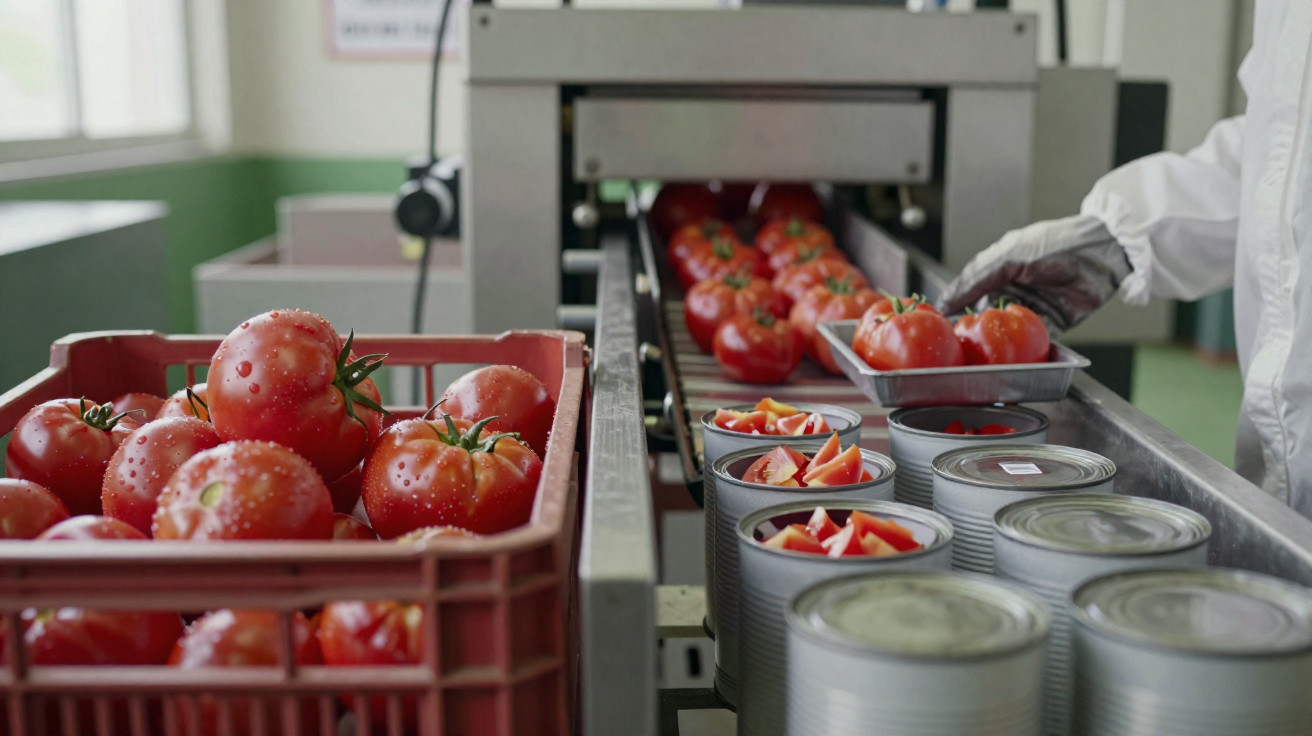
A tin of chopped tomatoes or carton of passata can sit in a British cupboard for months, which makes it easy to assume it was made steadily throughout the year. For factories built around fresh field tomatoes, however, the decisive work is squeezed into a short summer harvest.
At Mutti’s main processing site near Parma in northern Italy, the fresh-tomato campaign lasts for roughly 70 days, usually from July into September. The real achievement is not simply fast machinery. It is the careful co-ordination of growers, harvesting, lorries, testing, sorting and production, so ripe tomatoes can be processed quickly after picking.
A short campaign, prepared all year
Mutti produces products including passata, tomato concentrate and polpa, its finely chopped tomato product. During the harvest, its factory at Montechiarugolo runs at its most intensive pace as fresh tomatoes arrive from farms in the surrounding region.
The headline idea of a factory operating for two months needs some context. The site is not necessarily empty for the rest of the year: planning, maintenance, packaging, storage, distribution and production of other lines can continue. What is concentrated into a short period is the work of receiving and processing freshly harvested tomatoes.
Fresh tomatoes are perishable. Once picked, they can lose firmness and begin to deteriorate, especially in warm conditions. Mutti says it aims to move tomatoes from harvest to initial processing within 24 hours.
That deadline affects decisions made long before summer:
- growers choose varieties suited to processing and mechanical harvesting;
- factory teams schedule maintenance before the first deliveries;
- packaging, ingredients and spare parts must be available;
- transport needs to match the harvest timetable;
- laboratories and intake staff need to assess loads without creating delays.
A short production season does not mean a short workload. It means there is far less time to recover from poor planning.
For any business handling seasonal crops, the lesson is straightforward: the work starts months before the product reaches the factory gate.
Why speed matters after picking
Tomatoes intended for canning are not generally the same varieties grown for a summer salad in a British garden. Processing tomatoes are selected for firm flesh, reliable colour, a high proportion of usable solids and the ability to ripen relatively evenly.
Even ripening is particularly useful where crops are mechanically harvested. If most fruit on a plant reaches the right maturity at around the same time, the crop can be picked in one pass, making volumes easier for farms and factories to manage.
At peak season, lorries can arrive in quick succession. Tomatoes are not intended to sit around for days: accepted loads move into washing and processing as soon as possible.
1. Pick at the right stage
Tomatoes need to be ripe enough for colour and flavour, while remaining firm enough to travel and withstand handling. Hot weather can alter ripening patterns and may change the most practical harvesting hours.
2. Move loads promptly
The crop is sent from fields to the factory as quickly as the harvest and transport system allow. Delays can affect quality and make production schedules harder to manage.
3. Check each delivery
A sample is taken from incoming loads before tomatoes enter the main production stream. This helps the processor decide whether the fruit meets its requirements.
4. Wash, sort and process
Tomatoes are washed, sorted and directed towards different lines according to the product being made. At this stage, automation can handle huge volumes, but it still depends on reliable checks and maintenance.
Testing is about quality as well as safety
Incoming tomatoes may be assessed for factors such as colour, ripeness, damaged fruit and visible defects. Processors also monitor measures relevant to the finished product, including acidity and soluble solids, often described in terms of sugar content.
These checks are partly about food safety, but they are also about consistency. A shopper buying passata in Leeds in January expects a product with a familiar colour, texture and flavour, even though crops naturally vary between farms, fields and harvest days.
Mutti says it grades tomato deliveries through a system linked to grower payments. It has also said that it uses technology to assist some quality assessments. Such systems can speed up decisions, but they do not remove the need for trained people, sound sampling and clear specifications.
Weather remains a major variable. Rain, heat, irrigation, soil conditions and harvest timing can all affect the crop. A processor can set exacting standards, but a workable supply chain also has to recognise the risks growers face.
Consistency is planned, not accidental
It is tempting to think that a consistent premium product must come from identical ingredients. In reality, agricultural ingredients are never completely identical. Industrial food production often relies on measuring variation and managing it carefully.
Mutti says it balances deliveries across quality grades to create a more even starting point for production. Blending tomatoes with known characteristics can help maintain a stable final product rather than allowing one unusually watery or pale load to dictate a whole batch.
Standardisation is not automatically the opposite of quality. It is often what allows a familiar product to remain dependable from one batch to the next.
The same principle appears elsewhere in food production. Flour millers blend wheat to achieve reliable baking performance; coffee makers use blends to maintain a recognisable profile; dairy processors adjust products to agreed fat and protein specifications.
That does not mean flavour is manufactured out of nothing. It means natural variation is managed before the product is packed.
One harvest, several tomato products
Once tomatoes are accepted, they can be processed in different ways depending on their destination. For chopped tomatoes, the flesh is prepared into pieces before being heat-treated and packed. Passata is smoother, while concentrate is cooked down further to remove more water.
Heat treatment and sealed packaging are central to shelf life. They allow tomatoes picked at the height of the Italian summer to become cupboard staples for autumn and winter cooking in the UK.
The finished products may be packed into cans, cartons, jars, bottles or tubes, then palletised for distribution. The fresh processing campaign may be short, but the resulting stock supports sales long after the harvest is over.
Climate makes a tight timetable harder
Tomatoes need warmth and sunlight, but extreme heat is not simply beneficial. Heat stress can affect plants, speed up ripening unevenly and make harvesting more difficult for workers and machinery.
Mutti has said that warmer conditions have brought earlier harvests in its region compared with previous decades. Earlier ripening affects more than fields: factories need labour, transport arrangements, packaging supplies and maintenance work ready sooner.
A seasonal system with a narrow window has limited slack. Food businesses dealing with field crops increasingly need to consider:
- whether harvest dates are moving earlier or becoming less predictable;
- how heat affects staff welfare and equipment;
- whether irrigation water will be available when needed;
- how to prevent harvested fruit waiting in high temperatures;
- whether crop rotations remain appropriate.
In tomato-growing areas of Emilia-Romagna, tomatoes are commonly included in crop rotations rather than grown on the same land every year. Rotation can support soil management and help reduce some crop-health pressures.
Common mistakes when judging tinned tomato production
It is easy to misread what a rapid, highly automated harvest system is trying to achieve.
- Assuming the factory is idle outside the harvest. Fresh processing may stop or slow sharply, but maintenance, logistics, packaging and planning still matter.
- Treating mechanical harvesting as proof of poor quality. It can work well when varieties, ripening and transport are carefully managed.
- Thinking all loads are interchangeable. Testing exists because tomatoes from different fields and days vary.
- Assuming more heat always means better tomatoes. Excessive heat can put pressure on crops, people and operations.
- Confusing consistency with blandness. A reliable flavour and texture can be the result of careful selection and blending.
The useful lesson for shoppers and businesses
For shoppers, passata and tinned tomatoes are practical ways to keep summer-grown tomatoes on hand through a British autumn and winter. Their long shelf life comes from processing fruit when it is abundant and ripe, then sealing it safely.
For food businesses, the model shows why supply chains must work around the biology of a crop. Pick at the right time, test promptly, process swiftly and manage natural variation before it reaches the shelf.
The 70-day campaign is therefore not a burst of activity that happens by chance. It is the visible result of a year of preparation, followed by a few weeks in which every delay matters.






Comments
No comments yet. Be the first to comment!
Leave a Comment