
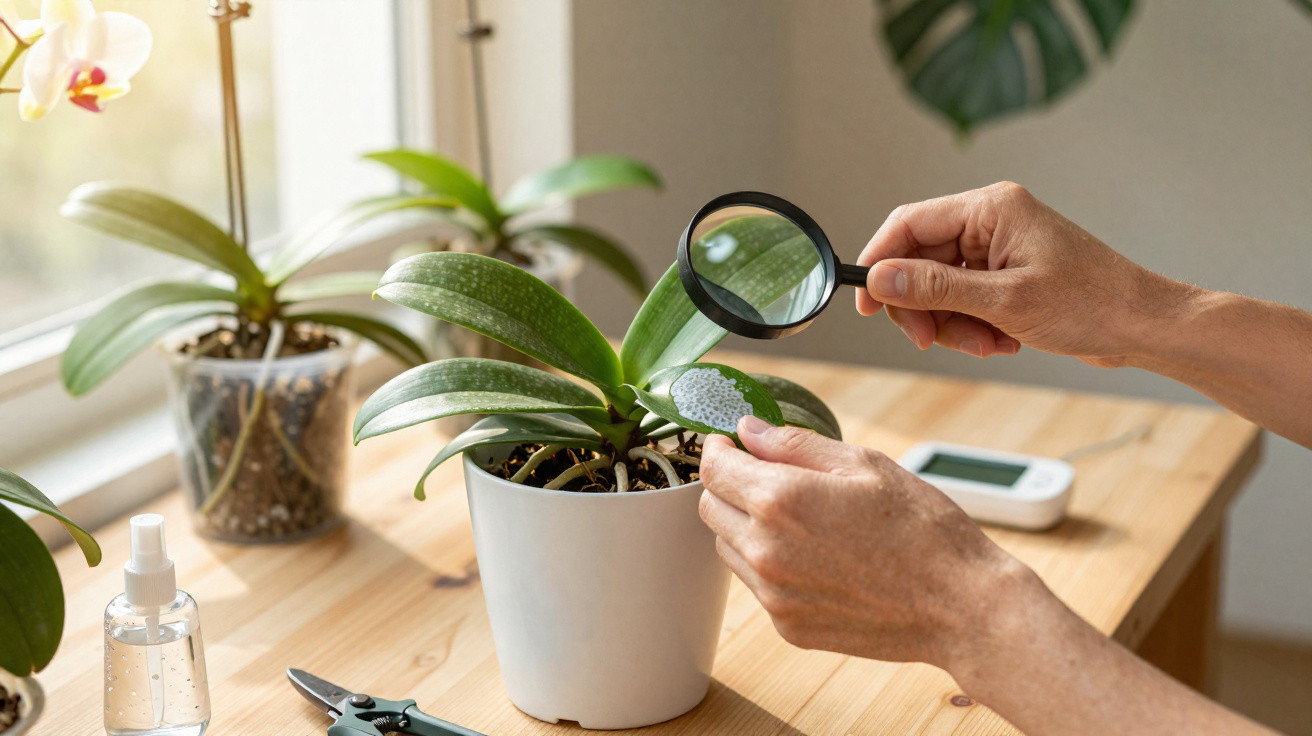
Small, clear-looking patches on orchid leaves often worry growers. Before you remove any leaf, it’s worth checking what the marks look like, where they appear, and whether they’re spreading. In many situations, the cause is linked to day-to-day handling or watering habits and can be corrected with simple care adjustments-without immediate pruning.
What do transparent spots on orchid leaves mean?
Translucent patches can stem from several sources, including physical damage, sun scorch, overwatering, or fungal and bacterial disease. Paying attention to the visual pattern and how quickly it changes helps you avoid unnecessary cutting and supports the plant’s overall health.
Physical damage usually appears as uneven, irregular marks and is often connected to bruising, creases, or folds. Sunburn tends to develop on the side of the leaf facing the light; it often starts pale, then dries out and turns brown. Moisture-related issues, on the other hand, can make the leaf look waterlogged, sometimes with a "jelly-like" feel when touched.
How to tell mechanical damage, sunburn and excess moisture apart
To separate one cause from another, think back over what happened to the plant recently-transport, repotting, moving it to a new spot, or watering more frequently. With mechanical damage, the affected tissue may look thin like a "film", there is no unpleasant smell, and the mark typically stays the same size rather than expanding.
When the issue is linked to too much direct sun or persistently high moisture, a few practical clues make identification (and routine corrections) clearer:
- Sunburn – appears after exposure to strong, direct sunlight; the patches begin pale and later become dry and brown.
- Excess moisture – watery, translucent areas with fragile tissue that tears easily and can encourage fungi and bacteria.
- Mechanical damage – caused by drops, rubbing, or leaf bending, without rapid progression of the affected area.
When do transparent spots point to orchid diseases?
Not every spot is caused by pathogens, but certain signs are more suspicious-such as lesions that enlarge quickly or shift in colour. Yellowish edges with a dark centre, very soft texture, or fluid seeping from the area can indicate a likely fungal or bacterial problem.
Tiny black specks on top of the patch suggest fungal activity. Very soggy areas accompanied by a bad smell are more typical of bacteria. In these situations, it’s advisable to isolate the plant, lower humidity, increase ventilation, and, if needed, use control products that are specifically suitable for orchids.
How to care for the plant, when to cut the leaf, and how to prevent new spots
Removing a leaf is usually only considered when the patch spreads rapidly, there are clear signs of infection, or more than half of the leaf has been affected; otherwise, the leaf can still contribute to photosynthesis. If you do cut, use a very sharp, sterilised tool and remove a few millimetres beyond the diseased area.
To reduce the risk of new spots, aim for filtered light, watering that allows the growing medium to partially dry between waterings, and good air movement-while avoiding water sitting on leaves for long periods. Handling the plant gently during repotting and transport also helps prevent mechanical damage and maintains orchid vigour over time.




Comments
No comments yet. Be the first to comment!
Leave a Comment