
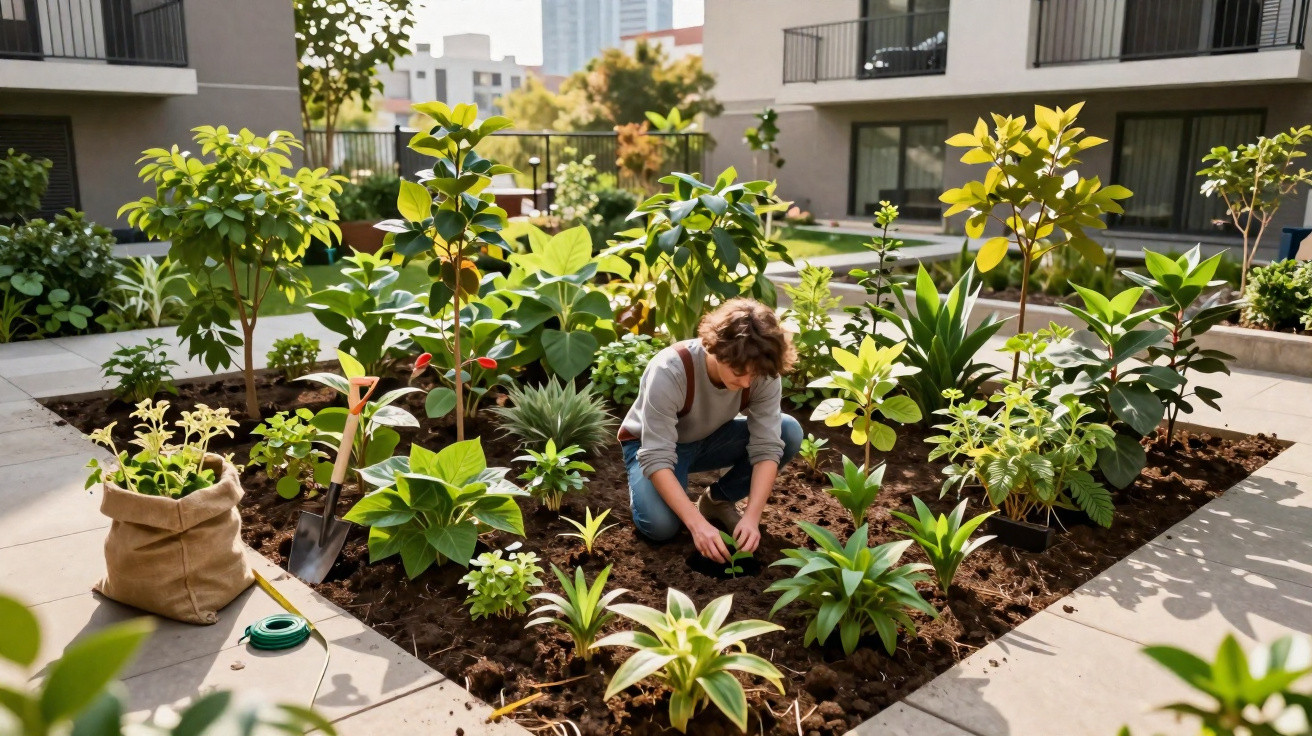
The approach created by Japanese botanist Akira Miyawaki makes it possible to turn small urban plots into dense pockets of native vegetation. The technique brings together site assessment, soil recovery and the planting of multiple species close together, but claims such as growth “ten times faster” and becoming independent in three years should be treated as reference figures used by projects, not as promises for every back garden.
How does the Miyawaki method work?
Rather than spacing a few trees widely apart, the Miyawaki method aims to rebuild the different layers found in a local woodland. Canopy trees, mid-storey species and shrubs are planted in a mixed arrangement, typically at a density of around three to five saplings per square metre.
- Identify the native species that belong to the area;
- Assess the soil’s texture, drainage and fertility;
- Add organic matter where the site is degraded;
- Mix plants with different heights and ecological roles;
- Plant saplings close together, avoiding neat, uniform rows;
- Cover the ground with straw or another organic mulch.
Why are the saplings planted so close together?
Planting at high density encourages competition for light, which tends to push growth upwards. At the same time, close spacing helps shade the soil, retain moisture, limit the room available for invasive plants and create a sheltered microclimate within the branches.
However, Akira Miyawaki’s forest restoration work is not simply about cramming in lots of young plants. Selecting the right plant community and preparing the site appropriately are fundamental. Without that groundwork, the outcome may be nothing more than an overcrowded planting where competition is too intense and losses are high.
Is it possible to start a mini-forest in just 3 m²?
A 3 m² patch can hold a small cluster of roughly nine saplings, assuming a density of three plants per square metre. It can still form an interesting green nucleus, but it is far too small to recreate all the structures and ecological relationships of a full forest.
- Choose species suited to the local climate and soil;
- Avoid large trees near walls and pipework;
- Keep a safe distance from roofs and overhead power lines;
- Mix shrubs and trees of different eventual sizes;
- Don’t use invasive species simply because they grow quickly;
- Factor in the mature spread of crowns and roots;
- Seek technical advice when selecting saplings.
Does the forest really grow ten times faster?
The claim of growth up to ten times faster and density up to 30 times higher appears frequently in promotional material about the method. However, a scientific review published in 2026 noted that there is still a lack of standardised comparisons and enough long-term studies to confirm that these figures repeat across different climates, soils and projects.
Survival rates also cannot be universally fixed at 97%. They vary with sapling quality, the species chosen, water availability, soil preparation, climate and ongoing care. A well-executed planting may develop quickly, but specific numbers should not be treated as an automatic outcome.
When does the mini-forest become self-sustaining?
During the first two to three years, saplings generally need watering, topping up the organic mulch, selective weeding and replacing plants that did not survive. Once the crowns begin to meet and the ground remains shaded, these interventions can drop significantly-although extended dry spells may still make irrigation necessary.
The method can sit alongside other ways of growing plants in small outdoor spaces, but it requires more planning than a conventional garden. A well-made native mini-forest starts with choosing the right species, takes nearby structures into account and is monitored until the planting settles into a stable whole.
Comments
No comments yet. Be the first to comment!
Leave a Comment