
Anyone building their first small chicken haven tends to picture fresh eggs, not rats. That changes when the sounds beneath the floor grow louder, feed disappears more quickly and the chickens suddenly become unsettled. The battle for the coop then begins – but it need not be cruel or expensive; above all, it needs careful planning.
Why rats love your chicken coop
For the brown rat, a chicken coop is much like an all-inclusive hotel: plentiful food, drinking water, dry corners and very few predators. These animals are remarkably capable athletes. They can jump almost one metre, swim, dig long tunnels and squeeze through gaps of barely two centimetres. Even timber, thin concrete or cheap plastic will not withstand their teeth for long.
The consequences affect more than just the keeper's peace of mind. Rats eat eggs, attack chicks and cause ongoing stress for hens. Many keepers report noticeably fewer eggs, sometimes falling by a good third. There is also a health risk: droppings and urine in the coop can spread pathogens such as salmonella or leptospires.
Typical warning signs of a genuine infestation include:
- Scratching noises at night, especially beneath the floor
- A strong, pungent smell in the coop or feed store
- Tunnels and holes around the edges of the run
- Rats visible in broad daylight
“Anyone who sees rats running about during the day will usually already have an established population – and a small trick will no longer be enough.”
Five simple immediate measures that cost almost nothing
Before investing in costly traps or professional pest control, straightforward habits can already make a considerable difference. The key is to make both food and hiding places consistently unattractive.
1. Offer feed only when chickens will actually eat it
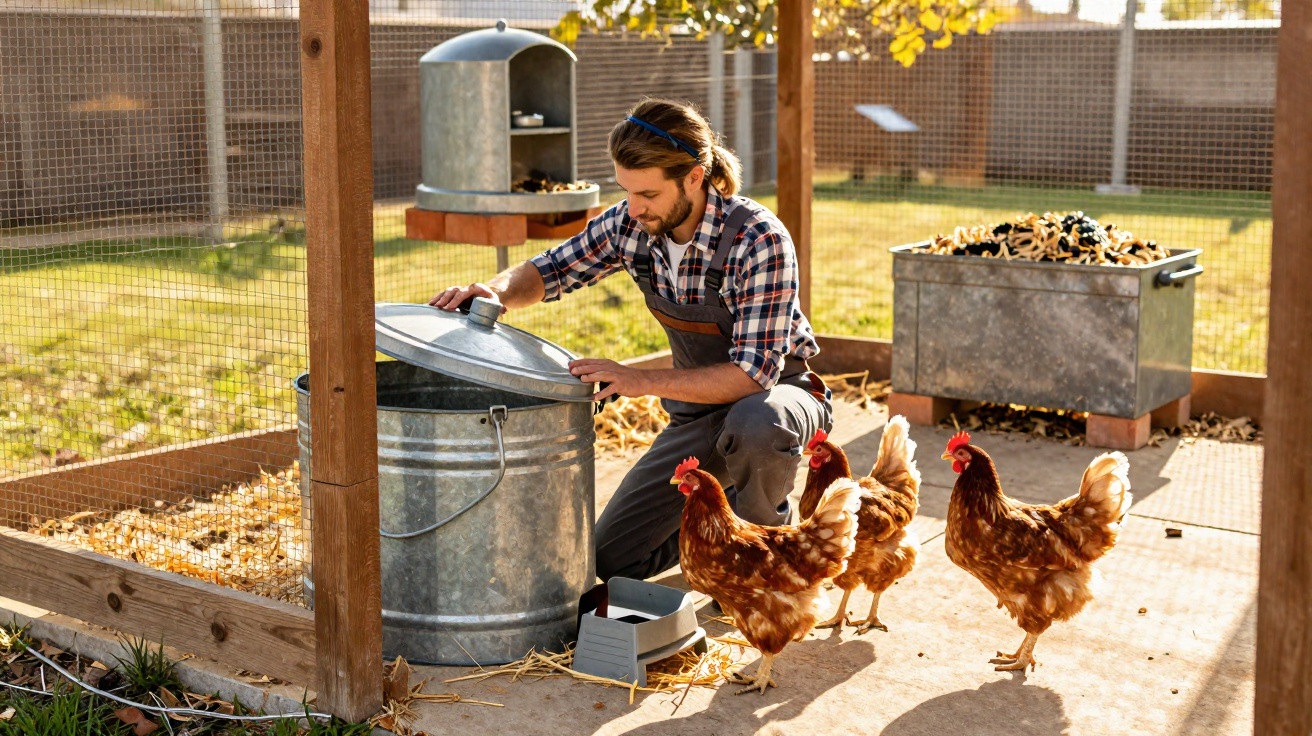
If feed remains in the trough overnight, rodents will feast after dark. The ideal approach is a fixed routine: feed in the morning or during the day, remove all leftovers each evening and put containers into a locked room or sealed bin. Those who work can offer smaller portions which the birds will peck up completely over the course of the day.
2. Store feed securely
Many infestations begin in the feed store. Thin plastic buckets and open sacks present virtually no obstacle to rats. Far safer options include:
- Old metal dustbins with tightly fitting lids
- Sturdy food-grade barrels made from thick plastic
- Well-screwed wooden boxes with sheet metal protecting the edges
It is important that containers sit directly on a solid surface rather than being tucked away in a dark, cluttered corner, where fresh hiding places can develop.
3. Use rat-resistant chicken feeding equipment
A treadle or pedal feeder can be a real game-changer for backyard keepers. Its lid opens only when a particular weight – such as that of a hen – stands on it. Rats generally cannot access the feed, or must work hard enough that it soon becomes too risky for them.
Anyone unable to afford such a system can limit feed lost on the ground by scattering only the amount the birds will eat in a short time. The fewer grains left lying around, the less worthwhile the nightly visit becomes.
4. Eliminate water sources
Leaking drinkers or buckets that repeatedly overflow create damp, dirty patches. For rats, this is the perfect complement to a food supply. Check regularly:
- Is the drinker dripping from its connections?
- Is there a puddle that never dries up?
- Is the water replaced every day?
The drier the coop floor remains, the less appealing it is to rodents and germs.
5. Manage compost and waste wisely
An uncovered compost heap right beside the chicken coop is effectively an invitation. Food scraps containing meat, cheese or dairy products are particularly attractive to rats. It is better to keep compost at least several metres away from the coop and in a closed container.
“Food waste containing animal products should not be left exposed on the compost – it is the number-one rat magnet in the garden.”
Simple building work for a rat-proof chicken coop
Anyone seeking long-term peace will usually need to do some practical work. However, many improvements can be made with a manageable amount of effort.
Secure the coop floor: concrete slab or raised coop
The most dependable solution is a continuous concrete slab beneath the coop, eight to ten centimetres thick. Rats can then no longer tunnel directly into the interior. For a small backyard coop, a slab matching the coop's footprint, properly poured and allowed to dry, is often sufficient.
An alternative is to raise the coop on legs, around 30 to 40 centimetres above ground level. The area underneath stays visible, leaving rats without dark corners in which to tunnel. This option is particularly suitable for lightweight timber structures in the garden.
Reinforce a timber floor from underneath
Those who already have a timber floor can protect it with strong galvanised mesh. Fix the mesh across the whole underside so that no gap exceeds one centimetre. Use welded wire mesh rather than thin chicken wire, which can easily be bent open.
| Solution | Effort | Rat protection |
|---|---|---|
| Timber floor only | Low | Poor |
| Timber floor + mesh | Medium | Good |
| Concrete slab | Higher | Very good |
Seal cracks and holes
A simple test reveals whether an opening is too large: if a pencil fits through it, a young rat usually will too. Do not merely fill these areas with soft material that can be gnawed away again. A better method is to:
- Push steel wool or metal fibres deep into the crack
- Apply mortar or cement over the top
- Screw on a small metal plate if necessary
Rats avoid sharp metal fibres because they can injure themselves on them. Combined with hard mortar, they create a reliable barrier.
Protect the run with mesh
The fence surrounding the chicken run is often underestimated. Ordinary chicken wire keeps chickens in, but does not keep rats out. Strong wire with small openings of roughly six to 13 millimetres is far more effective.
To prevent tunnels forming beneath the fence, bury the mesh around 20 centimetres deep and bend it outwards. Digging animals will soon hit metal and turn away.
When traps become unavoidable
In many cases, consistent coop hygiene is enough to reduce rodent numbers. However, once a colony is established, targeted traps are usually needed. Traditional snap traps still work, but they must be robust enough and positioned safely so that chickens and pets cannot enter them.
Electronic traps lure rats into a chamber and kill them quickly with an electric shock. They are suitable for protected areas such as sheds or feed stores, rather than in the middle of the run. Whichever option is used, leave traps unset for a few days first so the animals gain confidence, then activate them.
“Anyone who continues to see rats during the day despite every measure needs help from a professional using approved products.”
When to call a professional – and what keepers should consider
If traps achieve little over several weeks, burrows repeatedly reappear or neighbours complain, it makes sense to contact a professional pest-control company. Reputable providers use secured bait boxes, preventing chickens and wildlife from reaching poison.
Keepers should ensure that the company carries out a detailed assessment: where are the food sources, where are the entry points, and how are the coop and run constructed? Anyone who simply puts down poison without addressing the causes will face the same issue again a few months later.
What many people underestimate: stress and illness in chickens
Rats in the coop mean more than wasted feed. For hens, nocturnal visitors create a constant state of alarm. They sleep less well, become more skittish and lay fewer eggs. Chicks are especially vulnerable because they can neither escape nor defend themselves.
There are also germs in rat droppings, which spread through the ground, feed and water. A meticulously clean coop, dry bedding and clear routes for the birds significantly reduce this risk. Regularly mucking out and removing wet areas immediately deprives both rats and bacteria of the conditions they need.
Ultimately, it is about creating a robust system: a well-ventilated coop with a sealed floor, intelligently organised feeding and an uncluttered run keeps chickens healthy – and makes conditions so unpleasant for rats that they would rather move on. Small, well-considered measures are more effective here than a major poison campaign that brings only short-term relief.




Comments
No comments yet. Be the first to comment!
Leave a Comment