
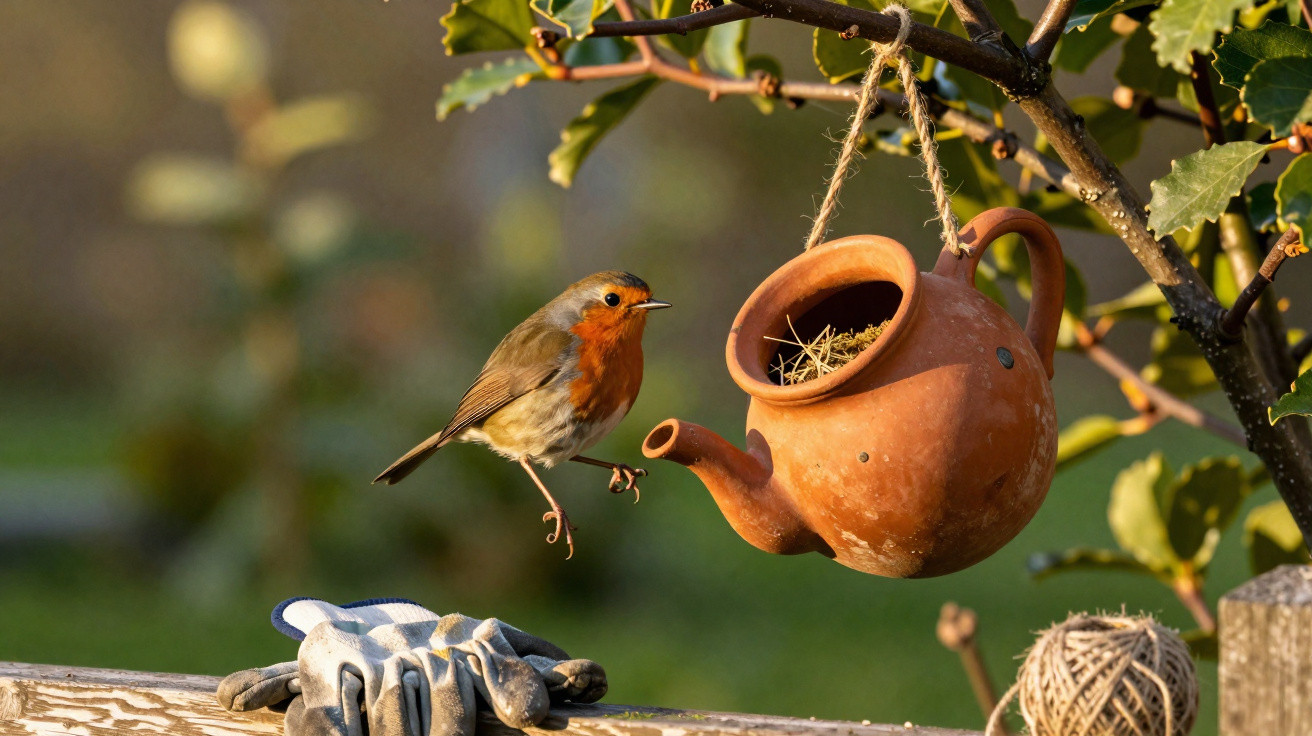
Many garden owners buy costly nest boxes, only to be disappointed when no bird moves in. Yet a simple trick using an everyday item gathering dust in many cupboards is often enough: an old clay teapot or jug. The price of the nesting place is not what matters, but its shape, position and orientation.
Why robins are so selective about nesting sites
The robin is a familiar garden bird and is happy to appear close to people, but it is far less accommodating when choosing somewhere to breed. Rather than a traditional enclosed bird box with a small round hole, it looks for a partly open cavity resembling a gap beneath tree roots or a hole in a bank.
An ideal nesting space for robins meets several requirements at once:
- a partly open entrance rather than a completely enclosed space
- an interior around 20 cm deep
- sufficient cover at the back and above
- an unobstructed view ahead for a rapid escape
- a quiet position among dense vegetation
The bird needs to feel concealed while still being able to watch its surroundings at all times. If a potential predator appears, the route out must be clear within seconds.
“Robins accept only nesting sites that cleverly combine protection with an escape route – every small detail can determine whether they accept or reject it.”
The unexpected solution: an old clay teapot
This is where an object that many people have long since discarded comes in: a terracotta teapot or a thick ceramic jug. Placed on its side, it becomes a small cavity that closely resembles the natural breeding places favoured by robins.
Why clay and ceramic work so well
Clay and thick ceramic offer characteristics that suit birds particularly well:
- They retain warmth and moderate temperature fluctuations.
- They do not heat up in sunshine as quickly as thin metal or plastic.
- They absorb some moisture from the air and release it again, helping to keep conditions inside more stable.
- They are durable and weather-resistant.
An old teapot therefore becomes a kind of natural grotto made from fired clay. Eggs and young birds benefit from this more even environment, particularly on nights with late frost or during very warm days.
Step by step: making a robin nest from a teapot
The arrangement is straightforward, although a few details make all the difference. Only a few minutes of preparation are needed:
- Clean it thoroughly: Rinse the teapot with plain water only; do not use washing-up liquid or harsh cleaners. Any residue could deter birds.
- Remove the lid: The interior needs to remain unobstructed, so the lid is no longer required.
- Position it correctly: Lay the pot on its side, with the opening pointing partly forwards and partly upwards, like the entrance to a small cave.
- Point the spout downwards: Angle the spout slightly down so rainwater can drain away and moisture cannot build up.
- Create a slight tilt: Raise the front a little, for example using half a cork, so the teapot slopes downwards by roughly 15–20 degrees.
- Fix it securely: Use galvanised wire to secure it to a tree trunk, in a forked branch or within dense ivy. The structure must not move.
“The teapot should resemble a secure hollow in a bank – not a loose pot that wobbles in the first gust of wind.”
The ideal garden location: height, orientation and surroundings
The location matters at least as much as the container itself. Robins live close to the ground and often hide in hedges, thick ivy or shrubs. That is exactly where the teapot should be placed.
Height and concealment in vegetation
Robins generally select breeding sites at low levels. For the teapot option, the following guidelines apply:
- install it 1 to 2 metres above the ground
- nestle it within dense planting such as hedges, ivy or groups of shrubs
- keep the approach clear at the front, with no tangled growth immediately in front of the opening
Trees covered in vegetation, untidy garden corners, an ivy-clad wall or dense privet are especially suitable. Position the pot so that it is barely noticeable from a distance; the robin is then more likely to feel secure too.
The right direction and protection from the weather
Correct orientation lowers stress for the birds and offers protection against heat, rain and wind. A sensible arrangement is:
- an entrance facing east or south-east
- no location exposed to full sun all day
- no direct draught from prevailing westerly winds
A semi-shaded spot keeps internal temperatures comfortable. Direct midday sun can overheat the interior, while permanent shade in a damp area encourages mould.
The right time: when robins inspect new nesting sites
Robins already move through their territories in autumn, remembering sheltered places. Ideally, the teapot should be in place by then. It should be installed by the end of February at the latest, allowing the bird to become familiar with it first as a resting place and soon afterwards as a breeding site.
Anyone putting up the teapot only in the middle of spring is taking a chance. It may still be accepted, but it will often remain unused at first and only be occupied the following year.
What disturbs a nesting site – and what helps
A common mistake is hanging a nesting site right next to a feeding station. For robins, this creates stress. Many other birds fly around there and competition arises, making it too busy for breeding.
| Unsuitable | Better |
|---|---|
| Nesting site directly beside a feeding station | Nesting site at least several metres away from feeding stations |
| Open lawn with no cover | Hedge edge, group of shrubs or ivy-covered wall |
| Cats can pass directly beneath it | An area that is harder for cats to access |
| Regular routes used by people | A quiet garden corner without frequent visitors |
Cats are a genuine risk factor. Thorny shrubs below the teapot, dense undergrowth or barriers such as stacks of wood make access more difficult for predators.
Care and checks: keeping the teapot usable for years
After the breeding season, the shelter needs a brief service. It takes no more than five minutes:
- Remove all old nesting material.
- Brush out the inside using a stiff brush.
- Rinse it with very hot water.
- Check for cracks or loose fixings.
Cleaning products should generally be avoided. Residues could cause problems, while hot water is entirely sufficient for hygiene. This short task in autumn ensures the teapot can serve as a winter roost and as a breeding site again the following spring.
Making your garden even more appealing to robins
Even the best nesting site is of limited use if the surrounding area provides little food. Robins like to scratch through leaves, pick insects from low-growing areas and use water sources.
A robin-friendly garden should therefore ideally include:
- piles of leaves or a corner where autumn leaves can be left in place
- small wood piles with bark and gaps for insects
- a shallow water dish or a gently sloping edge of a garden pond
- untreated beds where earthworms and beetles can live
Robins are inquisitive and often come close to people when someone is working in a flower bed and loosening the soil. This proximity is an added benefit when a safe nesting site is waiting nearby.
Why the effort is worthwhile – in the wider context
With one old teapot, you are supporting more than a single pair of robins. You are encouraging a small ecosystem in your own garden. Insect-rich corners, leaf piles and water sources help countless species, from beetles to hedgehogs.
Anyone who has watched a robin cautiously inspect the teapot, then bring nesting material and later return with food in its beak, sees their garden differently. An everyday object that might otherwise have gone in the bin becomes a practical piece of conservation – unassuming, yet highly effective.
Comments
No comments yet. Be the first to comment!
Leave a Comment