
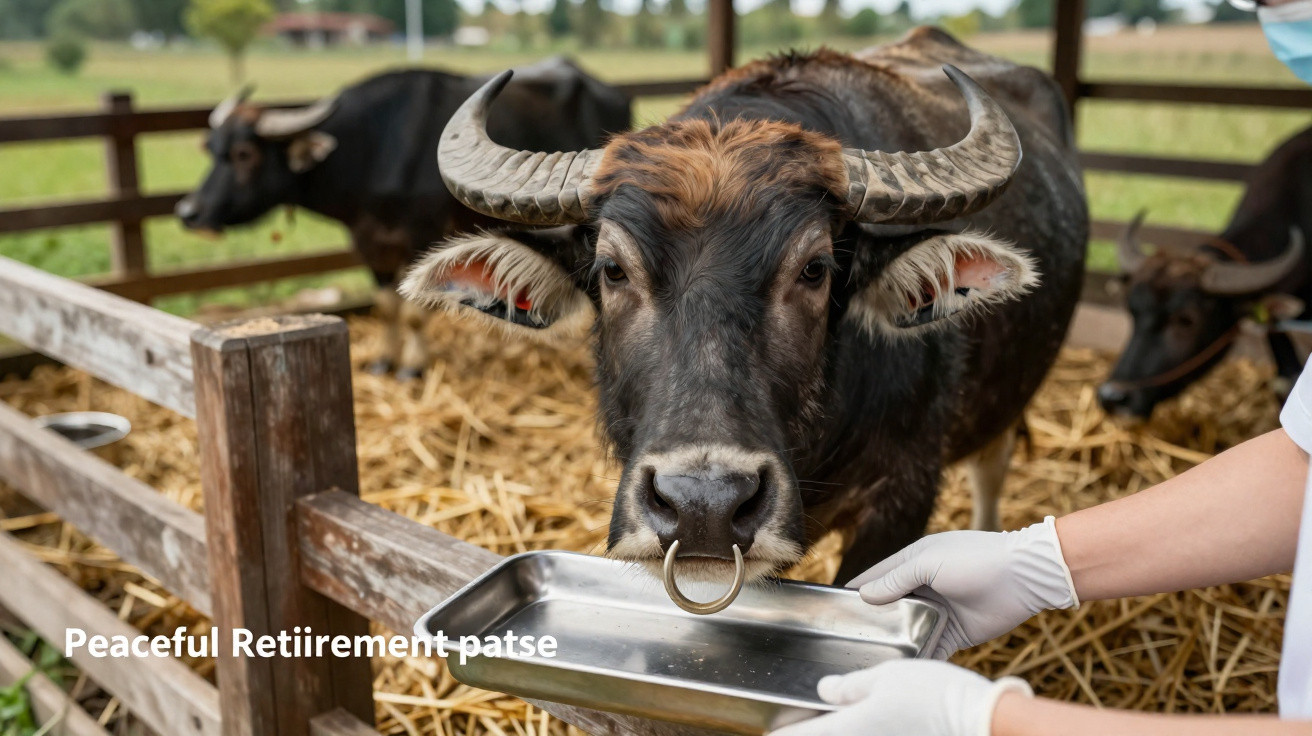
Moving an elderly working animal into retirement is not simply a matter of finding a quieter field. A water buffalo may need a long journey, careful health checks, secure accommodation and a gradual introduction to unfamiliar animals. The key to a good outcome is steady, competent care rather than one dramatic moment.
Reports from Yunlin describe an older buffalo called Bai Haitun settling into a retirement setting after leaving Green Island. While an animal’s expression cannot reliably tell us how it feels, the account is a useful prompt: any decision about transport, companionship or equipment such as a nose ring must put welfare and safe handling first.
Retirement is a long-term care commitment
An older animal may no longer be expected to work, but retirement still brings substantial daily responsibilities. For large bovines, these include suitable forage, clean water, secure fencing, shelter, hoof care, monitoring and access to veterinary support.
The reported move to Yunlin involved a lengthy journey. That matters because travel can be physically demanding for any elderly animal, especially where loading, unloading and changes in temperature or routine are involved.
For UK keepers, the same principle applies whether the animal is a retired cow, pony, donkey, sheep or goat: the plan needs to cover the animal’s likely needs for the rest of its life, not just its arrival.
Giving an animal a quieter life still requires skilled management, reliable funding and safe facilities.
Before taking on a retired farm animal, consider:
- the cost of feed, bedding, fencing, routine treatment and emergency veterinary care;
- whether the land provides safe grazing throughout the year, including wet winter conditions;
- who can care for the animal every day, including during illness or holidays;
- whether appropriate companionship is available;
- how the animal could be handled safely if it becomes lame, unwell or difficult to move.
Why the settling-in period matters
A move removes an animal from familiar sounds, smells, feeding routines and companions. Even a calm destination can be stressful at first.
The account from Yunlin says that Bai Haitun was initially unsettled but gradually became more comfortable around other buffalo. That is the outcome carers hope for, but it should not be rushed. Herd animals need time and space to establish safe social routines.
A sensible settling-in plan usually includes:
- a secure area where the newcomer can see and smell resident animals before direct mixing;
- clean drinking water, shade or shelter, and a dry place to rest;
- gradual changes to forage and feed;
- daily observation of appetite, droppings, mobility, breathing and demeanour;
- more than one feeding point, so a less dominant animal is not pushed away from food.
Large bovines can injure people without intending to. Their size, horns, hooves and speed mean that calm handling and secure boundaries are essential. Children and visitors should never enter an enclosure with an unfamiliar buffalo or cow.
Safe transport for older livestock
Long-distance transport should be planned with veterinary advice where an animal is elderly, lame, underweight or managing a long-term condition. Not every animal is fit to travel.
In the UK, livestock movements and transport are subject to animal-welfare and identification rules. Requirements vary with the journey and species, so keepers should check current guidance from the Animal and Plant Health Agency, their local authority and, where needed, a vet.
1. Assess fitness to travel
A vet can help identify problems that make a journey unsuitable or more risky, including severe lameness, dehydration, respiratory illness, advanced pregnancy or poor body condition.
2. Use appropriate transport and handlers
The vehicle should have secure partitions, non-slip flooring, adequate ventilation and enough headroom. Loading must be calm and unhurried. Shouting, chasing, steep ramps and overcrowding increase the risk of panic and injury.
3. Prepare the destination first
Before departure, check gates and fencing, prepare a quiet arrival pen, provide water and make sure other animals and dogs cannot crowd the newcomer.
4. Keep useful records
Feeding routines, identification details, previous treatment, known injuries and notes on temperament can all help a new keeper understand what is normal for that individual animal.
A nose ring is not a DIY removal job
One reported update from Bai Haitun’s new home concerned the removal of a nose ring. The owner interpreted the buffalo’s appearance afterwards as brighter and more relaxed. That may be an understandable impression, but behaviour and expression alone cannot confirm comfort or health.
Nose rings have long been used to assist the control of cattle and buffalo because the nasal septum is highly sensitive. However, an old ring may be associated with scar tissue, irritation, infection or an embedded fitting. Removing it may also change how safely the animal can be managed.
Any decision to remove a nose ring should be made by a vet and an experienced livestock handler. They can assess the tissue, manage pain and bleeding if necessary, and decide what handling arrangements are appropriate afterwards.
A moving image of apparent relief should never replace a proper examination and a safe handling plan.
Never cut, pull or prise out a nose ring yourself. This could cause severe pain and bleeding, while a startled animal weighing several hundred kilograms may react suddenly. Do not enter a pen or restrain a large bovine without experienced help.
Feeding an animal in later life
Reports say Bai Haitun’s appetite improved after the move. A return of appetite can be encouraging, but older animals still need their weight, teeth and droppings monitored rather than simply being given extra treats.
In Britain, a retired bovine’s diet is commonly based on suitable grazing and conserved forage during winter, adjusted for body condition and the quality of the available grass or hay. Mineral supplements should be chosen for the species and used with professional advice, particularly where other livestock share grazing.
Avoid sudden changes in diet. Rich grass, large quantities of sugary feed and unsuitable garden waste can cause digestive problems. Animals that are struggling to chew, losing condition or gaining excessive weight should be assessed by a vet or properly qualified nutrition adviser.
Useful observations include:
- whether the animal comes to food normally;
- whether it chews cud and drinks as expected;
- changes in gait, posture or time spent lying down;
- swelling, discharge or rubbing around old fittings or wounds;
- whether other herd members are preventing it from reaching food or shelter.
Companionship needs careful boundaries
Bai Haitun was reportedly accepted by other buffalo and also became familiar with dogs at the site. That may be reassuring in an individual case, but it is not a model to copy automatically.
Dogs can frighten cattle and buffalo, provoke chasing behaviour, or be badly injured by a hoof, horn or defensive charge. Even familiar dogs should be kept away from gateways, feeding areas and handling pens, and should never be left unsupervised with large livestock.
For herd animals, suitable company of their own species is normally the priority. Introductions should begin across a fence where possible, with enough space for animals to move away from each other.
Common mistakes when rehoming retired farm animals
- Treating retirement as a one-off expense. Care costs continue for years and can rise quickly if health problems develop.
- Mixing animals immediately. Quarantine, health checks and gradual introductions can reduce avoidable stress and disease risk.
- Changing feed overnight. Dietary changes should be gradual and based on the animal’s existing routine.
- Ignoring mobility and teeth. Old injuries, hoof problems and dental difficulties can become more obvious with age.
- Letting untrained people handle livestock. Good intentions do not make a pen safe for visitors or volunteers.
- Altering equipment without advice. Nose rings, head collars, restraints and old harness fittings need competent assessment.
A calmer life is built day by day
The encouraging part of Bai Haitun’s reported progress is not a claim about one look in its eyes. It is the possibility of a calmer routine: safe accommodation, regular food, patient human care and contact with other buffalo.
Anyone considering a permanent home for an older farm animal should begin with the practical essentials. Get veterinary input, arrange secure housing and suitable companions, prepare for transport properly and budget for lifelong care. Those quiet decisions are what give a retired animal the best chance to settle well.




Comments
No comments yet. Be the first to comment!
Leave a Comment