
As spring unfolds, countless owners open the back door and allow their pets outside without giving it much thought. But those gentle afternoons in March and April overlap with a far quieter struggle in hedges and trees, where this year’s young birds are trying to stay alive.
The hidden nesting boom behind the garden fence
From the middle of March in much of Europe and North America, birds enter the busiest breeding period of their year. Pairs come together, defend their territories and build nests in easily overlooked places: within dense hedgerows, beneath loose roof tiles, inside cavities in old trees or behind climbing plants growing on walls.
After eggs are laid and kept warm, adult birds make continual journeys to feed their chicks. Many fledglings leave their nests before they are capable of flying properly. They may hop awkwardly over lawns or shelter beneath bushes while they wait for their parents to return with food.
Those “lost” chicks on your lawn are rarely abandoned. They are in the most vulnerable 48 hours of their lives.
A hedge being cut back, an inquisitive dog or a patrolling cat can turn this fragile stage into a fatal encounter. French conservation organisations report that familiar garden bird numbers have fallen by roughly 30% over three decades. Certain urban birds have declined even more sharply: house sparrow numbers in Paris, for example, have dropped by over two-thirds.
Comparable trends are being recorded across Europe among blackbirds, greenfinches and other birds that were once commonplace. With so many species already affected by habitat loss, pesticides and climate change, additional deaths in spring place pressure on populations at their most vulnerable moment.
What your cat really does outside in spring
Many owners assume their cat “doesn’t hunt” because no dead animal appears on the doorstep. Research suggests otherwise. Pet cats retain a powerful instinct to hunt even when they have plenty of food. It is movement that prompts them: grass rustling, something fluttering close to the ground or a fledgling attempting one of its first brief flights.
Studies following cats that go outdoors show that small mammals, including mice and voles, make up most of their prey. Birds account for a substantial proportion, often about a fifth. Cats do not bring every animal they catch home. Some prey is eaten where it is caught, while other animals are left behind, so the true impact is much greater than the trophies an owner sees.
Scaled up to millions of pets, a “harmless” garden stroll becomes a major pressure on already struggling wildlife.
France has approximately 15 million pet cats alone. Estimates indicate that each one may kill several birds annually on average. This rapidly amounts to tens of millions of birds being lost each year. The overall effect is similar in countries with high levels of cat ownership, including the UK: the figures are large enough to influence local bird populations, particularly in suburban areas and villages where gardens provide important nesting habitat.
To a cat, a garden is more than somewhere to play. It is its territory. Any small animal moving through that space may become prey, regardless of whether the cat is hungry.
The double risk: wildlife under threat, cats too
Spring can also put your pet at greater risk. Longer daylight hours bring more traffic to the roads. Cats wander further to protect their territory or seek mates, increasing the likelihood of fights and the spread of parasites and infectious illnesses.
Nearly every vet has stories of injuries occurring in spring and early summer: bite-wound abscesses, fractures caused by road collisions and infections caught from other animals. The same period that poses the greatest danger to young birds is also one of increased risk for cats that go outside.
Building a spring routine indoors that your cat actually enjoys
Keeping a cat indoors during March and April does not have to result in frustration or damaged furniture. It does, however, call for an adjusted routine and some imagination.
Turn windows into “cat TV”
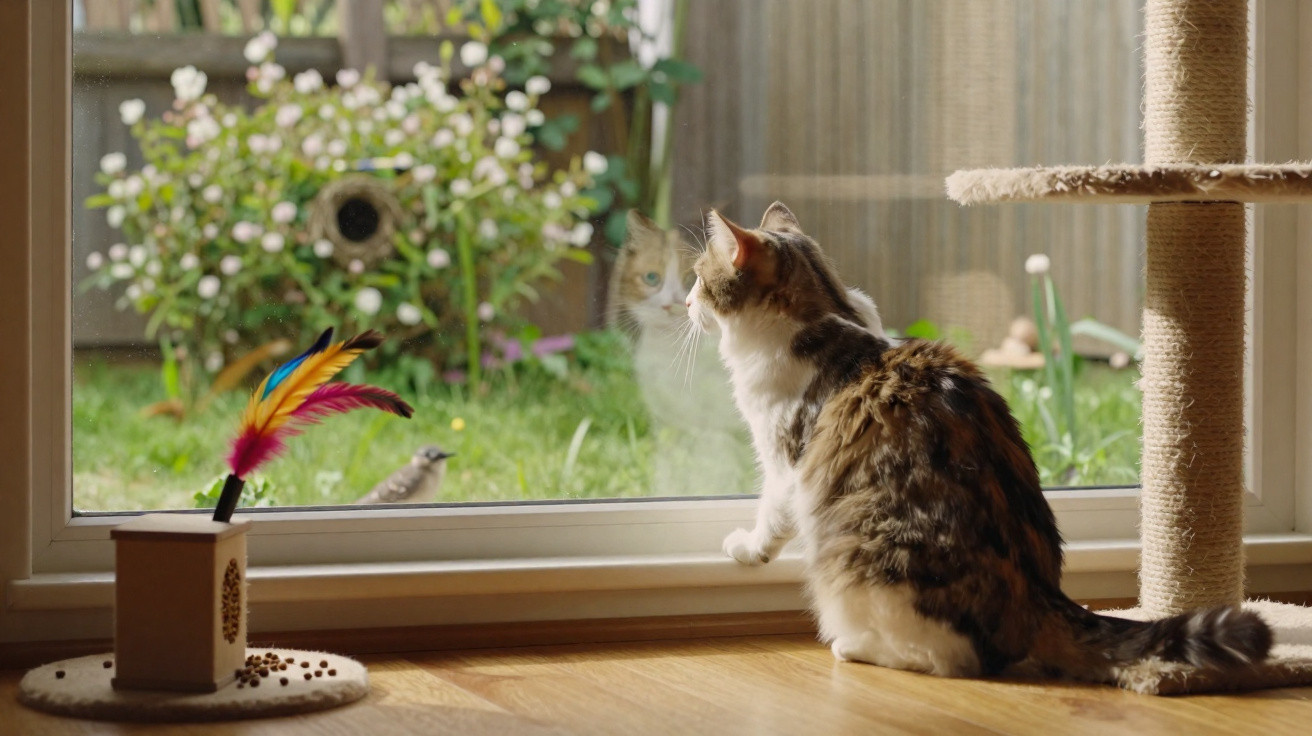
Window perches and shelves allow your pet to watch birds, insects and passers-by clearly. A basic chair beside a window or a specially designed shelf attached to the sill can offer many hours of interest. Height and stability are essential, allowing the cat to relax and observe in safety.
Replace real hunting with play hunting
Cats that can stalk toys indoors may be less driven to stalk wildlife outdoors. Brief but concentrated play sessions are most effective. Two ten-minute sessions each day using a wand toy or feather teaser can wear out even a very lively cat.
- Choose toys with unpredictable movements, such as fishing-rod toys or small balls.
- Move the toy away from the cat to imitate prey trying to get away.
- Allow the cat to catch and “win” at the end, preventing frustration.
- Swap toys around regularly so they remain interesting.
Food puzzles and treat-dispensing balls appeal to these same hunting instincts. Rather than providing a full bowl once or twice daily, divide meals into smaller amounts, hiding them around the home or dispensing them through puzzle feeders.
If your cat must go out, tweak the timing
Some households cannot realistically keep a cat indoors all the time, particularly where doors and windows are regularly opened. In those circumstances, timing and equipment can still make a meaningful difference.
Most garden birds are most active – and most exposed – around dawn and dusk, exactly when many cats love to roam.
Limiting outdoor access at these times lowers a cat’s hunting success. Keeping cats indoors early in the morning and during the final hours before nightfall can help protect fledglings learning to fly. A bell fitted to a quick-release collar may modestly reduce successful hunts by alerting birds, although it will not prevent every kill. Bells should never be used for kittens or in places with a high danger of snagging.
| Strategy | Benefit for wildlife | Benefit for your cat |
|---|---|---|
| Indoor-only March–April | Protects nesting birds and young mammals at peak vulnerability | Reduces fights, traffic accidents, exposure to disease |
| Curfew at dawn and dusk | Less predation during key feeding and fledging hours | More rest, fewer night-time hazards |
| Active play and puzzle feeding | Channels hunting urge away from wildlife | Better fitness, lower boredom and stress |
| Supervised garden time or harness walks | Wildlife less likely to be stalked and killed | Outdoor stimulation with more owner control |
Rethinking what a “good life” for a cat looks like
Many people believe a cat “needs” the freedom to roam in order to be content. Behavioural research presents a more complex view. Cats chiefly need security, mental stimulation, reliable access to resources and opportunities to express natural behaviours such as climbing, scratching and chasing.
All of these needs can be met indoors, particularly in flats and houses designed with cats in mind: shelving that creates elevated routes, robust scratching posts, places to hide and regular contact with people. Some studies have found that indoor cats in enriched homes display fewer stress-related behaviours than outdoor cats exposed to continual threats and conflict.
There is also an aspect of wildlife welfare that is often overlooked. A fledgling killed by a cat is not simply another figure in a statistic. It represents a future breeding adult lost, a missing part of the insect-control chain and another absence from the spring birdsong that people say they miss.
How small choices in one garden add up
A single household deciding to keep its cat indoors for two months may seem insignificant. Applied across a street, village or neighbourhood, though, the outcome is very different. Fewer predators roaming outside means more chicks surviving into adulthood.
Consider it part of a wider “spring truce” with nature. Letting an area of lawn grow slightly longer, postponing hedge trimming, planting a bird-friendly shrub and restricting cat access all improve the chances of survival in the same way. No individual measure will undo decades of bird declines, but together they can change conditions locally.
For owners who are undecided, it may help to imagine a typical early-April day in the garden. Beneath a neatly clipped box hedge, a blackbird could be sitting firmly on a clutch of eggs. In wall ivy, house sparrows may be pushing food into open beaks. Near the compost heap, a young robin might be making its first leap from cover.
This is the environment your cat enters when the back door opens. For only a few weeks each year, deciding not to open it quite as often could mark the difference between a peaceful, flourishing spring and another unseen loss.




Comments
No comments yet. Be the first to comment!
Leave a Comment