
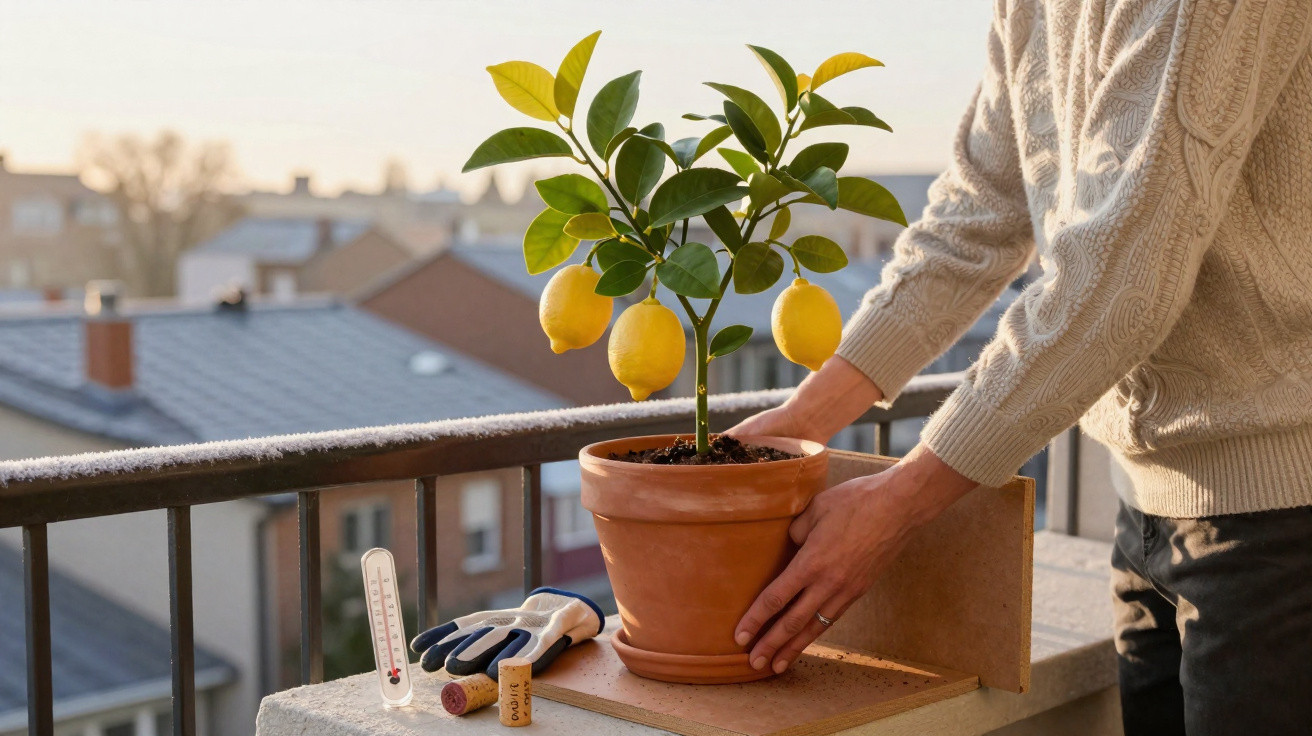
For lemon trees kept in containers, this can be fatal.
A lot of hobby gardeners are delighted in March when their lemon tree on the balcony or patio starts showing fresh, green leaves - and they feel reassured. The thick winter covers have been put away, the days are getting longer, and the sun already has a spring-like warmth. It’s precisely at this point that late frost often strikes. The dangerous part is that the damage doesn’t begin up in the foliage, but quietly down below at the base of the pot.
Late frost in March: why potted lemon trees suffer most
Lemons and other citrus plants thrive on light and warmth, but they only tolerate frost to a limited extent. In the ground they have a bit more breathing space, because soil changes temperature more slowly and doesn’t freeze through as quickly. In a container it’s completely different: the roots sit far closer to cold air and to the number-one cold sink - the surface of your balcony or patio.
The usual pattern looks like this: during the day the sun is out, the thermometer reads 10 to 15 °C, the lemon tree pushes new growth, and the first buds may even start to open. Then at night the temperature suddenly drops to -1 or -3 °C. The air doesn’t seem brutally cold, but concrete, tiles or stone beneath the pot soak up the chill and pass it straight into the container.
"The real frost shock for a potted lemon tree comes from below - through the base of the pot, not through the canopy."
That’s where the big risk sits: the roots are the plant’s most sensitive part. If they freeze, the tree can decline noticeably within a few days - leaves droop first, then darken, and eventually entire shoots dry out.
The underestimated cold conductor: balcony and patio as a frost bridge
Professionals refer to a “heat or cold bridge effect”. Hard surfaces such as concrete, tiles or natural stone hold onto night-time cold particularly well. If the container is placed directly on top, you get direct contact - effectively a cold bridge that draws sub-zero temperatures down into the root area.
A typical scenario in everyday city-balcony life:
- a sunny south-facing balcony that feels mild and pleasant during the day
- March nights dipping just below 0 °C
- the pot sitting directly on tiles or concrete
- the next day, or the day after: the first leaf damage appears
Lemon trees can cope with brief dips to around -6 or -7 °C, provided they are well protected. In a pot, though, the problem intensifies: the small volume of compost cools far more quickly than garden soil. Fresh fine roots - the ones responsible for water uptake - are usually the first to die off. The crown often still looks fine, while the roots are already under severe stress.
The discreet protective shield: an insulation board under the pot
The most effective step targets exactly this weak point: under the pot. Rather than only wrapping the crown in horticultural fleece or shifting the plant’s position slightly, a very simple item - one many people already have at home - makes the crucial difference.
"A simple insulation board under the plant container breaks the cold bridge to the ground - and saves the roots."
Which materials work?
You don’t need expensive specialist products. Good options include:
- a thicker sheet of polystyrene (Styrofoam), for example from packaging
- sturdy cork boards or thick cork mats
- other pressure-resistant, water-tolerant insulating materials
What matters most is thickness. Ideally aim for 2 to 5 cm. The board should extend about 1 to 2 cm beyond the base of the pot all the way round, so there is no direct contact with the cold surface.
How to position the insulation board correctly
A few simple steps are enough for this to work:
- Carefully lift or tilt the pot (with large containers, it’s best done with two people).
- Place and align the insulation board where you want it.
- Set the pot centrally on the board so it stands stable and level.
Key point: the drainage hole must not be blocked. If water backs up, the risk of root rot increases - and that becomes especially critical during cold nights.
Drainage trick: halved corks as mini feet
With one extra, very simple trick you can combine frost protection and water drainage. If you have wine or sparkling-wine corks at home, put them to work:
- split two or three corks lengthways
- space the halves evenly under the base of the pot
- make sure the drainage hole remains clear
This creates a thin air gap between the board and the pot. That air layer acts as additional insulation, while still allowing water to drain freely. It takes only a few minutes, costs virtually nothing, and can make a huge difference to frost resilience.
Layered protection until mid-May: helping a lemon tree through the danger period
In many areas, mid-May - around the so-called Ice Saints - is treated as a rough cut-off for late frost. Until then, a multi-step approach is worth it. The insulation board is the foundation and can stay under the container long-term.
If a particularly cold night is forecast, you can strengthen protection in a flexible way:
- drape a light horticultural fleece loosely over the crown and the pot
- don’t let the fleece sit directly on the leaves; instead, stretch it over canes or bamboo stakes
- move the pot as close as possible to a sheltered, south-facing house wall
- position it under an overhang or balcony above to reduce radiation frost
Fleece typically provides a buffer of about 3 °C. Combined with an insulated pot base, that can be the difference between minor frost scorch and a total loss.
A “second skin” for the container: keeping roots deliberately warmer
If you want to go one step further, you can wrap the container itself. A “layering” approach works well: an insulating layer that’s then covered with a natural-looking outer material.
Practical combinations include:
- a layer of bubble wrap directly around the pot
- over that, a layer of hessian, reed matting or coconut matting to disguise it
- secure with cord or cable ties, without blocking drainage underneath
This creates a jacket around the root ball that softens temperature swings. Together with an insulated standing surface, it protects the vulnerable roots far more effectively, without making the entire tree look like a parcel.
Watering behaviour and placement: small mistakes with big consequences
Alongside insulation, how you handle water can decide whether a lemon tree gets through March and April. Wet compost conducts cold faster than lightly moist compost. A saturated root zone on a frosty night can dramatically worsen the damage.
So the rule is:
- don’t water heavily right before cold nights
- keep the compost evenly moist, but on the moderate side
- avoid standing water in saucers without exception
Placement also deserves careful attention: a south-facing wall stores solar warmth during the day and releases it slowly overnight. That reduces sudden temperature drops around the container. Exposed, draughty corners or free-standing platforms, by contrast, speed up cooling.
Why lemon trees react so sensitively
Lemons originate from much warmer climates. They can grow here, but in containers they’re always somewhat on the edge. New spring shoots and leaves are particularly vulnerable to frost. At the same time, fine roots sit very close to the pot wall - exactly where the cold hits.
Many hobby gardeners wonder why their lemon tree suddenly collapses in March after what seemed like a mild winter, even though the truly severe frosts are over. In a lot of cases, it’s this cold stress from below that triggers the problem. The canopy may still look acceptable for a few days or weeks, while serious damage is already developing in the root zone.
Practical add-ons: what pairs well with an insulated base
An insulation board under the pot is almost invisible from the outside. It doesn’t get in the way when watering or when moving the container. If you’re rearranging your balcony or patio in spring anyway, it’s easy to build this protection into your setup - not just for citrus, but also for other frost-sensitive container plants such as olives, figs or Mediterranean herbs in large pots.
It’s also worth considering the container material itself. Thin-walled plastic pots cool down much faster than thick terracotta or wooden planters. Combining a substantial pot, an insulated base and, when needed, a simple fleece on very cold nights provides a surprisingly large safety margin - without turning the balcony into a winter storage area.
If you use this straightforward strategy to get through the critical weeks up to mid-May, you’ll head into the warm season with a healthy, vigorous lemon tree. In return, it rewards you with steadier growth, more blossoms and a far better chance of aromatic fruit in late summer - all without a spring frost shock.


Comments
No comments yet. Be the first to comment!
Leave a Comment