
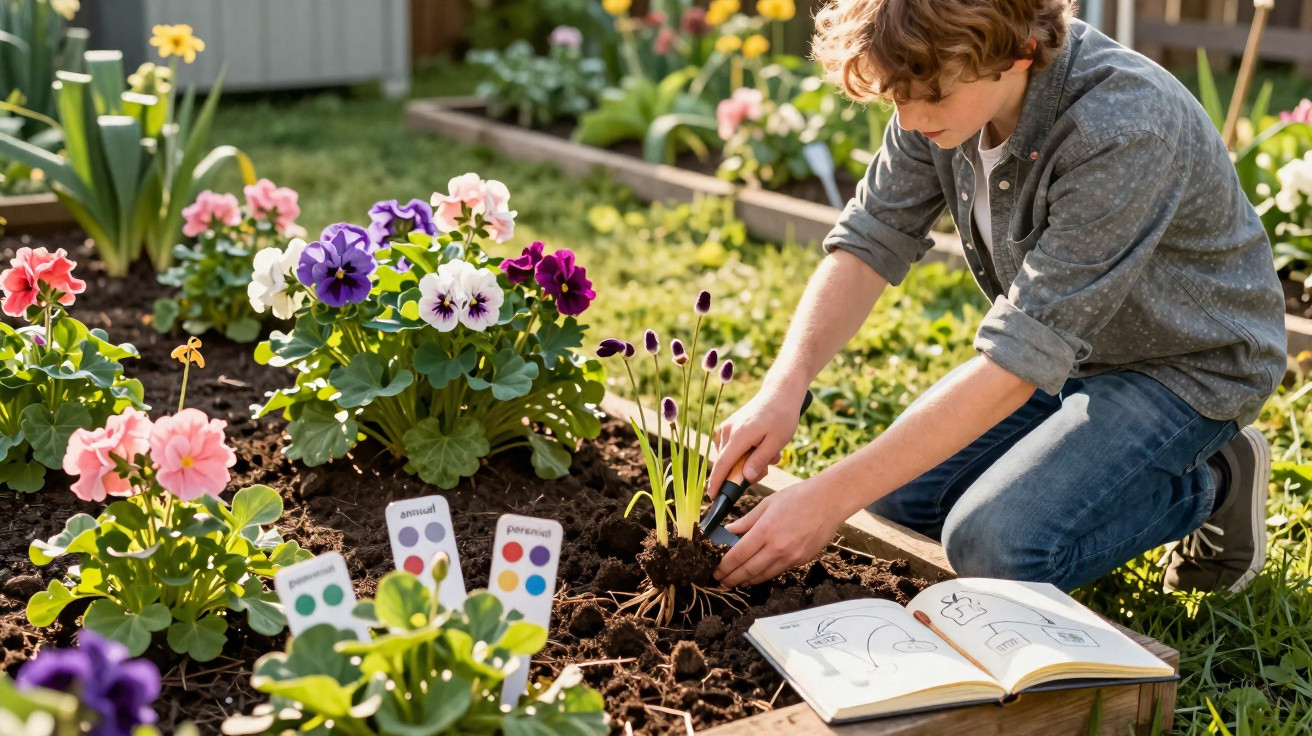
The word perennial sounds straightforward, yet in a border it rarely is. Perennials, annual flowers, tubers, shrubs: if you want to plan planting sensibly, you need to know what truly comes back, what only lasts a single season, and how to tell the groups apart with confidence. This guide is designed to do exactly that.
What gardeners really mean by perennials
In strict botanical terms, any plant that lives for more than two years is perennial. By that definition, trees and shrubs would also count as perennials - but that is not how gardeners use the word.
In everyday gardening, a “perennial” usually means plants that:
- live for more than two years
- die back each year to their roots, rhizome, tuber or bulb
- sprout again from the ground in spring
Typical examples include hostas, daylilies, delphiniums and coneflowers. Through winter you may see nothing at all - then in May they suddenly reappear as lush green clumps in the border.
"Perennials are the invisible long-term residents of the border: gone in winter, back again in spring."
The difference between annuals and biennials
Annuals: full speed in a single season
Annual plants last only one summer. They germinate in spring, grow, flower, set seed and die within the same year. Their advantage is that they avoid building woody structure and instead pour their energy into flowers and seed.
Common annual garden plants include:
- tomatoes (usually grown as annuals in home gardens)
- pumpkin and courgette
- basil
- cosmos, sunflowers, zinnias
Annuals often provide colour for months, but once frost arrives they are finished for good.
Biennials: leaves in year one, flowers in year two
Biennials mainly produce leaves and roots in their first year. In the second year they flower and set seed - and then die. Classic examples include foxglove, hollyhock and some bedding pansy types.
Woody plants: shrubs are always perennial
If you want to recognise perennials in the gardening sense, you cannot avoid the question of whether a plant is woody. Wood forms when a plant grows over multiple years: older conducting tissues inside die back and become supportive material. Each year, a new layer is added on the outside - which is why tree trunks show annual rings.
So the rule is: any plant with true wood is perennial - but not every perennial forms wood.
- Woody plants (shrubs/trees): trees, shrubs, roses, soft fruit bushes
- Low woody plants: blueberries, dwarf shrubs, ground-cover roses
Many of these plants look small and almost herbaceous, yet they are woody at their core. If you look closely and can see lignified, woody shoots, you are not dealing with a classic herbaceous perennial but a woody plant.
Herbaceous perennials: the hidden life underground
A typical garden perennial dies back above ground in autumn. Below the surface it stores energy and sets itself up for the following spring. Gardeners often group herbaceous perennials by the storage organ they use:
| Storage organ | Characteristic | Examples |
|---|---|---|
| Roots / rhizomes | Thickened root parts, sometimes creeping | mint, yarrow, many grasses |
| Bulbs | Bulb-like storage organ with scales | daffodils, tulips, ornamental alliums |
| Tubers | Thickened stem parts or roots | dahlias, gladioli, potatoes |
"No plant organ signals staying power as clearly as a fat bulb or tuber: that is where the energy for the next garden year is stored."
Grasses are a special case: they can be annual or perennial, but never biennial. Many ornamental and wild grasses grown in gardens - for example buffalo grass or prairie grasses - form long-lived tussocks and are counted as perennials.
Typical perennials in the garden - and their pitfalls
Popular long-term bloomers for borders and wildlife gardens
Whether you garden in a cottage-garden style or have a modern gravel strip in front of the house, perennials provide the backbone of the planting. Classic examples include:
- delphinium: tall and dramatic, but can be somewhat labour-intensive
- aquilegia: readily self-seeds and turns up in new spots
- sage (ornamental forms): long flowering period, excellent for insects
- coneflower: tough, long-flowering, popular with bees
- Echinacea: medicinal value and an attractive perennial at the same time
Many medicinal plants used in gardens - such as yarrow or Echinacea - are also perennials. They produce fresh flowers each year and can persist in one place for many years.
Why “perennials” sometimes fail to return
A label in the garden centre may say “perennial”, yet the next spring the border stays bare - a familiar frustration. There are several common reasons:
- Lack of nutrients: the plant flowered so heavily in its first year that it failed to build reserves for year two.
- Wrong site: waterlogging, planting too deep, or bone-dry soil weakens the plant.
- Cold: some perennials are only partly hardy - perennial in mild areas, but not in harsher locations.
- Over-breeding: especially with tulips, some varieties flower spectacularly in the first year, then decline sharply.
Tulips show this particularly clearly: botanical species often persist for a long time, while highly bred varieties disappear quickly unless you care for them - for example by leaving the foliage in place after flowering until it has fully died back.
Hidden perennials: plants we usually treat as annuals
Some species are actually perennials in their native climate, but in UK gardens they are often used for only one year. Typical reasons include sensitivity to frost, disease pressure, or a decline in appearance.
Common examples include:
- tomatoes: perennial in tropical regions, but here usually replaced after one season
- peppers and chillies: can be overwintered indoors, but are often bought again
- potatoes: form tubers that could theoretically be used over multiple years, but in practice we work with fresh seed potatoes
- pansies: partly perennial, but in the second year they are usually no longer especially attractive
"Many supposed ‘summer flowers’ are actually perennials - just not in our climate and our gardening habits."
“Volunteers” in the bed: why they are not perennials
Almost every vegetable grower has seen it: small tomato plants, pumpkins or sunflowers suddenly appear where nobody sowed anything. These self-sown surprise residents are often called “volunteers”.
They grow from seed that reached the soil the previous year - for instance when an overripe tomato split. Biologically speaking, the new plant is still an annual, even if it looks as though the spot has been continuously planted.
Typical “volunteers” include:
- tomatoes
- pumpkin and courgette
- melons
- beans
- sunflowers
For bed planning, that means: only plants that resprout from an old rootstock, bulb or tuber count as true perennials in the gardening sense.
Practical tips for recognising perennials in everyday gardening
A simple checklist for home gardeners
If you want to get better at telling plants apart in your own garden, a few straightforward questions help:
- Does the shoot remain as woody growth over winter? If so, it is probably a shrub or other woody plant.
- Do all above-ground parts disappear, with fresh growth emerging from the soil in spring? That points to a herbaceous perennial.
- Are there thick bulbs or tubers in the ground? Then the plant is very likely perennial.
- Does the plant set lots of seed in its first year and die after the first frosts? That is more typical of annuals.
Looking at the combination of lifespan, storage organs and winter behaviour often tells you a great deal - without needing to reach for botanical reference books.
Why knowing your perennials saves money
Once you understand which plants truly stay for the long term, you plan your border differently. Perennials and woody plants form the lasting framework, while annuals provide bright seasonal highlights. That approach means you buy far less each year and still keep the garden looking lively throughout the seasons.
Perennials also help stabilise the small ecosystem around your home. Over many years they offer food and shelter for insects, birds and soil life. For example, combining Echinacea, yarrow and a range of grasses creates a long-term, valuable habitat - and a border that still looks appealing in autumn and winter.
Comments
No comments yet. Be the first to comment!
Leave a Comment