
There’s more to it than appearance alone.
Plenty of plant lovers know the moment: you water your favourite houseplant, run your hand over the pot, and notice the brown surface of the compost has developed a thin white film. At first you might blame tired, depleted compost or a bit of household dust. In reality, that discolouration is a pretty accurate signal that something in the pot and soil has slipped out of balance - and it says a lot about how your indoor plants are really doing.
What the white layer on the soil is actually telling you
Most of the time, it’s a superficial, whitish mould on the surface. That sounds more alarming than it often is - but it isn’t something to ignore, either.
"The white layer almost always means: the pot is too wet, the soil is too compact, and the conditions for fungi are practically perfect."
This mould is made up of microscopic fungi that settle in the top layer of nutrient-rich compost. Substrates with lots of organic material are especially prone - for example compost mixes containing pieces of bark, fibres, or other plant matter.
Usually, these fungal networks stay near the surface and don’t attack the roots directly. Even so, they’re a clear sign that:
- the compost is staying too wet for too long,
- the plant isn’t getting enough light,
- air circulation is poor - for instance in winter when windows stay shut.
There’s also a second very common cause: a pale crust formed from limescale and dissolved mineral salts.
When limescale rather than mould is the culprit
In many homes, tap water is high in limescale. If you use it for watering over a long period - especially alongside frequent feeding - calcium and salts can gradually build up on the surface. This is particularly likely if you often water from below via the saucer: the water (and the dissolved salts) moves upwards, evaporates at the top, and leaves behind a dry, light-coloured crust.
This kind of layer is generally less dangerous than mould, but it still sends a clear message: the potting mix is overloaded with minerals and leftover fertiliser salts. Over time, that can stress the roots and interfere with the uptake of water and nutrients.
Mould or limescale? How to tell the difference in seconds
You can usually work out whether your plant is dealing with damp conditions or with limescale using your eyes - and your nose.
- Soft, fluffy, cottony and a bit uneven, often with a musty “damp cellar” smell: very likely mould.
- Hard, dry, crumbly, like plaster or chalk, and it breaks under your fingers: more likely a mineral deposit.
- No smell, frequent watering with hard tap water, and lots of fertiliser: points towards limescale and salt build-up.
Mould isn’t just a cosmetic issue. It indicates the compost is almost constantly wet and the roots aren’t getting enough air. Typical knock-on effects include:
- slower growth,
- yellowing, increasingly limp leaves,
- a higher risk of root rot,
- greater susceptibility to pests such as fungus gnats.
Indoors, spores can also get into the air and be unpleasant for sensitive people, for example those with allergies or asthma.
Important special case: a white layer on succulents
With succulents and some cacti, there’s an important exception: many species naturally carry a fine white or bluish coating on their leaves. That isn’t dirt - it’s a protective layer that helps guard the plant against strong sun and moisture loss.
"If you panic and wipe or scrub off this natural protective layer, you’ll harm the plant far more than you’ll improve its appearance."
The trick is simple: remove dust gently with a very soft brush, but leave the whitish waxy coating alone.
How to respond properly when a white coating appears
When that pale film shows up on the soil surface, it’s best to act promptly rather than just turning the pot and pretending you didn’t see it. A straightforward step-by-step approach will help you get on top of the problem.
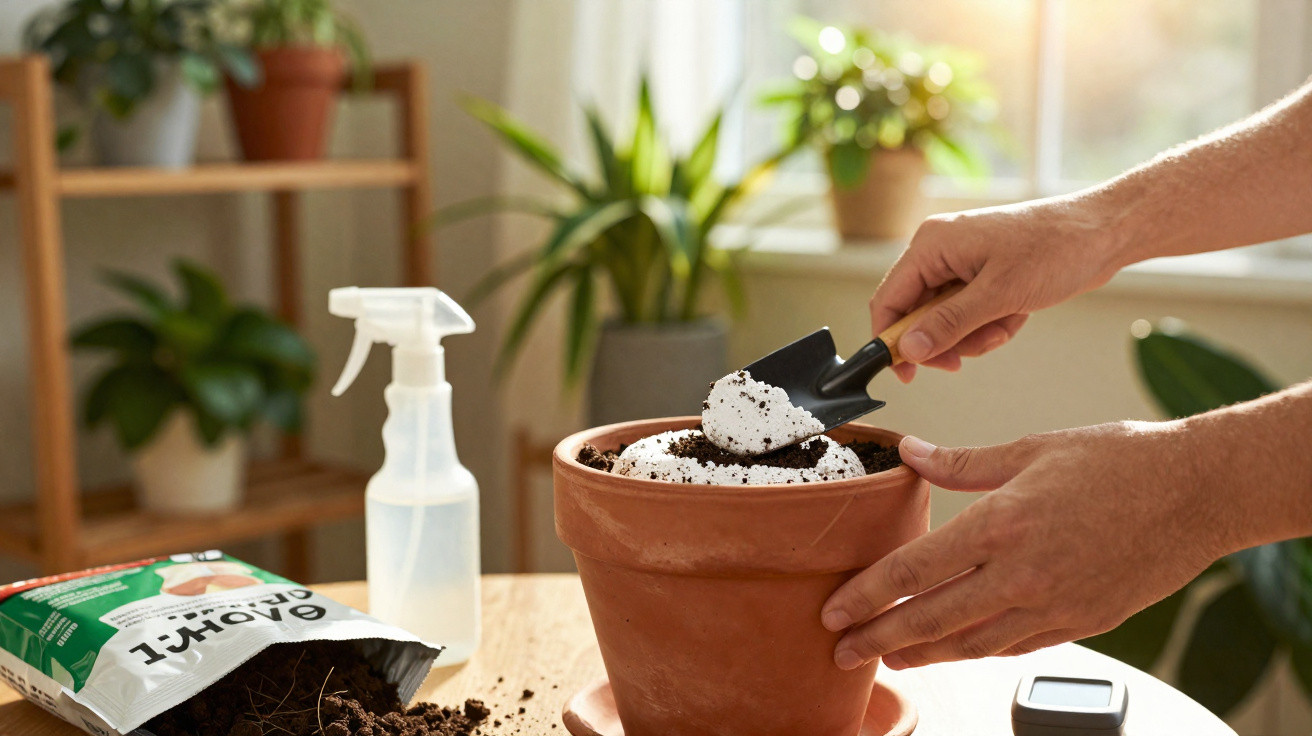
Remove and refresh the top layer
- Using a spoon or small trowel, carefully lift off the top about 2 cm of compost.
- Don’t keep the removed compost in the same room; bin it or compost it well away from your other plants - especially if it smells musty.
- Top up with fresh, clean potting mix, leaving about 2 cm of space below the rim so water doesn’t spill over when you water.
That takes care of what you can see. Next, you need to address the causes.
Adjust watering and improve airflow
The key lever is moisture in the pot. Fixed “watering days” on a calendar can quickly lead to constantly damp compost - particularly in winter, when plants use less water.
- Before watering, push a finger roughly 2 cm into the compost. Only water if that area feels dry.
- After about 30 minutes, pour away any excess water sitting in the saucer.
- Occasionally loosen the surface gently so air can penetrate more easily.
- Ventilate rooms regularly, especially where there are lots of plants and dry air from heating.
If you like, you can dust the newly refreshed surface lightly with cinnamon or mix in a small amount of activated charcoal. Both can be mildly antifungal and help stabilise the conditions at the surface. A lightly diluted spray of a household vinegar-and-water solution onto the compost (not the leaves) can also make the surface less hospitable for fungi.
When a full repot is necessary
If mould or heavy limescale rings keep returning despite these measures, there’s usually a deeper issue: potting mix that’s consistently too compact or exhausted, a pot that’s too small, or a completely unsuitable substrate.
"Repeated white coating is often a sign: it’s time for a complete reset in the pot."
In these cases, repotting into fresh, airy compost is the only real fix:
- Gently remove the plant from its pot and clear old compost from the roots.
- Check the roots and trim away any mushy, rotten sections with clean scissors.
- Wash the pot thoroughly with hot water and a splash of vinegar to remove old deposits and spores.
- Add a drainage layer of expanded clay pellets or gravel to the bottom.
- Replant in a suitable, free-draining mix, for example one amended with sand or perlite.
How to prevent a white layer from forming
Prevention starts with set-up - not only once a problem appears. During the heating season in particular, many houseplants end up caught in an awkward combination of dry indoor air, warm radiators, and yet constantly damp compost.
A few effective strategies:
- Match the compost to the plant type: succulents and cacti need very free-draining mixes; tropical foliage plants can take more humus, but still need air around the roots.
- Make drainage a priority: add a layer of expanded clay pellets or gravel at the bottom so excess water can run away.
- Feed only when needed, not out of routine - plants typically use fewer nutrients in winter.
- If your tap water is very hard, switch occasionally to filtered water or collected rainwater that has been left to stand.
- Remove dead leaves and spent flowers from the soil surface regularly so they don’t become extra “food” for fungi.
When the white coating appears most often
Houseplants are especially vulnerable in the darker months and in very warm rooms. When light levels drop in autumn, less water evaporates through the leaves. Plants drink less, yet many watering habits stay unchanged - and the compost stays wet for days or even weeks.
White coatings also show up more often after repotting, when using very nutrient-rich compost, or with heavy feeding. Fungi and minerals then have ideal conditions to become visible on the surface.
Why it pays to look closely at the soil
Most people judge a plant’s health by its leaves and flowers first. But the compost in the pot gives you just as many clues. Colour, smell, and texture can reveal a great deal about moisture balance, nutrient levels, and airflow.
If you learn to read these signals, you’ll often spot trouble far earlier. A thin white layer may look trivial at first glance, but it’s a practical early-warning system - pointing to too much water, too much limescale, or too little air. Acting at this stage often prevents a minor visual issue from turning into a genuine plant problem.


Comments
No comments yet. Be the first to comment!
Leave a Comment