
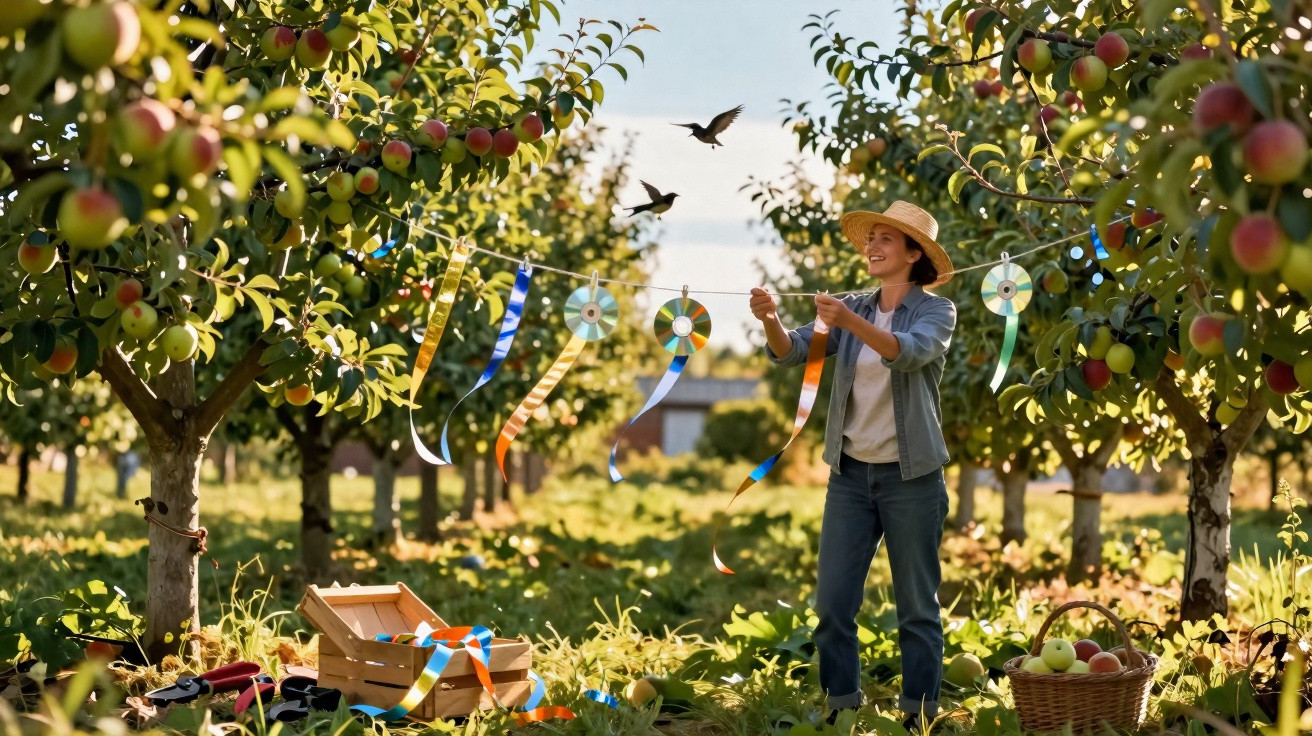
Anyone with a garden - or even just a couple of fruit trees - will recognise the problem: the moment cherries, plums or berries begin to colour up, sparrows, blackbirds and thrushes are already perched in the canopy. Instead of a bowlful, you often end up with only a handful of fruit on the plate. That’s why an age-old but surprisingly effective approach is making a comeback: a simple figure placed in the plot that moves in the wind and puts birds off - with no chemicals and without harming wildlife.
Why a home-made “garden guardian” works so well
The principle is straightforward: birds tend to avoid places where they think a person might be present. A human-shaped figure that stands out visually and shifts slightly triggers instinctive caution. A guardian like this fits just as well in an orchard as in a vegetable patch, or beside a raised bed of soft fruit.
"The method taps into birds’ primal instincts - and works entirely without poison, traps or nets."
The deterrent effect is even stronger when the “guard”:
- has unusual shapes or colours,
- moves slightly in the breeze,
- reflects light or rustles,
- is moved to a new spot from time to time.
This is exactly where a DIY version shines: you can tweak it, redecorate it and reposition it whenever you like.
Materials: what you need for a simple build
A classic garden guardian doesn’t require much - and many of the essentials are already in the shed. Good options include:
- two sturdy wooden battens or strong branches,
- old clothes (shirt, jacket, trousers),
- straw, wood shavings or fabric scraps for stuffing,
- string or strong twine,
- a tough fabric sack, an old plant pot or a ball for the head,
- optional: old CDs, tin cans, colourful fabric ribbons, felt-tip pens.
Many gardeners deliberately treat the build as an upcycling project: stretched-out jeans, holey shirts or old curtains get a useful second life.
Step by step: how to build the scarecrow
1. Put together the basic frame
Start by making a cross that will form the body and arms:
- One batten should be at least 1.5 metres long - preferably a little longer - so it can be driven firmly into the ground.
- The second, shorter batten becomes the arms and is fixed across the upright at roughly one third of the height.
- Screws or hefty nails keep everything rigid; with branches, strong wire or thick twine can work just as well.
Within minutes you’ll have a T-shape that already reads as a torso.
2. Dress it and stuff it out
Now the guardian starts to look “alive”:
- Pull an old shirt or jacket over the crosspiece.
- If you want, slide a pair of trousers over the lower part of the long upright.
- Pack the sleeves and body with straw, shavings or fabric offcuts until you get a clear, human-like shape.
Avoid stuffing that clumps or goes mouldy in wet weather. Paper or cotton wool quickly becomes useless outdoors. Dry, robust fillers that cope with damp are a better choice.
Use string to tie off the waist, wrists and waistband so nothing slips. It’s fine if a bit of straw pokes out at the cuffs and hems - it boosts the effect and gives the classic scarecrow look.
3. Make the head and face
For the head, almost anything round that can be attached will do, such as:
- an old cloth bag, stuffed and knotted,
- a damaged ball pushed onto the upright,
- an upturned plant pot that you paint.
Add eyes, a mouth and a nose with felt-tip pens, fabric scraps or buttons - drawn on or glued in place. The more striking the face, the more it startles birds.
"A distinctive face with clear contours increases the chances that birds will take the figure for a real person."
The best position in the garden
Placement often determines whether it works or not. The ideal spot is one where:
- a breeze regularly passes through,
- fruit trees or beds are clearly visible,
- the guardian can be seen from several angles.
Push the long upright deep into the soil so the figure won’t topple in a gale. In very loose ground, it helps to start a hole with a spade first, or stand the upright in a bucket filled with sand and stones.
A “sentinel” usually has the strongest impact in the centre of the garden or between several fruit trees. From there it appears to keep watch over the area - often enough to make blackbirds and other visitors change course.
Movement and noise: how to boost the effect
Birds quickly get used to objects that never change. So the guardian shouldn’t just stand still - ideally it should rustle, clatter or flash.
| Trick | Effect on birds |
|---|---|
| old CDs on the arms | rotating light reflections in the wind confuse and unsettle |
| tin cans on strings | clattering creates brief moments of alarm |
| colourful fabric ribbons | fluttering signals movement and disturbance |
| changing headwear | regularly alters the overall silhouette |
A light breeze is enough to spin CDs or make fabric strips dance. That combination of motion and shifting reflections makes the figure hard for birds to judge.
Move it regularly - or birds will work it out
One of the most common mistakes is leaving the figure in exactly the same place for weeks. Blackbirds, crows and magpies are among the cleverest garden regulars, and they soon realise when something poses no real threat.
A better approach is to treat it like a “patrol”:
- choose a new position every one to two weeks,
- swap clothing or headwear now and then,
- rearrange reflectors or cans.
That keeps the guardian unpredictable. To the birds, it looks more like a person keeps turning up in different places - and that’s often enough to keep them at a distance.
Maintenance and durability through the seasons
Because the guardian lives outdoors all year, it takes a beating: sun fades fabric, rain makes stuffing heavy, and wind pulls at seams. A quick check every few weeks prevents unpleasant surprises.
Keep an eye on:
- Is the frame still firmly anchored in the ground?
- Are battens, wire and strings still sound?
- Is the stuffing dry, or is it starting to mould?
- Have mice or insects moved into the outfit?
If anything looks brittle or waterlogged, replace it. Often it’s enough to renew the shirt or trousers - the frame itself can last for years.
How well does this method really protect crops?
It isn’t an impenetrable shield, but many garden owners report noticeably fewer pecked cherries or gnawed apples. On smaller plots in particular, losses can be reduced quite significantly.
For the best results, gardeners often combine the scarecrow with other measures:
- nets directly over especially tempting bushes,
- colourful wind spinners between beds,
- planting fruiting shrubs that ripen at different times.
This creates a kind of “security mix” that doesn’t drive birds out of the garden entirely, but does a better job of protecting the harvest.
Risks and being considerate to wildlife
Even with a clear aim, it’s worth remembering that birds shouldn’t be pushed out of the garden altogether. Many species eat pests such as caterpillars and beetles, which benefits your vegetables. A guardian is therefore most useful during the critical window when fruit is close to ripening.
Poison, sticky traps or lines that animals can become entangled in have no place in a home garden. A scarecrow is a far gentler option: it deters without injuring anything. If you remove it after harvest - or move it to a less sensitive corner - you strike a sensible balance between wildlife-friendly gardening and safeguarding your own crop.
Practical tip: fitting the guardian to your garden style
Some people hesitate because they don’t want an ugly figure in the middle of the beds. It doesn’t have to look that way. With a bit of imagination, the guardian can double as garden décor:
- fabrics in colours that match the shed or patio,
- a smart hat instead of a garish cap,
- a painted wooden knob as a nose to suit garden furniture,
- seasonal touches such as a scarf in autumn or sunglasses in summer.
If you have children, turning the build into a family project works brilliantly. Little ones can paint the face, pick the clothes and later check whether the figure is “keeping watch properly”. That way, a simple deterrent becomes a regular feature of the garden - practical for the harvest, and a real talking point at the same time.


Comments
No comments yet. Be the first to comment!
Leave a Comment