
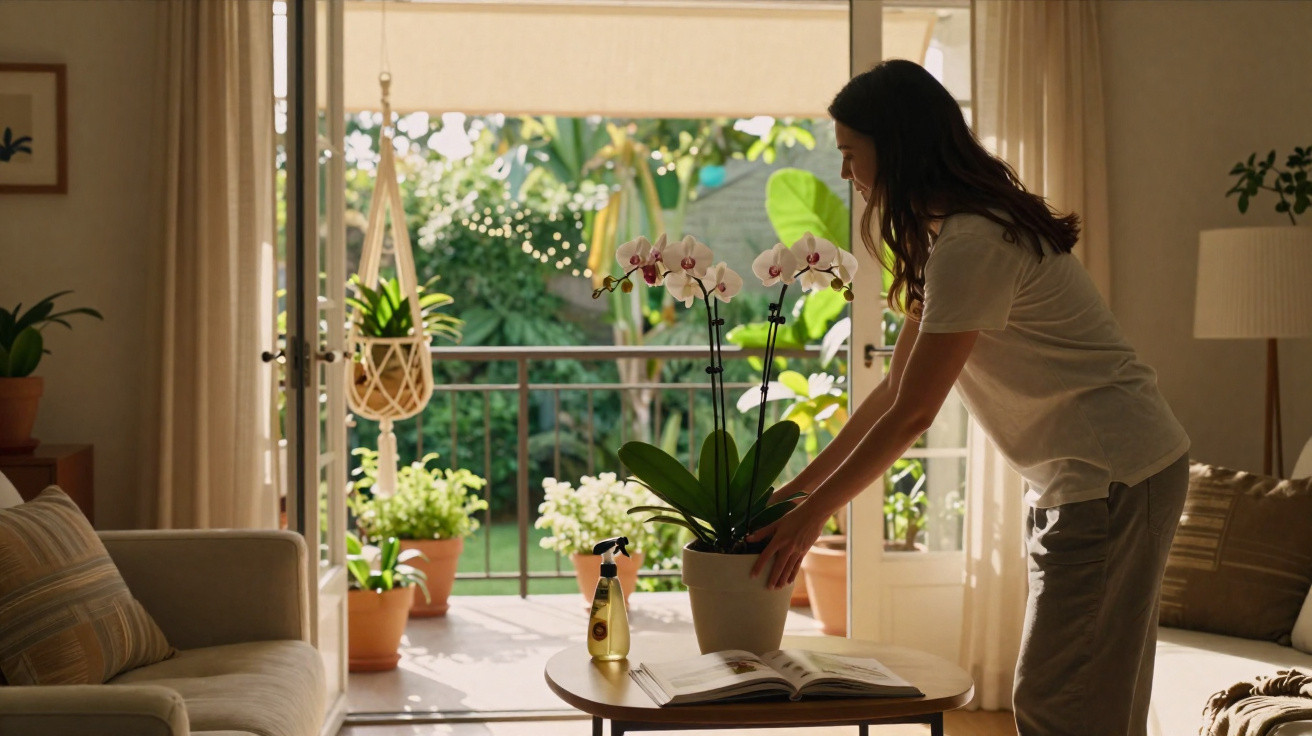
In countless living rooms, there is an orchid that was once magnificent but now produces nothing but green leaves. Its pot stays in the same spot, it receives the occasional splash of water, and eventually it is labelled difficult. Yet a look at its natural habitat reveals that fertiliser is not what it lacks: it needs the right location, which is often somewhere we would not expect.
Why orchids often stop flowering on the windowsill
The familiar moth orchids, botanically known as Phalaenopsis, originate in tropical forests. They grow high up in trees, surrounded by humid air and experiencing nights that are noticeably cooler than the daytime. Permanently heated homes have little in common with these conditions.
When an orchid remains in precisely the same position throughout the year, it does not experience any seasonal change. Temperatures generally stay around 20°C, both day and night. Dry air from central heating, often directly above a radiator, adds to the problem. In these circumstances, the plant may continue producing leaves but will rarely grow new flower spikes.
The most important trigger for new flower spikes is a noticeable difference between a warm day and a cooler night.
Temperatures of around 18–22°C by day and 12–15°C overnight are ideal. This drop in temperature tells the orchid that it is worth producing fresh blooms.
Light matters too: plenty, but never harsh
Light is the other key factor. Orchids need a bright setting, but cannot cope with fierce midday sun through a south-facing window. Conversely, when placed deep inside a room, far from a window, they effectively “starve” from lack of light.
- In direct, blazing sunlight at a south-facing window: leaves can quickly develop scorch marks.
- In the middle of a room, several metres away from a window: it is too dark and growth slows.
- At a bright east-facing window with gentle morning sun: conditions are ideal and leaves remain deep green.
If light and temperature hardly ever change, the orchid has no reason to invest energy in another flowering cycle. It survives, but it does not shine.
The unusual trick: move it out of the living room and into a summer basket
Finnish garden designer Sari Lampinen has shown for years just how simple an orchid’s “wake-up call” can be. Her method is to move the plant outdoors in summer. Not onto a table or into full sun, but raised up in a well-ventilated and carefully protected position.
She places her orchids, still in their pots, inside a hanging basket in the garden. The location is in bright shade, providing abundant light without exposing the leaves to harsh rays that could burn them. Rain may wet the plants, but standing water must never be left in the cachepot.
Outdoors, the orchid finally experiences what it misses in the living room: humid air, natural daylight and cool nights.
For many plants, this precise combination encourages new flower spikes after a few weeks. The contrast between daytime and night-time temperatures, along with changing breezes and humidity, is far closer to a tropical habitat than a heated corner of a home in winter.
When it makes sense to move an orchid outside
The ideal timing depends on the climate, although one rule of thumb is useful: take it outside once night-time temperatures are reliably above 10°C. As a guide:
| Period | Recommendation for keeping it outdoors |
|---|---|
| May | From the middle of the month in mild areas; otherwise, wait a little longer |
| June to August | Main outdoor season; keep it in the hanging basket as continuously as possible |
| Late August to September | Bring it back indoors once nights become distinctly cooler |
Those with only a balcony can create a similar effect. What matters is a sheltered site without fierce midday sun or constant rain, ideally beneath an overhang or on the shaded side of the building.
How to create the ideal summer position for your orchid
Existing materials are usually enough for a hanging location. You will need a secure hook, a basket or hanging container that allows good air circulation, and a cachepot that is as lightweight as possible.
- Put the orchid, still in its pot, into a well-ventilated hanging basket.
- Hang the basket high enough to keep slugs and other crawling pests away.
- Choose a bright position that is not in full sun, ideally dappled shade beneath trees or a roof overhang.
- Keep the growing medium lightly moist, while consistently preventing waterlogging.
During particularly wet weeks, it is worth checking after every shower. If water has collected in the cachepot, empty it. The roots are sensitive to prolonged dampness.
Care for the rest of the year: the right winter position
Once nights start turning chilly, bring the orchid back inside. It needs a bright spot without relentless direct sunlight. East-facing windows are especially suitable, while north-facing windows can also work if they have a genuinely unobstructed view outside.
A room that cools down slightly overnight is best, such as a guest room, bedroom or hallway with a window. Around 20°C during the day and 15–18°C at night is enough to keep the plant in flowering mode.
Keeping an orchid in a slightly cooler room during winter strengthens the effect of its summer stay in the fresh air.
Water sparingly. Many owners are too generous and practically drown the aerial roots. A better approach is to wait until the growing medium looks almost dry and the pot feels noticeably lighter when lifted.
What if you have no garden or balcony?
Even without outdoor space, this location trick can be adapted. An unheated conservatory, a bright stairwell or a little-used guest room can at least expose the orchid to greater temperature variations. Opening a window slightly on mild evenings helps as well.
- Use a bright east-facing or north-facing window.
- Turn the heating down slightly at night.
- Open windows regularly to introduce fresh air and small temperature shifts.
If you have a bathroom with a window, the orchid can be placed there temporarily. The higher humidity after showering benefits the plant, provided it still receives enough light.
Mistakes that put orchids off flowering
Many problems result from straightforward care mistakes. Three occur especially often:
- Constant heat: 23°C or more, day and night, directly above a radiator.
- Too little light: attractively displayed on a shelf but far from a window.
- Waterlogging: a cachepot filled with water, leaving little air around the roots.
Avoid these common errors and choose the location more deliberately, and you will often see significantly stronger flowering as early as the following year - without specialist fertiliser or complicated tricks.
Why this “unusual” orchid location works so well
Ultimately, an orchid responds only to signals that belong to its natural environment. Hot, dry air from central heating and light from a ceiling lamp are not among them. Humid air, fluctuating temperatures and daylight that gradually lengthens and shortens again are what its internal calendar follows.
A hanging basket outdoors imitates that calendar remarkably well. The plant senses the wind, shifting leaf shadows, daytime warmth and cooler air after sunset. All of this releases hormones that signal one thing: every new bloom is worthwhile.
Once you understand this principle, you can vary the location creatively. Some people combine an outdoor summer basket with a cool winter position in the bedroom. Others use a shaded balcony and intensify the winter light stimulus with a grow light at an east-facing window. In both cases, the fertiliser in the watering can matters less than one central question: is the orchid positioned where it can genuinely tell day from night?


Comments
No comments yet. Be the first to comment!
Leave a Comment