
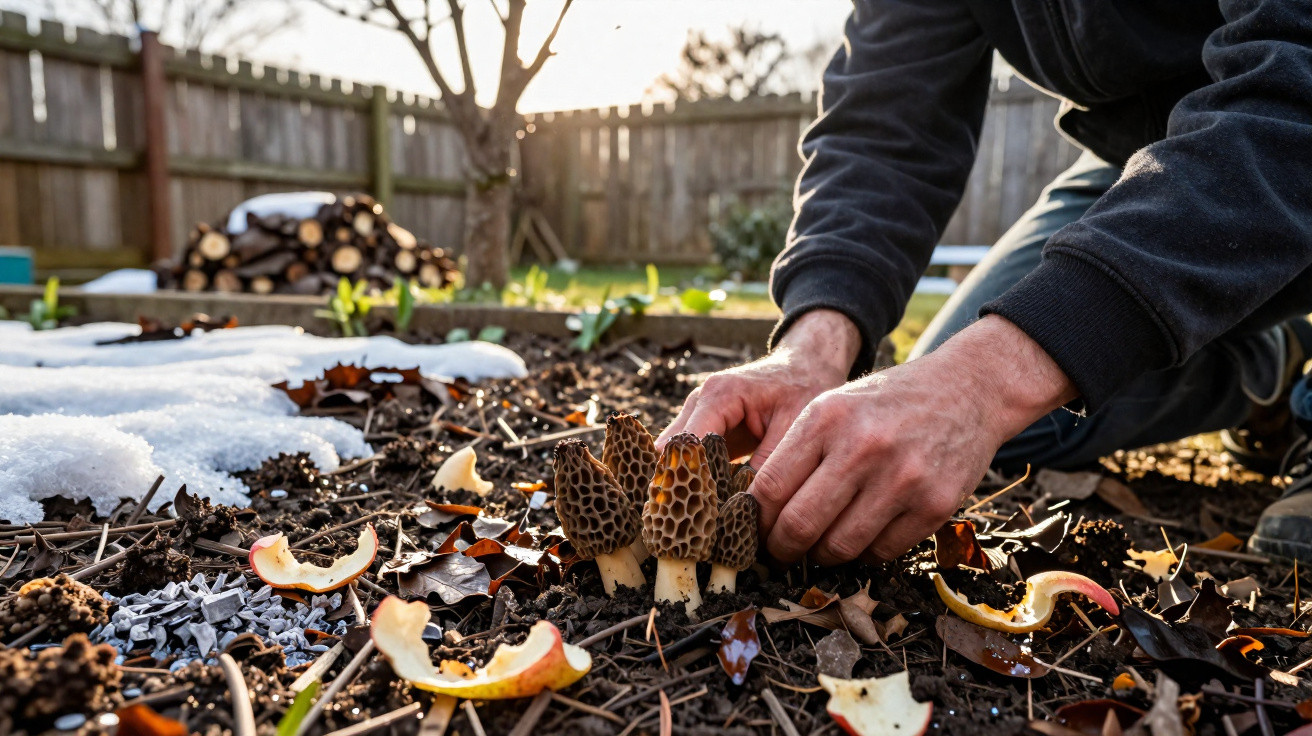
Morels are often treated as the holy grail of edible mushrooms: scarce, expensive and seemingly temperamental. Many amateur gardeners have already written off the idea of cultivating them. Yet a humble kitchen by-product, paired with fireplace ash, suggests something different: with a bit of forethought, you can markedly improve your odds in your own garden.
Why morels are so sought-after - and so difficult to find
Morels are spring mushrooms with a nutty flavour that are prized in fine dining. At farmers’ markets they can easily fetch €80 to €150 per kg, depending on quality and the season. At the same time, they’re notoriously hard to come by in the wild. Most people who wander through woods in March or April end up going home with an empty basket.
There are biological reasons for this. Morels fruit only when several conditions line up precisely:
- slightly calcareous, well-drained soil
- a semi-shaded spot with a layer of leaf litter
- consistent, fairly fine soil moisture
- a clear temperature shift from winter into spring
If even one of these building blocks is missing, the would-be morel patch stays empty. For a long time, mushroom enthusiasts concluded that morels were practically impossible to cultivate on purpose.
"Research shows: morels aren’t moody - they simply respond very consistently to their environment."
The unexpected key: fireplace ash and apple leftovers
More recent work in agricultural mycology points in another direction. It indicates that you can, in fact, create morel beds in a garden - provided the ground is prepared correctly. Two materials that many households already have to hand play a central part: wood ash from a stove or fireplace, and apple pomace, for example from home juicing.
Wood ash raises soil pH. Morels favour a slightly alkaline range of around 7.5 to 8. Apple pomace contributes readily available carbohydrates such as fructose and pectin. Together, this pairing encourages the underground fungal network (the mycelium) to form what are known as sclerotia: small, compact storage nodules from which the coveted fruiting bodies can shoot up in spring.
Choosing the right spot in the garden
Before you start thinking about ash and apple scraps, you need an appropriate location. The best places are those that won’t bake bone-dry in summer, but also won’t sit waterlogged.
Suitable areas at a glance
- beneath mature apple or pear trees
- on the edge of an open, lightly planted orchard
- near a hedge where leaves fall, but without standing water
- on naturally chalky ground (for example, in areas with hard tap water)
A patch where you can leave autumn leaves in place is particularly helpful. The leaf layer acts as a natural blanket, shielding the mycelium and holding moisture.
Step-by-step: how amateur gardeners can create a morel patch
If you want to encourage morels in your garden, the ideal time to begin is autumn, as trees start to drop their leaves.
1. Prepare the soil
Start by gently loosening the chosen area without digging deeply. Remove stones and thick roots if needed, but fine root remnants can stay in the ground. One key point: you shouldn’t be constantly walking over this spot later on, so plan the patch near the edge of a bed rather than across a route.
2. Work in apple pomace and leaves
Next comes the kitchen or juicing waste. These options are particularly suitable:
- pomace from freshly pressed apples
- leftover apple purée (no added sugar, diluted slightly)
- finely chopped apple peelings and cores
Spread it over the area to about finger thickness, then mix it with a thin layer of leaves. This creates a loose organic mat that provides food for the fungus.
3. Add wood ash
Now for the crucial part: sprinkle a 2 to a maximum of 3 cm layer of cold, pure wood ash evenly across the surface. It should come from:
- untreated firewood burned in a fireplace
- a wood-burning stove with no painted wood or chipboard residues
- a garden fireplace using natural, untreated logs
Ash from barbecue briquettes, paper, or painted/varnished timber is unsuitable. It may contain heavy metals and can damage the soil.
"Wood ash creates the lime-rich ‘burn site’ where morels are naturally especially common."
4. Introduce morels or mycelium
For the fungal network to take hold, the soil needs a starter culture. Several approaches are possible:
- In autumn, crumble overripe or worm-eaten morels and work them into the top layer.
- Rinse morels in water and pour the rinse water over the prepared patch.
- Use a commercially available morel mycelium kit and set it up according to the instructions.
Afterwards, cover everything with a thin layer of leaves or fine bark mulch. This cover helps prevent drying out and offers protection from winter frost.
What happens in the months that follow
From the outside, the patch looks unremarkable throughout winter. Beneath the surface, however, the mycelium can be very active. In the best case, lots of sclerotia form during the cold season. The combination of apple pomace and alkaline soil provides exactly the energy impulse the fungus needs to build these reserve structures.
To support that process, soil moisture must stay even. It should never dry out completely, but it also shouldn’t form puddles. In low-rain winters, occasional careful watering can be worthwhile.
The “snowmelt trick” in spring
Between late February and early April, depending on where you live, the temperature shift becomes decisive. Across many trial series, one pattern emerged: an artificially triggered cold stimulus can prompt morels to produce fruiting bodies.
A practical method:
- On a mild spring day, water the area generously with very cold water.
- The water should be almost straight from the fridge.
- Soak the soil thoroughly without turning it to sludge.
This “temperature shock” mimics snowmelt in natural morel habitats. Over the following weeks, it pays to keep a close watch: between March and May, if conditions are right, the distinctive honeycomb-like caps may suddenly appear in the mulch.
How long does it take for the first morels to appear?
Anyone hoping to establish morels in a garden needs patience. Even with excellent preparation, you may see nothing in the first year. Many patches only produce their first mushrooms in the second season, once the morel ecosystem has settled in.
| Period | What typically happens |
|---|---|
| Autumn | Set up the patch, work in apple pomace and ash, introduce mycelium |
| Winter | Mycelium spreads, sclerotia form in the soil |
| Spring Year 1 | First morels possible, but no guarantee |
| Spring Year 2 | Much higher likelihood, stable morel patch |
When harvesting morels, cut them off just above ground level. That way, the mycelium remains undisturbed in the soil. Do not dig the bed over.
Maintaining the patch long-term
To keep a morel patch productive over the years, give it a small “refresh” each autumn:
- add a thin layer of fresh apple leftovers
- dust with a little wood ash - only a few millimetres
- cover again with leaves or fine mulch
This keeps the soil slightly alkaline and topped up with organic matter. If you have an orchard, it’s easy to combine this approach with the prunings and leaf litter you already generate.
Risks, limitations and sensible precautions
Even with careful preparation, success is never guaranteed. Morels are sensitive to weather extremes. Prolonged spring drought or very wet winters can hold back fruiting. On top of that, not every region naturally offers suitable soil conditions, even with ash added.
If you use wood ash, apply it sparingly. Too much can make the soil overly alkaline and harm other plants. It’s better to increase gradually, and on very sandy soils it may be worth considering a soil test beforehand.
One more point: only cook and eat morels if you can identify them with confidence. Confusion with poisonous false morels is possible. When in doubt, consult a qualified mushroom expert or a local mycological society.
What else makes morels interesting for the garden
Morels aren’t just a luxury ingredient for the frying pan. Their mycelium binds roots and soil particles, can improve soil structure and water retention, and helps create a more stable microclimate in a bed. Encouraging fungi in this way complements many sustainable gardening practices, including mulching, composting and avoiding heavy cultivation.
If you already have apple pomace, fallen leaves and fireplace ash available, a morel patch is also a smart form of re-use: waste stays out of the bin and instead becomes a nutrient-rich habitat - one that, in the best case, yields a very exclusive mushroom treasure every spring.
Comments
No comments yet. Be the first to comment!
Leave a Comment