
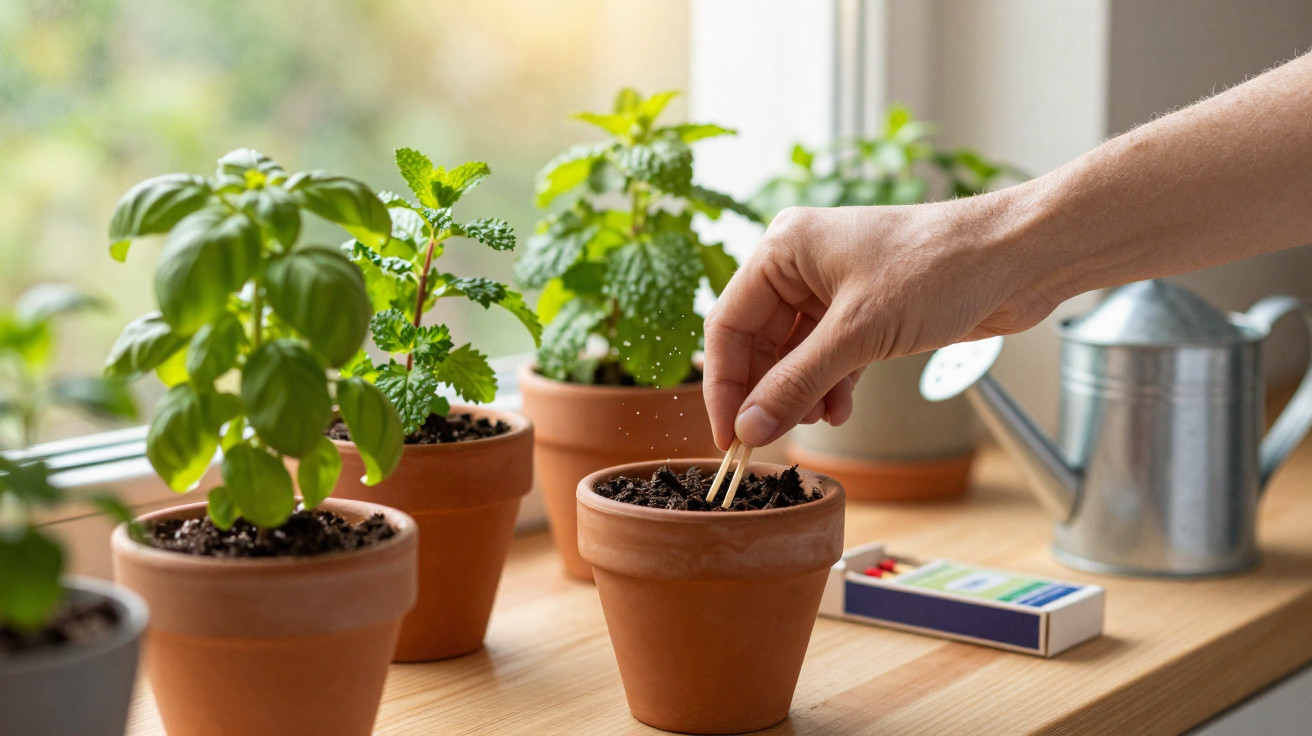
Anyone who dotes on their houseplants will recognise the tell-tale nuisance: out of nowhere, tiny black flies lift off from the potting mix, gather on the windowpane and make watering feel like a battle. In many garden centres and florists, you’ll spot an unremarkable detail when this happens: matchsticks pushed into the compost. It isn’t superstition at all, but a tried-and-tested anti-gnat approach you can replicate at home-provided you understand what’s going on.
What’s actually flying: fungus gnats, not fruit flies
Most people initially assume they’re fruit flies. In reality, the pests coming from plant pots are almost always fungus gnats-more precisely, Sciaridae. They’re dark, slim insects that tend to sit on the surface of the compost and around the rim of the pot.
The real harm isn’t caused by the adults you see flying. The damage comes from their larvae, which live in the top, damp layer of the compost and feed on fine root tips. That weakens the plant and, over time, can slow growth.
Fungus gnats love it damp, warm and organic-wet, old potting compost is like a gourmet buffet to them.
Typical signs of fungus gnats in the compost include:
- When you move the plant, small black flies rise up from the surface.
- The top of the compost stays persistently wet and feels slightly slimy.
- Young plants or potted herbs look limp even though they’re being watered.
Why florists push matchsticks into the compost
In many greenhouses and shops, florists place matchsticks into the pot with the head facing downwards. No insect spray, no chemical fog-just a few wooden sticks in the compost. The method has been passed around among professionals for years because it works quietly in the background and is relatively gentle on the plant.
What matters is what the match head is made of. It typically contains:
- sulphur
- potassium chlorate
- red phosphorus
- sometimes other additives in very small quantities
When you water, tiny amounts dissolve at the surface of the compost. The sulphur affects the microflora in the top few centimetres-exactly the zone where fungus gnat larvae live and feed.
The idea: the compost becomes slightly unpleasant for larvae and egg-laying, without directly harming the houseplant.
The biology behind this is straightforward: female fungus gnats prefer to lay eggs in compost that stays wet and is rich in organic matter. If the micro-environment shifts, they’re less inclined to remain and lay more eggs. Any larvae already present are also put under pressure, as their habitat becomes less inviting.
How to use the matchstick trick properly in a plant pot
Start by checking that fungus gnats are genuinely the issue. Gently shake the foliage. If small black insects lift off just above the compost, it’s a strong sign. And if the surface feels cool and tacky, excess watering is usually part of the problem.
Step-by-step instructions for small to medium pots
For a pot measuring about 15 cm in diameter, this approach has proved effective:
- Push 3 to 5 matchsticks head-first about 1 cm into the compost around the edge.
- Space them evenly in a circle, rather than placing them right next to the plant’s stem.
- Lightly loosen the top layer with a fork so it dries out more quickly.
- Empty the saucer after watering so water can’t sit underneath.
Many florists replace the matchsticks regularly over a period of about two weeks. That helps maintain the effect across a full larval development cycle.
Comparing two common “dosages”
| Method | Number of matchsticks | Duration | Use case |
|---|---|---|---|
| “Professional version” | 3–5 per 15-cm pot | Replace every 3 days, total approx. 15 days | In nurseries and flower shops |
| “Home version” | 8–10 around the edge, half-buried | Replace weekly, total approx. 3 weeks | At home when the infestation is heavier |
If your plant reacts badly-for example, leaves suddenly turning yellow or growth stalling-remove the matchsticks and aerate the compost well. Not every houseplant tolerates the same level of change in the top layer.
Without good watering habits, even the best trick won’t help
The matchstick method works best when you also tackle the underlying cause: too much water. Compost that remains wet is an ideal nursery for fungus gnats, regardless of what you put into it.
Keep these points in mind:
- Use a pot with a drainage hole, not a sealed container.
- Add a drainage layer of expanded clay pellets or gravel.
- Only water again once the top layer of compost has dried noticeably.
- Avoid standing water in the saucer every time.
Without an adjusted watering routine, any trick is only a short-lived effect-the gnats will otherwise return.
Another common pitfall is mixing them up with fruit flies, which mostly hover around fruit bowls. Fruit flies rarely sit directly on the compost of houseplants. If you confuse the two, you may end up looking for the cause in the wrong place.
Safety and sensible add-ons to the matchstick trick
Matchsticks should only ever go into the compost unlit. Burning match heads have no place in a plant pot, not least because of fire risk. Store the box out of children’s reach. In homes with cats or dogs, a light mineral mulch-such as fine gravel-can help stop pets digging in the compost or chewing on the sticks.
If you want to boost the overall effect, combine a few simple measures:
- A thin layer of fine sand on the surface makes it harder for larvae to reach the top.
- Yellow sticky traps catch adult fungus gnats and reduce egg-laying.
- When you next repot, replace old, heavily compacted compost completely.
- Only use coffee grounds fully dry and sparingly; never mix them in while damp.
Some hobby growers occasionally water with a heavily diluted hydrogen peroxide solution or a mild soapy mix. It’s best to trial those experiments on a less sensitive plant first to avoid damage.
Why potted herbs are so often affected
Potted basil, in particular, often suffers from fungus gnats. It’s usually kept in a warm kitchen, watered frequently, and may end up sitting in a sink full of water. That exact set-up turns the pot into an ideal breeding site.
Florists report that, especially with herb pots like these, a combination of improved watering, matchsticks placed around the edge, and a lightly loosened surface can noticeably calm the situation within a few days. The plant looks fresher, new shoots appear more quickly, and far fewer gnats rise up when you pick the leaves.
How to prevent fungus gnats in future
If you’ve dealt with a serious fungus gnat problem once, the priority is stopping them from moving back in. A few simple habits can help:
- Keep new plants separate from the rest for a few days and monitor them.
- Repot cheap, waterlogged supermarket plants into fresh, loose compost as soon as possible.
- Keep potting compost airy and don’t fill pots right up to the rim.
- Water far more sparingly in winter, as plants use less.
In ornamental plants, fungus gnats are generally more annoying than truly dangerous, but they can severely hold back seedlings, cuttings and sensitive varieties. A simple technique like placing matchsticks strategically can give you an advantage-as long as basic care is right and the pot isn’t left standing in water.
Comments
No comments yet. Be the first to comment!
Leave a Comment