
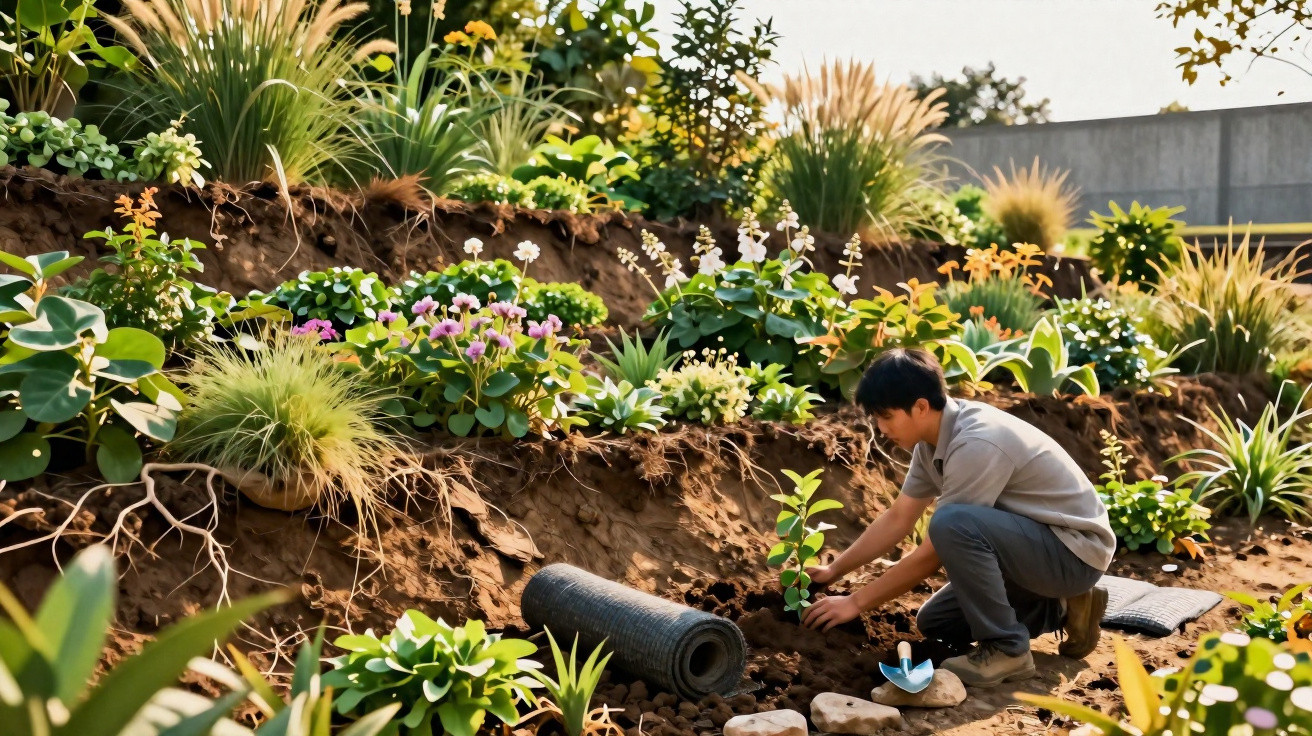
With the right planting, the whole scene changes.
Instead of paying for an expensive retaining wall, more and more garden professionals are relying on plants that hold the soil together like a net-while looking like a colourful cascade of flowers. With a well-thought-out plan, you can achieve this for well under €20 per square metre, and you gain more wildlife, less erosion and a feature that looks better year after year.
Why a planted slope is often better than concrete
A bare earth bank doesn’t just look bleak. Rain cuts channels into it, soil creeps downhill towards a path or the house, everything turns dusty in summer, and in winter it becomes a slippery mess. The classic response is to design a retaining wall, gather quotes, then wince at the cost. For a built wall, €150 to €300 per square metre is easily on the table.
Garden and landscape contractors are increasingly choosing a different approach: so-called soil bioengineering planting. Plants take over the job that concrete used to do. Roots knit the soil together, foliage slows raindrops, the slope doesn’t dry out as aggressively, and it keeps its shape.
“Properly planned planting stabilises many slopes for under €20 per square metre – including a sea of flowers.”
There’s more to it than stability. A greened slope protects the soil, supports tiny organisms, gives insects and birds food and shelter, and lets rainwater soak in rather than dumping it into drains all at once.
Phytostabilisation: how plants pin a slope in place
In technical terms, the principle is called phytostabilisation. The concept is straightforward: shallow-rooting, heavily branched plants thread through the ground as a three-dimensional root mesh. That mesh works like natural reinforcement.
In practice, the most reliable choices are tough, mat-forming perennials and dwarf shrubs, for example:
- creeping St John’s wort (millepertuis-type cultivars)
- low-growing cotoneaster (Cotoneaster)
- groundcover roses
- periwinkle (Vinca cultivars-evergreen flowering plants for shadier spots)
- various sedums (stonecrop)
Dense foliage absorbs the impact of raindrops. Where water used to carve proper runnels, it now hits a leafy canopy, trickles down slowly, and stays in the ground.
How to plant a difficult slope properly
Professionals stick to a clear pattern: fewer species, but planted densely and in groups. That creates a calmer look, and the roots interlock more effectively.
Basic planting rules:
- Prepare thoroughly: remove weeds, pick out large stones and old roots, loosen the soil-but don’t pulverise it into fine dust.
- Plant spacing: allow for 4 to 5 plants per square metre. Plant in groups of 6–7 of the same species to create a full, continuous coverage.
- Staggered layout: position plants in a zig-zag (quincunx) so roots spread evenly across the bank.
- Mulch immediately: cover the newly planted area with coarse woodchip or a woody mulch (for example ramial chipped wood) that won’t slide downhill.
From a steeper pitch-roughly from about 15 percent-an extra trick helps: add a layer of jute fabric or coconut-fibre matting. Lay it over the soil, peg it down, and cut cross-shaped slits. The plants go into these openings. The material decomposes slowly and gives the bank support during the vulnerable establishment phase.
Good planting windows are autumn from mid-September to the end of November, or spring between March and April. In these periods, plants root in more reliably without struggling through intense heat or hard frost.
Three tiers: how to create the flowering cascade
A slope that’s both stable and attractive works like a small, stepped ecosystem. Rather than planting the same thing everywhere, it pays to think in three zones: top, middle and bottom. Each has different conditions-and needs different plants.
Upper zone: heat-tolerant structural plants
Right at the top it’s often driest and windiest. This is where robust structural plants come into their own. They form the framework, add height and guide the eye.
Suitable options include, for example:
- ornamental grasses such as fountain grass and blue fescue
- small, drought-tolerant shrubs such as Ceanothus cultivars or box substitutes
- germander (Teucrium) for silvery foliage and crisp shapes
- spindle (Euonymus species) for structure and winter greenery
- broom species that cope well with poor soils
Once established, these shrubs and grasses generally need only occasional pruning and, in the first few years, some water during dry spells. They give the slope a natural, slightly wild look that’s currently in high demand.
Middle zone: strong groundcover against erosion
The middle is where erosion bites hardest. Here, the planting should be dominated by plants that make broad cushions, close over quickly and produce lots of roots.
Popular choices include:
- coral bells (Heuchera) for colourful foliage
- lamb’s ear (Stachys) for bold leaves
- sedum and fleabane (Erigeron) as undemanding long-flowering plants
- baby’s breath (Gypsophila), rock-garden forms, for airy clouds of flowers
- St John’s wort varieties and compact privet for more woody structure
This zone carries the main load in heavy rain. When planted densely, it forms a buffering layer that absorbs water and releases it evenly. Bare patches are off-limits in this tier-left open, they quickly become fresh channels.
Lower area: use moisture instead of fighting it
At the foot of the slope, water and nutrients collect. Here, plants can be a little more delicate-while rewarding you with stronger colour.
Well suited:
- alyssum species with yellow or white carpets of flowers
- cushion bellflowers (Campanula)
- scented violets
- sedum and fleabane (Erigeron) again, to visually and ecologically link back to the upper zones
Large stones or smaller boulders add extra stability here. They break the slope into mini-terraces, hold back soil and create fresh planting pockets.
Practical example: a slope settles down in two seasons
A common scenario looks like this: a bank of around 30 degrees by the house, exposed to heavy rain, regularly revealing roots and sending soil towards the patio. The first thought is often an expensive wall. In one real case, a gardener instead used groundcovers such as periwinkle (Vinca) and creeping bugle (Ajuga), combined with jute matting and coarse woodchip.
With careful planning, the costs stayed clearly under €20 per square metre. After two growing seasons the outcome was obvious: the slope was fully covered, rainwater soaked into the ground, and the feared mudslides didn’t happen. At the same time, the area looked like a naturally established wildlife garden.
Limits, risks and sensible combinations
Plant-based stabilisation does have limits. On extremely steep banks or very large areas, planting alone can be overwhelmed. In those cases, professionals often take a two-track approach and combine plants with light structural elements:
- low dry-stone walls
- gabions that are planted up
- small terrace steps made from timber or stone
- pre-formed planting rings filled with perennials and shrubs
Particularly tricky situations include sandy soils or ground that is severely compacted. Here, a stable base with jute or coconut matting in the first year is close to essential. If you can see clear cracks, sections are slipping, or the slope sits near building foundations, a specialist should assess the site before any work begins.
What hobby gardeners should also bear in mind
Doing it yourself can save money, but it’s important not to cut corners in the wrong place. Using fewer plants per square metre may look cheaper at first, but it leaves bare soil exposed for longer-giving erosion time to return. Early watering is also non-negotiable: in the first weeks after planting, it’s better to water thoroughly once than to keep giving small amounts.
The ecological pay-off is worth noting too. A varied, well-planted slope attracts wild bees, butterflies and birds. If you choose species that provide nectar and pollen, you create-alongside the stabilisation-a small stepping stone for biodiversity in built-up areas.
If you’re unsure which plants suit your soil, aspect and local climate, use regional planting lists or take advice from local nurseries. They know what genuinely performs in your area-and help ensure that a budget-friendly slope doesn’t need starting again in five years.

Comments
No comments yet. Be the first to comment!
Leave a Comment