
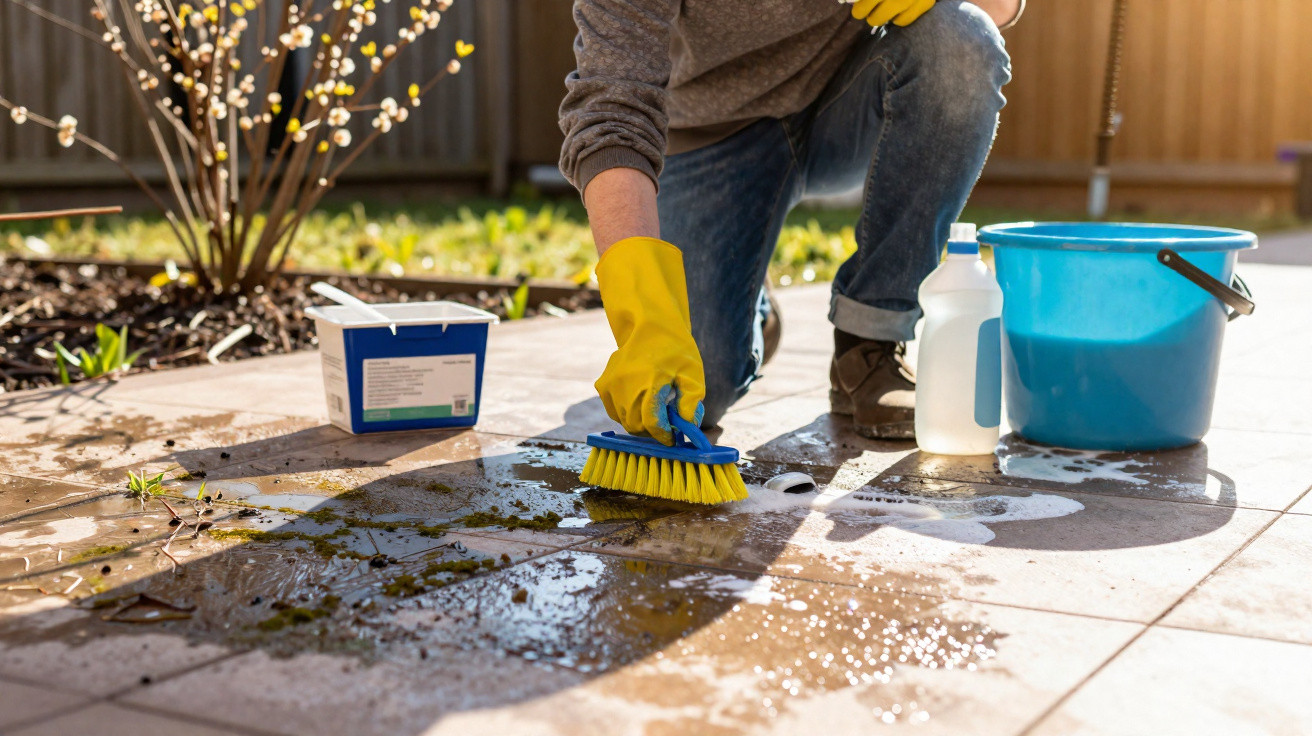
When you finally want to drink your first coffee outdoors after winter, the patio often brings you back down to earth: a green haze, dark marks, rusty rings beneath chair legs. Many people instinctively reach for chlorine, vinegar or a noisy pressure washer. There is a tried-and-tested approach, though: with two straightforward cupboard staples, paving comes up clean again - without vinegar and without destroying the joints.
Why the terrace looks so dirty after winter
Rain, frost and a lack of sunshine take their toll on any terrace. Paving stones and slabs hold on to moisture, and algae, moss and lichen settle in the pores. The familiar green film builds up gradually, but it often only really stands out on a bright spring day.
On top of that, you may see brown or orange edging - for example under garden furniture legs or plant pots. That’s where rust or tannins washed out of wood can show through. If you like barbecuing in summer, you’ll also be dealing with grease and soot residue on the paving. Together, it creates that classic “tired terrace” look after the colder months.
"Instead of blasting the terrace at full pelt every year, it’s worth taking a gentle but effective approach - one that protects stones, joints and beds."
Why many experts advise against vinegar and constant pressure washing
Reaching for the pressure washer is tempting: the grime visibly disappears and the result is immediate. The downside tends to appear later. Strong water pressure can roughen the stone surface and wash jointing material out. Water then sits in the opened pores, new dirt sticks more quickly, and algae returns more easily. On older terraces, slabs can end up rocking - or even cracking.
Vinegar is often marketed as “natural”, but it is still an acid. On sensitive natural stone, it can leave dull, bleached patches. If vinegar water repeatedly runs into nearby beds or the lawn, it may shift the soil pH and stress plants.
Chlorine cleaners and aggressive descalers are even more problematic. They attack jointing mortar, can affect nearby metals, and place a burden on soil and groundwater. If you have pets or children playing in the garden, you likely won’t want those residues lingering outdoors.
The two-product trick: washing soda and washing-up liquid
A straightforward alternative relies on two familiar household helpers: washing soda (soda crystals) and ordinary washing-up liquid. Both are inexpensive, available in any supermarket or chemist, and easy to dose.
What washing soda does on a terrace
Washing soda - often sold as soda crystals - is usually used as a laundry booster. It’s alkaline and helps break down grease, grime films and organic deposits. On terraces, it helps lift the green film and general crusting from the surface of the paving.
- breaks down greasy and organic dirt
- softens layers of algae and grime
- is significantly milder than many specialist cleaners
- costs only a few pounds per pack
Important: washing soda is not the same as caustic soda (sodium hydroxide). Caustic soda is highly corrosive and does not belong on paving slabs - or in untrained hands. When buying, the packaging should clearly say “washing soda” or “soda crystals”.
Why washing-up liquid is the perfect partner
Washing-up liquid brings its well-known degreasing power. It cuts through oily residue from barbecue grease, soot or road dust and supports the soda as it loosens dirt. A simple, colourless washing-up liquid without bleaching additives is perfectly sufficient. Many people now deliberately choose eco-friendly options to reduce the impact on soil and plants around the terrace.
How to clean it step by step
For a spring deep clean, you don’t need professional kit. A sturdy yard broom or scrubbing brush, a bucket, a hand joint scraper (or an old knife) and a garden hose are enough.
- Clean out the joints: First, scrape weeds and moss from the joints. This stops roots spreading further and lifting slabs.
- Sweep away loose debris: Brush the whole area thoroughly. Remove leaves, sand, small twigs and loose soil so the cleaning mix can reach the stone properly.
- Dampen the terrace: Use the hose to wet the slabs evenly. Soda crystals dissolve and work better on a damp surface.
- Sprinkle on the soda: Scatter a thin layer of soda crystals over the wet area - you don’t need half the packet; a light dusting is enough.
- Add washing-up liquid: Apply washing-up liquid sparingly. A few streaks or squirts spread across the terrace will do.
- Work it in: Scrub firmly over the slabs. The soda-and-washing-up-liquid mix forms a light film that settles into pores and joints.
- Leave it to work: Let the area sit, ideally for one to two days. Rain isn’t a problem as long as the mixture isn’t completely washed away.
- Rinse thoroughly: Finally, rinse again with the hose until no foam remains.
"If you give the mixture time, you get a double benefit: the dirt lifts from deep within the surface without having to scrub for hours."
Important safety and material tips
Even though washing soda and washing-up liquid are considered relatively gentle, a few basic rules help keep both paving and garden in good condition.
- Protect your skin: Washing soda can irritate skin. It’s best to wear household gloves and avoid touching your face.
- Keep children and animals away: While the surface is wet, children and pets shouldn’t walk over it. After rinsing, it’s not an issue.
- Test the material: With pale or very sensitive natural stone, test a small, inconspicuous corner first to rule out discolouration.
- Avoid wire brushes: Metal scrapers and coarse wire brushes can scratch stone and leave unattractive dark streaks.
How much washing soda is sensible?
More isn’t better here. A thin layer on a damp surface is enough - or mix a bucket of warm water with a few tablespoons of washing soda and a little washing-up liquid. If you apply too much, you’ll create unnecessary foam and will need more water to rinse everything off.
How to keep the terrace cleaner for longer
Once the spring clean is done, you can keep effort low through the year. The key is stopping the green film from building up in the first place.
- sweep briefly every one to two weeks
- don’t leave wet leaves and petals lying around
- move plant pots now and then to prevent rings
- mop up barbecue grease as soon as possible rather than letting it dry on
Many terrace owners find it works well to repeat a lighter version of the two-product clean in autumn. That way the area goes into winter relatively clean, algae has less to feed on, and the spring job becomes much easier.
When a pressure washer can still make sense
A pressure washer doesn’t need to be banned entirely. Very muddy areas - for example on driveways or after building work - can be cleared more quickly with one. On solidly laid concrete block paving with intact joints, cleaned only every few years, it is usually unproblematic.
The key points: reduce the pressure, use a wider fan spray, don’t get too close to the stone or the joints, and don’t “mill away” at the same spot. If you notice sand being flushed from the joints, stop and switch to the gentler soda-and-brush method.
Further practical tips for different terrace surfaces
A terrace isn’t always the same. Depending on the material, it’s worth adjusting your approach slightly:
| Material | Tip |
|---|---|
| Concrete paving slabs or flags | Ideal for the washing-soda-and-washing-up-liquid method; robust and easy to maintain. |
| Brick and clay pavers | Porous and absorb lots of water - allow the mixture to work, but rinse very thoroughly. |
| Fine natural stones (e.g. sandstone) | Always do a test patch first, use a soft brush, and avoid any high-pressure attachment. |
| Coated slabs | Check the manufacturer’s guidance, as some coatings can react sensitively. |
If you’re not sure what material has been laid, take a photo and ask at a DIY shop. With very smooth, premium stone in particular, a quick bit of advice is worthwhile before cleaning a large area.
How to combine the method with other garden jobs
Many homeowners schedule terrace cleaning alongside the usual spring jobs: washing garden furniture, preparing beds, and the first mow. It’s easy to combine. While the soda-and-washing-up-liquid mix is doing its work on the paving, you’ll have plenty of time to rinse chairs and a table or plant up window boxes.
If you collect rainwater, you can use water from the butt for the final rinse. It saves mains water and is more than adequate for washing the remaining cleaning solution off the surface.
Comments
No comments yet. Be the first to comment!
Leave a Comment