
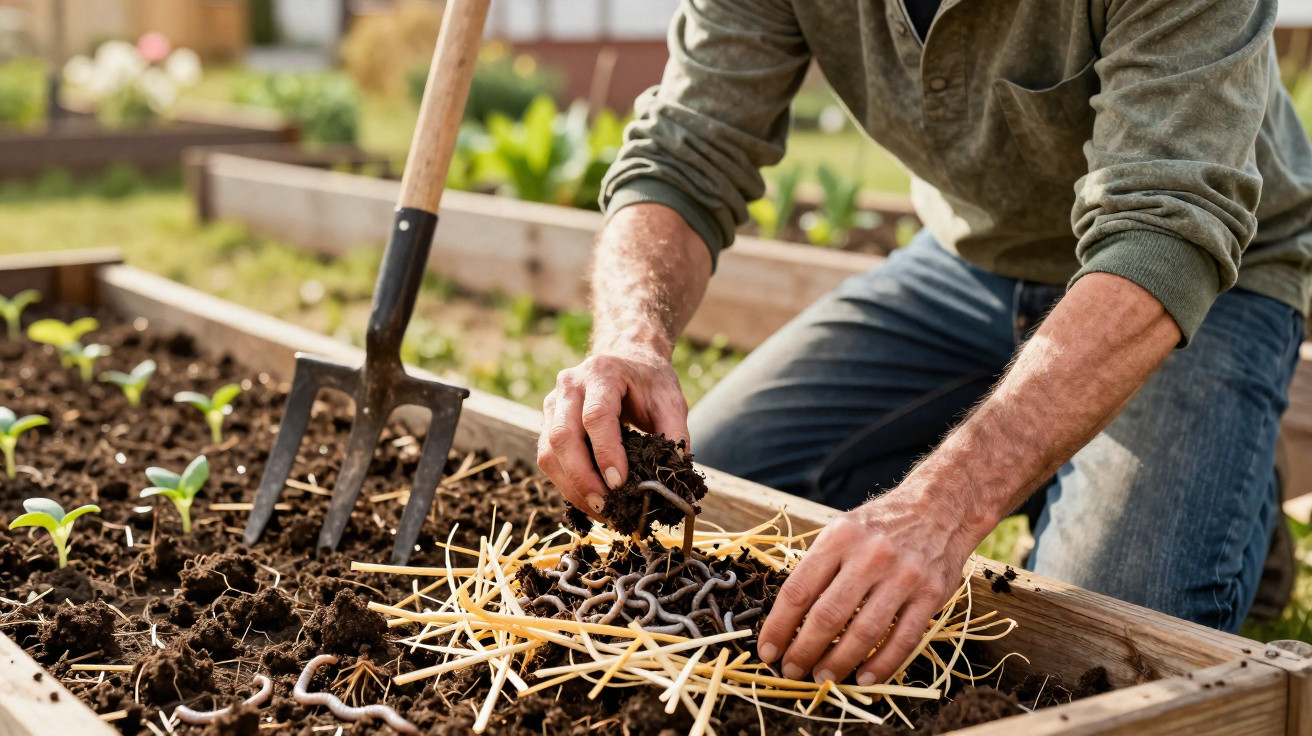
For generations, thoroughly digging over the vegetable patch in spring has been treated as a non-negotiable date in the gardening diary. If you didn’t turn your beds upside down, you were almost seen as careless. However, newer findings from soil science suggest the opposite: this habit breaks up living structures underground, leaves plants weaker, and often creates more work in the long run than it ever saves.
Spring digging over: a tradition with side effects
The familiar routine goes like this: after winter the beds sit bare, the spade is ready, and once the first mild days arrive you flip the soil over, clod by clod. The intention sounds sensible-loosen the ground, get rid of weeds, and make the plot look “tidy”.
That’s exactly where the trouble starts. Soil isn’t a lifeless growing medium that can be mixed at will. It is much closer to a multi-storey city packed with millions of inhabitants-and every “floor” has its own conditions and its own community.
"In a single gram of healthy soil there are hundreds of millions of bacteria, plus fungi, nematodes, tiny arthropods and earthworms – a dense, delicate network."
When you churn everything up with a spade, you tear that network apart. You won’t necessarily see the damage immediately-but the plants tend to make the consequences clear as the season unfolds.
What actually happens below the surface when you dig
In the top few centimetres of soil, organisms are adapted to light, oxygen and fluctuating temperatures. Further down live species that cope with low oxygen and prefer stable conditions.
Traditional digging flips that whole arrangement over:
- Organisms from deeper layers end up on top and die because they can’t handle oxygen and UV light.
- Creatures from the surface are pushed downwards, where they starve or suffocate.
- Fine earthworm tunnels collapse, reducing aeration.
There’s also a factor many people overlook: fungal networks in the soil, known as mycorrhiza. These ultra-fine threads link roots to nutrients and can multiply a plant’s effective root area many times over.
Deep digging snaps those connections with every spadeful. Plants then begin the season as if they’ve lost part of their “extended root system” before they’ve even got going.
Grelinette instead of a spade: gentle loosening for living soil
One practical way out of this dilemma is a tool that’s still relatively uncommon in the UK but has huge potential: the broad digging fork, often called a Grelinette after its French inventor.
It has two or more sturdy tines and a cross handle. You push it straight into the soil, pull the handle slightly towards you, and lift the ground only a little-loosening it without turning it over.
"The layers largely stay where they are; the soil is loosened, not turned on its head."
This approach is particularly helpful for older gardeners:
- it’s kinder on the back because there’s no heavy lifting and throwing
- the motion is more like levering than hoisting
- you can work larger areas at a steady, unhurried pace
Timing matters. The soil should be slightly moist. If it’s powder-dry, clods shatter and the tines take a beating. If it’s wet, the soil smears and compacts again as you walk on it. A good moment is typically the day after a decent spring rainfall.
Mulch layer: a protective blanket instead of bare soil
Handling the soil surface is at least as important as gentle loosening. In nature you almost never find naked soil-it dries out, overheats and is easily washed away by rain. Exactly the same thing happens in the garden.
A mulch layer-a cover of organic material-copies the conditions of woodland soils. Suitable options include:
- straw or hay (ideally unsprayed)
- shredded, dry leaves
- dried lawn clippings applied in thin layers
- woodchips or pieces of bark for paths and around shrubs
This cover delivers several benefits at once:
- It holds moisture in the soil, cutting watering noticeably.
- It slows the germination of unwanted plants.
- It shields soil life from heat and heavy rain.
- It gradually feeds earthworms and microorganisms.
Over time, the mulch moves downwards: worms pull material into their tunnels, while fungi and bacteria break it into ever smaller pieces. In the end, humus forms-the foundation of a crumbly, fertile soil.
What soil biology really does
For a long time, soil was mainly viewed as a storehouse for water and mineral fertiliser. Research from recent decades paints a very different picture: plants are in constant exchange with microorganisms around their roots.
Examples:
| Organisms | Function in the soil |
|---|---|
| Bacteria | convert atmospheric nitrogen into forms plants can use and break down residues |
| Mycorrhizal fungi | extend root reach and supply nutrients in exchange for sugar solution from the plant |
| Earthworms | loosen the soil, incorporate organic material and excrete nutrient-rich crumbs |
The less you disturb the soil, the more you encourage these partnerships. Plants build stronger root systems, cope better through dry spells, and rely less on bought-in fertilisers.
Practical plan: how to step away from the spring digging ritual
No-one needs to overhaul their entire garden system overnight. A gradual shift usually brings better results-and far less frustration.
One workable year plan:
- Spring: loosen beds with the Grelinette; don’t turn the soil.
- Afterwards: spread 3–5 cm of mature compost on top; don’t dig it in.
- After planting: mulch between rows and cover any bare patches fully.
- Summer: hoe only in specific spots if persistent weeds push through the mulch.
- Autumn: leave crop residues on the beds, or chop and use them as mulch.
If you’re starting with very compacted ground or heavy clay, a one-off deeper loosening can help. In that case, a combination of digging fork, a little spade work and plenty of organic material may be sensible. The key is to treat deep disturbance as an exception-not a yearly duty.
Common mistakes when changing over-and how to avoid them
Switching to gentler soil management doesn’t always go perfectly at first. Three stumbling blocks crop up again and again:
- Mulch that’s too thick with lawn clippings: fresh clippings in deep layers rot and smell. Better: let them dry a little and apply only thinly.
- Mulch piled against plant stems: damp mulch right up against stems encourages rot. Leave a small gap.
- Impatience: the full effect often appears only after two to three years, once soil life and structure have had time to stabilise.
Why older gardeners benefit in particular
Anyone who has gardened for many seasons knows how physically demanding heavy digging can be. Back pain, tired shoulders and a stiff neck-spring often shows up first in the joints and muscles.
Working with a Grelinette and mulch reduces exactly those strains. Instead of heaving heavy clods, you move the soil using leverage. Instead of constant hoeing and weeding, the mulch takes on a large share of the workload.
At the same time, experience becomes an advantage: those who’ve watched their soil respond to different weather patterns over decades can quickly tell when it is firm enough to work, when it is too wet, or when it is too dry. That observational skill fits perfectly with an approach that treats soil as a living system.
When the soil finally starts doing the work
After a few years of not digging, many gardeners report a subtle but unmistakable change: the soil begins to “co-operate”. A spade, fork or dibber slides in more easily, water drains better, and bed edges no longer crumble into concrete-like lumps.
Letting go of the old spring digging obligation isn’t a fashionable eco choice-it’s simply following a straightforward logic. Living soil doesn’t need to be remade every year. It does the work itself-if you allow it to.
Comments
No comments yet. Be the first to comment!
Leave a Comment