
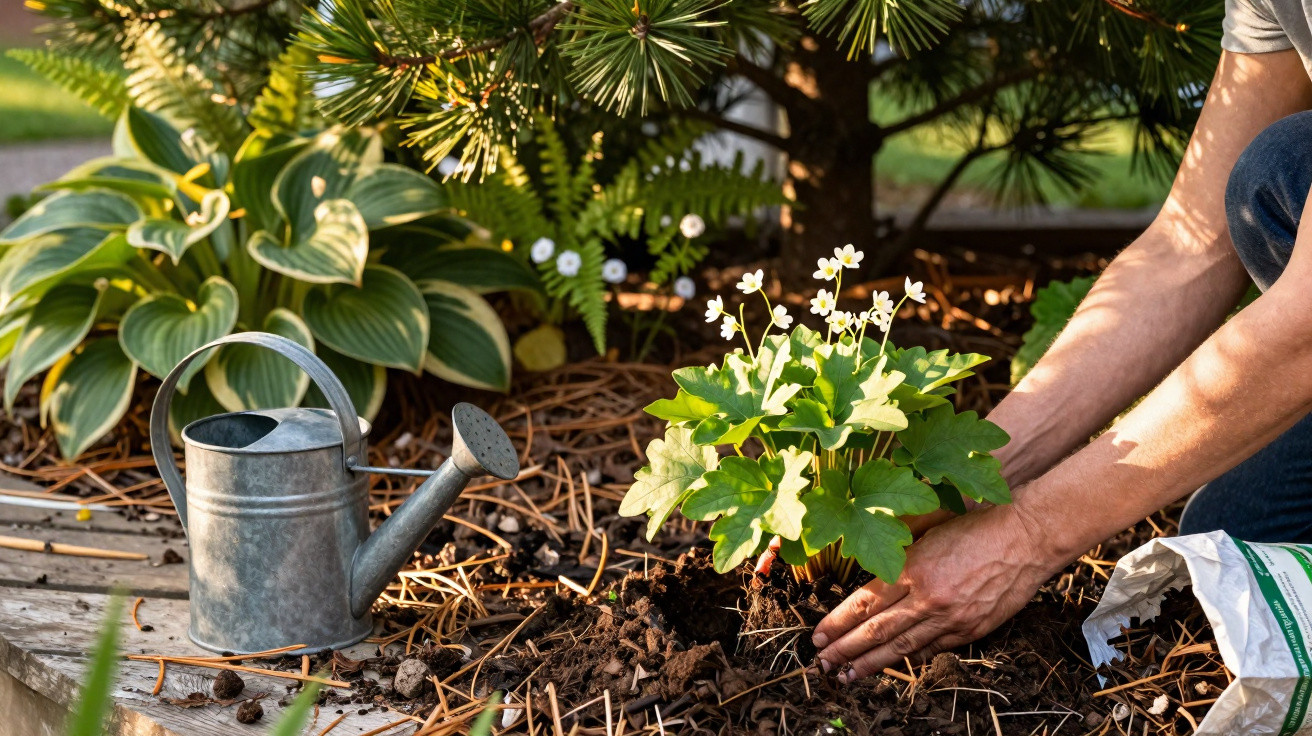
Many hobby gardeners know this particular frustration: beneath an old pine, at the base of an oak, or behind a dense hedge, all that remains is a dusty hollow. Lawns fail, perennials limp along, and watering cans feel pointless. Yet the issue is usually not a lack of skill, but an extremely unforgiving site - and one plant that hardly anyone thinks of.
Why nothing seems to grow under pine, oak and hedges
The classic problem spot looks like this: beneath mature trees or tight hedging, the grass yellows, the soil sets hard like concrete, and roots push up through the surface. This is exactly where garden professionals talk about dry shade.
There’s a straightforward reason it happens:
- Tree roots pull water and nutrients out of the soil relentlessly.
- The canopy intercepts most rainfall - very little actually reaches the ground below.
- Heavy shade means fewer than two hours of direct sun per day.
- Over time the soil compacts and crusts, so moisture struggles to penetrate.
Many familiar “shade plants” suffer twice over in these places: they have low light and too little moisture. For lawns it’s close to the harshest conditions possible, and most perennials surrender after a year or two.
"The notorious 'dry shade' isn't a myth, but one of the toughest sites in the garden - and the reason why beds beneath trees keep failing."
Why hostas, ferns & co. often fail
The first instinct is often to buy what the garden centre labels “for shade”: hostas, astilbes, and assorted ferns. In pictures they look perfect - rich green, lush growth, big leaves or elegant flower plumes.
In real gardens, the pattern is frequently this:
- In the first year, they settle in reasonably well.
- By the second summer, leaves develop brown edges and blotches.
- Flowers don’t appear, or they’re disappointingly small.
- After a few years, you are staring at bare soil again.
The explanation is simple: these plants may enjoy shade, but not dry shade. They prefer deep, humus-rich soil that stays evenly moist - like a natural deciduous woodland. Under an established conifer, or close to a thirsty hedge (such as thuja), they get the exact opposite.
The gamechanger in dry shade: Epimedium
The fix for these “cursed” corners is surprisingly understated: Epimedium, often called barrenwort in English. It’s easy to overlook in nurseries, but in the ground it can deliver a striking transformation.
What barrenwort looks like
Epimedium forms a dense, low carpet of fine foliage. Many varieties are evergreen or semi-evergreen. In spring - usually between April and May - it produces delicate flowers in white, yellow, pink or coppery orange, often bi-coloured. They hover above the leaves like tiny stars.
But its main advantage is not just appearance:
- It creates a tight network of roots that suppresses weeds.
- The foliage stays attractive for a long time and disguises bare patches.
- Once established, it copes with dry spells far better than most shade perennials.
"Epimedium is like a secret ground cover for awkward spots: unassuming in the pot, powerful in the garden when everything around it gives up."
Why it can handle root competition
Barrenwort has fine yet resilient rhizomes. They thread their way between the coarse roots of trees without doing serious harm, and they make efficient use of small pockets of remaining moisture. If the soil is reasonably fertile and free-draining, the carpet starts off at a moderate pace, then thickens year after year.
Epimedium is not entirely carefree: at the beginning it needs a somewhat prepared soil and extra watering in its first year. After that, its strengths really show - and maintenance becomes minimal.
Step-by-step: how to establish Epimedium in dry shade
Choosing the right time
Autumn is the ideal planting window, once the first proper rains arrive and the soil is still warm. That gives roots time to grow without heat stress.
Prepare the soil gently
Especially under older trees, deep digging is risky because it can damage major roots. A light touch near the surface works better:
- Loosen only the top 5 to 10 centimetres with a small rake or hand cultivator.
- Work around large tree roots; don’t cut through them.
- Mix in a thin layer of leaf compost or well-rotted leaf mulch.
This leaf humus mimics the natural woodland floor. It holds water, improves structure, and supplies nutrients slowly.
Prepare the plants properly
Before planting, a brief soak pays off:
- Place the pots in a bucket of water.
- Wait about 15 minutes, until no more air bubbles rise.
- Plant only then - especially where the soil is already very dry.
That way, the root ball starts fully saturated and the plant is less likely to suffer immediate stress.
Spacing and first-year care
For a closed cover, set Epimedium about 30 centimetres apart, staggered in a chessboard pattern. This helps the carpet knit together more evenly.
After planting, water thoroughly. Over the following months, the rule is simple: whenever the soil stays dry for an extended spell, water again - at least in the first year. The rhizomes need that time to anchor properly. After that, the workload drops noticeably.
A light leaf mulch helps establishment. It protects the surface from drying out without smothering the crown.
Which plants combine well with Epimedium
If you want more than a green carpet - and prefer sharper contrasts - you can pair barrenwort with a few tough companions.
Alchemilla mollis: light-catching highlights in shade
Alchemilla mollis (lady’s mantle) works brilliantly at the edges of these beds. Its fresh green leaves form soft cushions. In early summer, it produces airy yellow-green flower sprays that read like little spotlights in the half-light.
It tolerates root competition fairly well, but it prefers slightly more moisture than Epimedium. For that reason, it’s best placed where deep shade transitions into partial shade.
Lesser periwinkle as a quick gap-filler
Vinca minor (lesser periwinkle) suits the outer areas or in-between spaces. It spreads faster than Epimedium and flowers from spring well into autumn, in violet or white.
Its strengths:
- Surprisingly tolerant of poor soils.
- Handles root competition.
- Stays green all year.
Together they create a lively ground layer: the finer leaves of Epimedium, the sturdier periwinkle runners between them, and the flowers of lady’s mantle and Epimedium as eye-catchers.
"With just a few carefully chosen species, a sparse patch of dust becomes a coherent woodland-style scene that looks good all year."
Practical example: from dusty pine base to an elegant shade oasis
A typical starting point: under an old conifer you see only bare, crusted soil, a few exposed roots, and perhaps some brave cushions of moss. Any attempt at re-seeding a lawn has already been forgotten after the first summer.
A realistic route to the transformation can look like this:
- Carefully loosen the surface to 5–10 centimetres, removing larger stones and old roots from smaller shrubs.
- Spread a thin layer of leaf humus and lightly rake it in.
- Plant Epimedium 30 centimetres apart in a staggered, chessboard layout.
- Water the area well, then water again during longer dry periods in the first year.
- Add a few clumps of lady’s mantle at the edges and the occasional periwinkle plant.
Even in the first season, the space feels markedly more alive: the first green “islands” begin to connect, and weeds are easier to keep under control. In year two, the planting becomes a continuous carpet - in spring with delicate flowers, later with a calm, dense leaf texture.
What gardeners should still know about dry shade
Dry shade is not a place for constant watering. If you try to “normalise” the site with daily watering, you risk encouraging shallow roots in the tree root zone while weakening deeper rooting. It’s better to water less often but more thoroughly, so moisture sinks further down.
It’s also worth paying attention to ground cover: fallen leaves can absolutely be left beneath trees, as long as you avoid thick layers of conifer needles that cause water to run off entirely. A thin, loose leaf layer works like natural insulation and makes it easier for plants such as Epimedium to hold their ground.
If you enjoy experimenting, you can expand the area in stages: start around the trunk, then work outwards towards the edges, perhaps adding simple structure such as low rows of natural stone or a partially shaded sitting area. What used to be a dead corner becomes a quiet, almost woodland-like space that stays pleasant even on hot days.
In the end, this type of site shows very clearly how different plants can be: some need constant attention and ideal conditions. Others - like Epimedium - look harmless in a pot, yet perform at their best precisely where ordinary garden plants have long since given up.
Comments
No comments yet. Be the first to comment!
Leave a Comment