
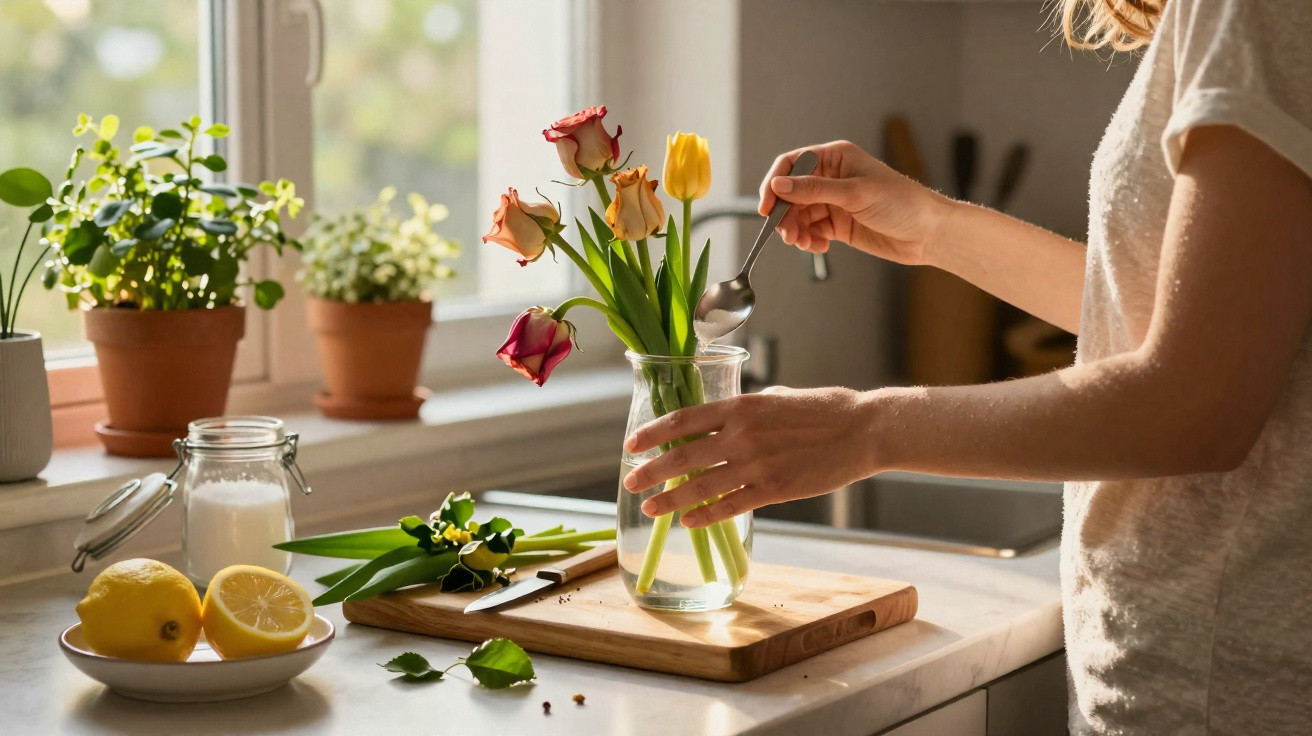
Everyone knows the situation: a magnificent bouquet sits on the living-room table at the weekend, but only a few days later the flower heads are drooping, the water is cloudy and the display looks rather sad. The flowers usually end up in the bin – unnecessarily, as an everyday item from the kitchen cupboard can restore some of their strength and make the vase bloom again.
Why cut flowers wilt so quickly in a vase
Once a flower has been cut, it no longer has its natural supply route from the soil. Although its stems retain some reserves, these do not last for long. Tap water provides moisture, but no energy. Meanwhile, tiny bacteria and fungi multiply in the standing water.
Over time, these microorganisms create a kind of slime that blocks the fine transport channels inside the stem. The plant may still be standing in water, but it can barely “drink” any of it. The effects soon become obvious:
- Stems soften and bend over
- Leaves turn yellow and drop off
- Petals point downwards or appear limp
- Vase water becomes milky, cloudy and unpleasant-smelling
Heat, direct sunshine through a window or a position immediately above a radiator can make the problem worse. Very ripe fruit placed nearby also releases gases that speed up the flowers’ ageing process.
Most cut flowers do not fail because of the water, but because they lack “fuel” and bacteria clog their stems.
The kitchen trick: why sugar revives tired flowers
The answer is quite literally in the kitchen cupboard: ordinary granulated sugar. It replaces some of the energy that the plant would otherwise have absorbed through photosynthesis and its roots while growing in soil. Once dissolved in water, the sugar travels up the stem into the leaves and blooms.
Sugar has the following effects in a vase:
- It supplies readily available energy to the plant cells that are still alive
- It supports petals that would otherwise hang limply downwards
- It can help slightly wilted flowers stand more upright again
- It often extends the life of fresh bouquets by several days
This is especially noticeable with bouquets that look tired but have not dried out completely: within a few hours, individual flower heads often start to lift again and their colours may look more vivid.
How to use the sugar trick for cut flowers correctly
For the desired result, it is not enough simply to pour sugar into old vase water. Taking a few extra steps makes a substantial difference.
1. Clean the vase thoroughly
First, empty the vase and rinse it carefully with hot water. A nearly invisible bacterial biofilm often sticks to the sides. Unless this coating is removed, the sugar will mainly feed the germs instead.
2. Recut the stems
Using a sharp knife, trim each stem diagonally at roughly a 45-degree angle. This increases the surface area available to absorb water and nutrients. Ideally, make the cut under running water so that air cannot enter the transport channels and later act like a plug.
Be sure to remove any leaves that would sit below the water line in the vase. They rot quickly, encourage bacterial growth and further contaminate the vase water.
3. Measure the sugar solution correctly
Next, fill the vase with lukewarm or room-temperature water – not ice-cold water straight from the tap. This is when the key ingredient, sugar, is added.
| Amount of water | Recommended amount of sugar |
|---|---|
| 0.5 litres | ½ to 1 teaspoon |
| 1 litre | 1 to 2 teaspoons |
| 2 litres | 2 to 4 teaspoons |
Allow the sugar to dissolve fully before returning the flowers to the water. This ensures that it is distributed evenly throughout the bouquet.
As a general rule, one to two teaspoons of sugar per litre of water is usually enough – more is rarely useful.
Why too much sugar can harm flowers
It sounds tempting: if a little sugar helps, surely a large amount will help even more. In reality, that can spoil the bouquet faster. Sugar feeds not only the plant, but also bacteria and fungi in the water.
An excess of sugar allows germs to multiply rapidly. The water then turns, becomes slimy, develops a harsh smell and quickly blocks the transport channels in the stems. The supposed freshness boost has the opposite effect.
Anyone wanting to try stronger mixtures should change the water more often. For everyday use, a moderate dose is much easier to manage and is often just as effective.
Sugar and acid: slowing down bacteria in vase water
Many amateur gardeners add a mild acid to vase water alongside sugar, traditionally a little clear vinegar or a few drops of lemon juice. This makes the water slightly acidic, which many bacteria do not tolerate well.
One possible mixture for each litre of water is:
- 1 to 2 teaspoons of sugar
- 1 to 2 teaspoons of clear vinegar or a few drops of lemon juice
This combination gives the flower energy while keeping the germ count in the water somewhat lower. The difference is often particularly noticeable during warm summer weather.
How to extend the life of your bouquet significantly
The sugar trick works best when combined with a few basic care measures. These steps can help you get as many days as possible from your flowers:
- Replace all of the water every one to two days
- Rinse the vase briefly whenever you change the water
- Trim the stems slightly again at regular intervals
- Choose a cool, bright location away from direct sunshine
- Do not place the bouquet immediately beside a fruit bowl
- Avoid draughts and positions directly above a radiator
If you remember to add a little more sugar and, where needed, a small amount of acid whenever the water is changed, many cut flowers will look noticeably fresher for several days.
Which flowers respond particularly well to sugar
Not every variety reacts in the same way. Roses, carnations, gerberas and many summer flowers particularly often benefit from a light dose of sugar. They stand more upright, their blooms may remain open for longer in some cases, and the bouquet looks more vigorous.
With highly delicate varieties or exotic blooms, it is worth testing a smaller quantity in a separate vase first. If they tolerate the addition well, the method can be used more widely with the next bouquet.
When it is no longer worth trying to save flowers
A few dried leaves or slightly drooping blooms are not a disaster. However, when stems become mushy, turn dark or a rotten smell is already coming from the vase, it is usually too late. Even the best household trick will not help then.
At this stage, bacteria and fungi have penetrated deep into the tissue. Even fresh water and sugar can no longer keep the transport channels sufficiently clear. In these cases, it is better to start again with a fresh bouquet and the right care from the outset.
Extra tips for keeping flowers beautiful for longer
The sachet of flower food often supplied with bouquets works on much the same principle as the kitchen sugar trick: nutrients combined with germ-inhibiting substances. If you do not have a sachet to hand, household sugar and a little acid can be mixed into a simple alternative.
For anyone who keeps bouquets at home regularly, it is also worth establishing a routine: fresh bouquet, clean vase, diagonal stem cut, prepare a sugar solution, choose a cool spot. Over time, you will develop a feel for how much sugar your favourite flowers appreciate and when the water needs changing.



Comments
No comments yet. Be the first to comment!
Leave a Comment