
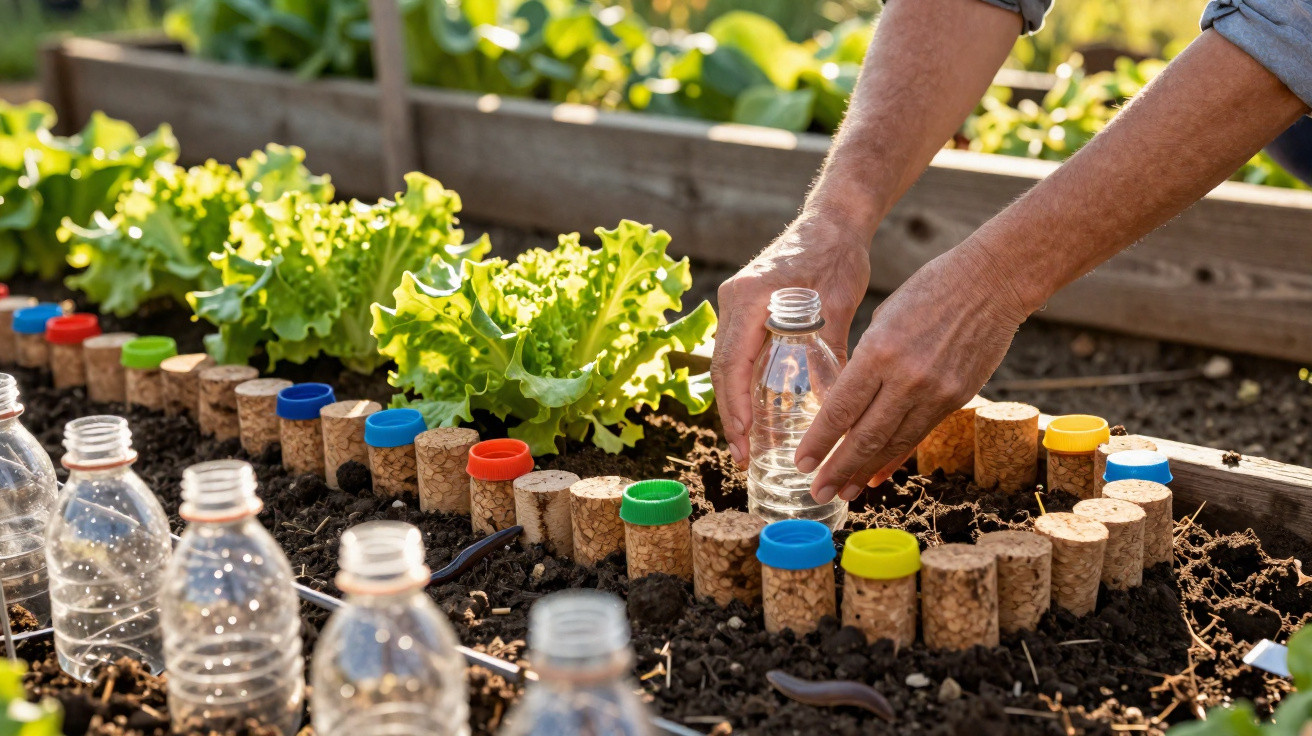
Anyone who looks after a vegetable patch in summer knows the familiar dilemma: either you are forever lugging a watering can around, or the plants start to droop. And just when growth finally picks up, slugs and other pests arrive. A straightforward trick using leftover bits from bottles in the kitchen can noticeably ease both problems at once.
How leftover bottle parts became secret garden helpers
The realisation came after a classic spring in the veg bed: young plants scorched in the sun, lettuces were nibbled overnight, and the water bill crept up. At the same time, the small leftovers from every empty bottle were being tossed into the bin or recycling without a second thought.
That is exactly where the overlooked opportunity was hiding. Over the course of a year, households accumulate surprising numbers of these unremarkable little pieces. Instead of throwing them away immediately, a few simple tweaks can turn them into practical tools for the vegetable patch: steadier watering, protection from hungry visitors, and more reliable plant supports.
"A simple leftover piece of a bottle can become a fully working mini irrigator that delivers water straight to the roots and, at the same time, keeps slugs away from delicate young plants."
Why bottle caps are perfect helpers in the bed
Plastic as a precise water regulator
Plastic bottle caps have one key advantage: they are watertight, cope well with moisture and sunshine, and are easy to modify. With a tiny hole, almost any bottle becomes a simple yet surprisingly effective drip-watering system.
Screw the cap onto a filled bottle, turn it upside down and push it into the soil: the water then drips out in very small amounts right into the root zone. Nothing runs off to the sides, and far less is lost to evaporation at the surface. Crops such as tomatoes, courgettes and aubergines benefit in particular, because they prefer deep watering while the foliage is best kept as dry as possible.
- No wet layer of leaves that encourages fungal disease
- Much less evaporation than watering from above
- Water reaches exactly where the roots need it
- The gardener saves time because watering is needed less often
Cork stoppers as a mini reservoir and protective ring
Natural cork brings different strengths: its porous structure acts like a small sponge. It absorbs excess water and then releases it gradually back into the soil as the earth dries out. Placed right at the base of a plant, it creates a kind of buffer against drought stress.
There is also an interesting chemical angle. Cork contains natural compounds whose scent can unsettle certain insects and crawling pests. Aphids, ants and some small gnats tend to avoid the immediate area, without any need for chemical treatments. At the same time, cork functions like a thin insulating layer on the soil: on hot days the ground around the stem heats up less, and on cool nights the soil stays slightly milder.
Step by step: build drip irrigation from bottles yourself
For a basic version of this semi-automatic watering, you only need items most households already have:
- A plastic bottle (0.5 litre for young plants, 1.5 litre for larger plants)
- The matching cap
- A sewing needle or a thin nail
- A lighter or another small heat source
- A craft knife or a sharp kitchen knife
You can put it together in just a few steps:
- Heat the needle briefly so it passes through the plastic more easily.
- Carefully pierce the centre of the cap, starting with a very small hole.
- Fill the bottle, screw the cap on, and test it over the sink.
- Aim for one drop every two to three seconds. If the flow is too strong, use a new cap and make a smaller hole; if it is too slow, enlarge the hole very slightly.
- Cut the bottom off the bottle cleanly so you can top it up conveniently from above later.
When installing it in the bed, a distance of around 10–15 cm from the plant base works well. Push the bottle into the soil upside down with the opening in the ground, about 5–10 cm deep. Firm the soil all around so it seals snugly.
In spring, topping up once a week is usually enough. During heatwaves, refilling every two to three days is more sensible. For seed trays and young plants, the same idea works on a smaller scale: smaller bottles and even finer holes so the compost does not turn to sludge.
More than just water: how the trick also keeps slugs away
Lure traps made from plastic caps
The same type of plastic cap can be used in a completely different way in the patch: press it level into the soil and fill it with beer or sweet syrup. These mini dishes act as lure traps that draw slugs in. Instead of heading for tender lettuce leaves, they gather at these spots.
If you want to be kinder to wildlife, you can use the approach in moderation: place the traps a little distance from vulnerable plants and collect the attracted slugs daily.
Rough barrier rings against slime trails
Natural cork can be cut into protective rings and laid directly around stems. The rough surface is extremely unpleasant for slugs and snails. They avoid the area, which can make all the difference for young plants-between being stripped bare and staying intact.
For container plants, a thin layer of crumbled cork scattered over the compost surface is also useful. This mulch layer helps the soil stay moist for longer and creates an extra uncomfortable zone for creeping pests.
Hidden helpers: drainage, root protection and safety
These small leftover pieces are also handy in places you rarely see day to day. Added to the bottom of a pot or the lower third of a planter, they loosen the growing medium and improve drainage. Waterlogging is less likely, and roots are less prone to rot.
In a bed, they can be distributed among sensitive roots. There, cork holds water and creates tiny air pockets. The roots do not grow straight into compacted, waterlogged soil, but into a looser, partly aerated zone.
Another practical use is as a cover for sharp poles and canes. Anyone who uses supports in the garden knows the risk: it is easy to walk into them. If you simply push a leftover piece onto the end, it is easier to spot and far safer.
How this changes day-to-day life in the vegetable patch
With a few dozen reused bottle parts, you can settle into a noticeably calmer watering routine. Rather than grabbing the watering can several times a day, it is often enough to stick to a set schedule for checking and topping up. This is particularly helpful for people who only see their beds in the morning or evening.
Plants tend to respond with steadier growth. Instead of cycling through dryness followed by sudden heavy watering, they receive consistent small amounts. That supports stronger roots and reduces stress-a factor that can measurably influence both yield and the flavour of vegetables.
There is also an environmental upside: every reused bottle part saves raw materials, and every skipped watering round reduces water use. In dry summers, every litre that is not wasted matters.
Risks, limits and sensible combinations
It still needs occasional supervision. If you push the bottles into the bed without testing, you risk either parched soil or flooded root zones. Fine-tuning the hole size is the crucial step. The soil should not be completely compacted or sludgy either, otherwise the water will not spread properly.
In very light, sandy soils, water drains through quickly. Here it helps to combine the system with organic mulch: grass clippings, leaves or shredded plant material around the bottle slow down drainage and keep more moisture in the root area.
For slug control, the trick works best when paired with other measures: early hand-picking, keeping hiding places such as boards or stone piles away from the immediate planting area, choosing robust varieties, and planting densely to avoid gaps.
If you set up your garden this way long term, you will notice your routines shifting over time: fewer frantic watering dashes, more targeted care. What looks like worthless waste turns into a quiet helper that saves water, protects plants and makes the vegetable patch more manageable in everyday life.
Comments
No comments yet. Be the first to comment!
Leave a Comment