
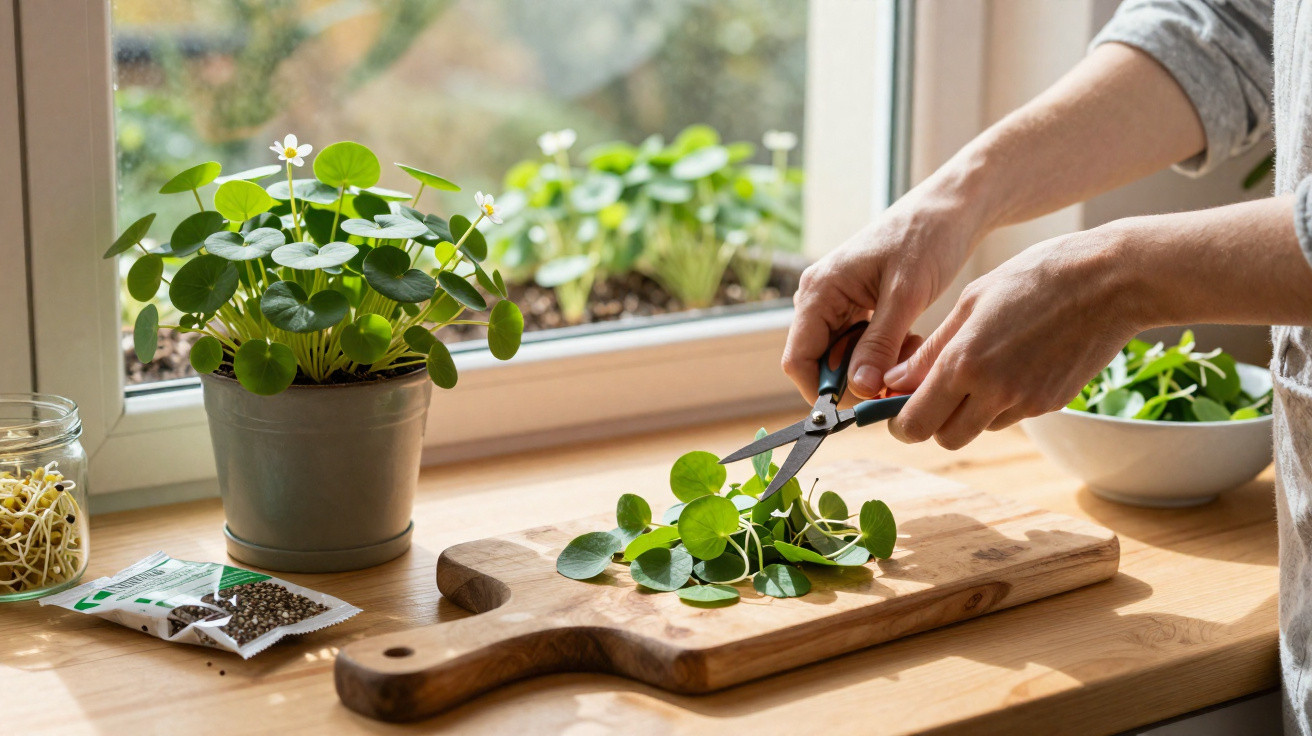
When you stroll through the garden at this time of year, your eyes usually go straight to the first tulips, daffodils or perhaps the spinach. Meanwhile, almost unnoticed, a plant quietly takes the lead - and it really delivers: winter purslane, also known as winter postelein or miner’s lettuce (Winter-Portulak; Claytonia perfoliata). This small green grows while other crops are still hesitating, bringing nutrients, a fresh flavour and a surprisingly generous yield from very little space.
The March herb that’s likely to surprise everyone
At first glance, winter purslane (Claytonia perfoliata) looks unremarkable: delicate, rounded leaves, thin stems, nothing showy about its growth. Yet it shines precisely where many vegetables struggle in late winter - vitamins, minerals and reliable cropping.
“While many beds are still empty in March, miner’s lettuce is already producing crisp greens - often for weeks without a break.”
Its high levels of vitamin C, magnesium and iron make winter purslane especially appealing after the darker months. If your winter diet tends to be on the hearty side, a portion of fresh leaves can do your body noticeable good. Another plus: it doesn’t only grow in cultivated beds - in many places it also appears wild, along woodland edges, on damp meadows or in neglected corners that no one pays attention to in summer.
How to recognise winter purslane in the garden
So you don’t miss miner’s lettuce, it helps to look closely at its structure. The giveaway is the saucer-like pairs of leaves, with the stem seeming to pass straight through the middle like a small arrow.
- rounded, slightly glossy leaves
- delicate, pale-green stems
- often a rosette-like growth close to the ground
- later, small white flowers appearing in the centre of the leaf “plate”
In March, winter purslane quickly carpets larger patches, especially where the soil is loose and not completely dried out. Many hobby gardeners initially dismiss it as “just some kind of weed” - until they taste it.
Why winter purslane outperforms other vegetables in spring
Compared with typical spring vegetables, miner’s lettuce has several clear advantages:
- Frost-tough: starts growing at temperatures just above 0°C
- Fast to crop: from seedling to harvest often takes only 4–6 weeks
- Pick-and-come-again: after cutting, the plant re-sprouts
- Space-saving: ideal for densely planted beds and balcony planters
- Good raw: no long prep - simply wash and eat
While carrots, beetroot or cabbage are, at best, still just seed in the ground in March, winter purslane can already be filling a bowl with fresh green leaves. That’s exactly what makes it so attractive for anyone aiming to be more self-sufficient.
How to grow miner’s lettuce (Tellerkraut) yourself
If you want to bring miner’s lettuce deliberately into your garden, you’ll find it straightforward. It’s one of the least demanding crops you can grow.
The right time to sow
Traditionally, sowing runs from October to February. The seeds need cool conditions to break dormancy. If you’re late, you can still take advantage of the final cold nights in March - especially in more exposed areas.
- lightly loosen the bed and break up large clods
- scatter the seed thinly over the surface
- cover with only a very fine layer of soil, or simply press in gently
- water carefully and avoid waterlogging
It can also be grown on a windowsill in a shallow tray. What matters most is a bright spot and evenly moist compost.
Site and care - almost foolproof
Winter purslane is happy in partial shade through to sun. It copes poorly with strong midday sun in high summer, but in very early spring those conditions are ideal.
| Factor | Recommendation |
|---|---|
| Soil | loose, humus-rich, not too dry |
| Watering | regularly, but without waterlogging |
| Feeding | usually unnecessary; low demands |
| Light | partial shade to sun |
Feeding is rarely needed - miner’s lettuce generally makes do with what’s left from the previous crop. If you allow a few plants to flower and set seed, you can often expect a spontaneous “self-seeded” crop next winter.
Harvest: cut, don’t pull
Around four to six weeks after sowing, you can start using the first leaves. Conveniently, the plant regrows if you only cut the top growth.
- use scissors to cut the rosettes about 2 cm above the soil
- don’t harvest everything at once; leave some plants to continue growing
- in wet weather, cut more carefully so the leaves don’t get splashed with mud
“With a small bed of one square metre, you can supply a family with fresh greens for several weeks.”
What winter purslane tastes like - and how to use it in the kitchen
In flavour, miner’s lettuce sits somewhere between mild lamb’s lettuce and a delicate baby-spinach note, with a slight nuttiness. It’s a good choice for anyone who dislikes the bitterness of many wild herbs.
Everyday ideas
- Winter salad: on its own with a simple dressing of oil, vinegar, a little mustard and salt
- Mixed salad: combined with lamb’s lettuce, rocket or sliced radishes
- Smoothie: add a handful of leaves to banana, apple and a little water
- Soup: stir into potato or vegetable soup just before serving
- Pesto: blend with nuts, garlic, oil and a little hard cheese
Because the leaves are so tender, avoid cooking them for long - otherwise you’ll lose both flavour and vitamin C. For hot dishes, it’s enough to let miner’s lettuce wilt briefly at the very end.
Mini vegetables, sprouts & more: perfect windowsill partners
If you’ve taken to miner’s lettuce, it pairs well with other mini greens. On a windowsill, you can create lively mixes from:
- cress
- radish leaves
- broccoli sprouts
- young spinach plants
These combinations provide fresh greens within days and work brilliantly on sandwiches, in bowls or as a topping for soups. Especially in small city flats, this makes a mini self-sufficiency garden with very little effort.
Winter purslane as gentle support in the home medicine cupboard
Traditionally, winter purslane is valued not only as food but also as a medicinal plant. Its high vitamin C content supports the immune system, which is particularly relevant during cold season. When you’re feeling run down, fresh, nutrient-rich greens can be far more helpful than heavy meals.
The secondary plant compounds it contains may have anti-inflammatory effects. For that reason, many herbalists use miner’s lettuce at the first signs of a cold - for instance as a large portion in a salad or in a green smoothie. Its mild, water-rich leaves can also help get digestion moving.
Winter purslane can be used externally too: crushed, lightly bruised leaves placed on the skin may calm minor irritation. For serious symptoms this is, of course, no substitute for medical advice, but as a complementary approach many people find it a pleasant, natural option.
How to forage the herb safely and avoid mix-ups
If you want to pick miner’s lettuce in the wild, you should be able to identify it with confidence. Confusion is less common than with well-known wild plants such as wild garlic, but the rule still applies: only take what you can identify beyond doubt.
- always check for the characteristic “plate” leaves with the stem running through the centre
- harvest only from clean sites - not right by roads or on dog-walking routes
- leave plants that smell odd or have discoloured leaves
Beginners may find a field guide helpful, or a course with experienced foragers. Once you’ve learnt it, you’ll often spot the plant instantly as you pass.
Why miner’s lettuce belongs in every bed
In many home gardens, plenty of ground sits unused through winter and early spring. That’s where winter purslane shows its value: it fills the gap when other crops have not yet got going.
Possible combinations in the bed:
- under early cabbage or broccoli as a living “gap filler”
- between rows of garlic
- in raised beds before planting tomatoes or peppers
- under fruit trees in lighter, open areas
“Miner’s lettuce makes use of the cool season that other vegetables avoid - and turns any bed into a bigger harvest.”
Once you’ve seen how much fresh green this unassuming herb can produce in March, you’ll rarely want to be without it. At best, winter purslane becomes a fixed part of your growing plan - a small green insurance policy that spring arrives on your plate well before it does on the supermarket shelf.






Comments
No comments yet. Be the first to comment!
Leave a Comment