
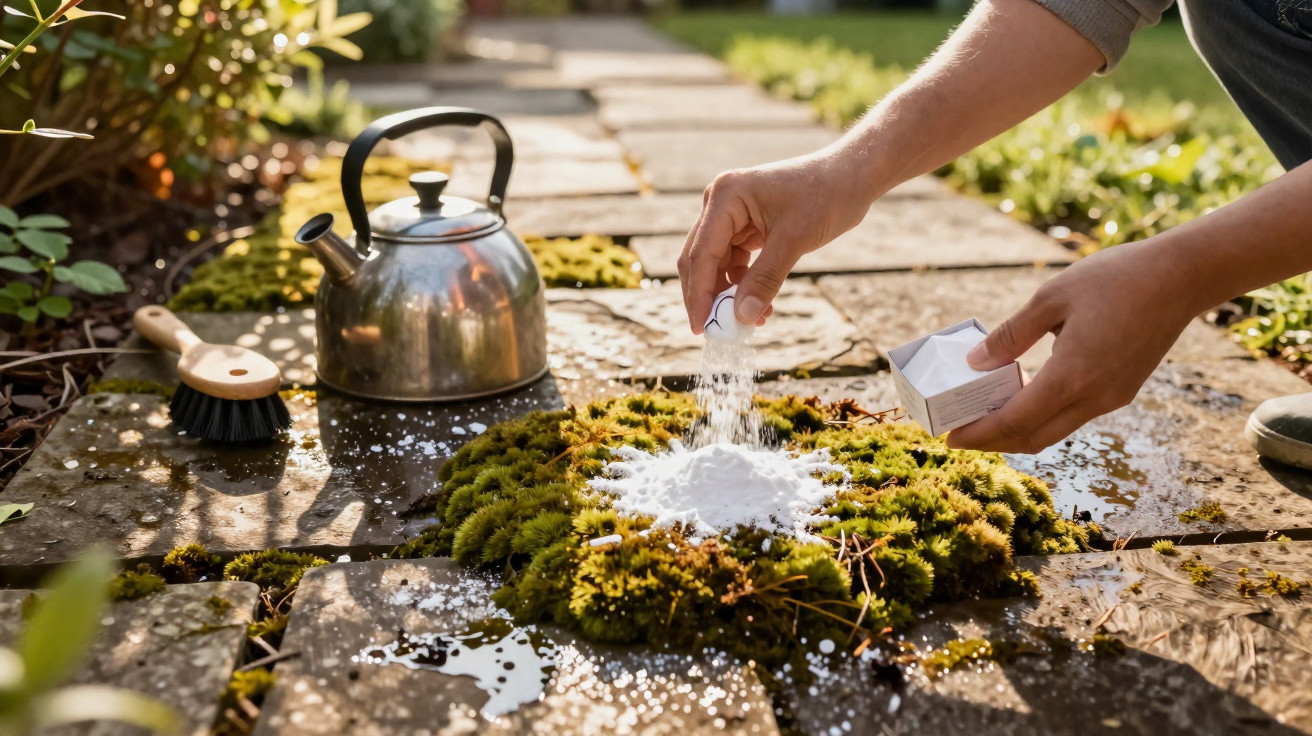
Many homeowners tip litres of boiling water over their patio slabs and hope for a spotless terrace in minutes. The result can look impressive at first, but it rarely lasts. A garden specialist points to a far gentler approach that protects the paving, reliably loosens moss, and fits easily into everyday maintenance.
Why boiling water nearly always loses against moss
Using very hot water feels like the obvious fix: it scalds the moss, the area looks cleaner, and it feels like you have properly “tidied up”. The problem is that moss cushions often sit deeper in the stone’s pores and in the joints than most people expect.
Moss thrives in particular conditions:
- areas that stay damp all the time or for long periods
- shaded spots with little or no direct sunlight
- corners and edges with poor air circulation
In exactly those places, a brief blast of heat does not penetrate far enough. After a few days or weeks, the same patches often turn green again. If you find yourself repeating the boiling-water routine every spring, it quickly becomes clear: it is more of a ritual than a lasting solution.
There is also a material risk. Severe temperature changes can:
- make jointing mortar brittle
- encourage cracks in more delicate stones
- roughen surfaces unevenly
Another issue is often missed: smooth slabs that have been slightly affected, combined with damp moss residue, can make the patio dangerously slippery. You may remove an eyesore, but you could create a safety hazard.
“Gentler methods last longer, protect the fabric of the build, and make paths and patios safer.”
The gardener’s simple trick: baking soda on damp slabs
The turning point in tackling moss is a small detail: choosing the right moment and the right surface condition. Instead of heat, one gardener relies on moisture plus baking soda (sodium hydrogen carbonate; essentially plain bicarbonate of soda without additives).
Why damp slabs are the key
If you scatter powder onto a dry surface, it can blow away easily or spread unevenly. When the slabs still have a thin film of moisture, the baking soda clings better and stays exactly where it needs to work-right on the moss.
The result is that the moss loses its grip and dries out within around 48 hours. The joints and stones are left alone, because the action is relatively mild and targeted.
“A dampened surface, a careful sprinkle, two days of patience-that’s all there is to the gardener’s trick.”
Step by step: how the method works
- Prepare the area
Sweep away loose dirt, leaves, and debris. The slabs should be clear, but there is no need for heavy scrubbing. - Lightly dampen
Either do it the day after rainfall, or water briefly with a watering can until there is a fine sheen of moisture. Avoid puddles. - Sprinkle baking soda
Apply the powder directly to mossy patches, joints, and shady corners. You do not need a wall-to-wall “snow” covering. - Leave it for 48 hours
Do not scrub and do not hose it off. The powder needs time to work; during this period the moss loses tension and colour. - Gently brush and rinse
Use a stiff brush or a yard broom to lift off the loosened cushions, then rinse with water-ideally with a garden hose on a low to medium setting.
Done this way, you can usually avoid pressure washers and harsh chemicals. The joints tend to stay far more stable, and the patio’s appearance ages much more slowly.
How much baking soda is actually needed?
Impatience often leads people to overdo it. However, a thick white layer does not improve results-it only wastes money. A light, targeted application is what matters.
- A thin film directly on the moss is completely sufficient
- Pay extra attention to dark joints, edges, and shaded borders
- On very porous natural stone, start with a small test patch
Light-coloured or sensitive stones can respond differently. A discreet test strip quickly shows whether the colour or surface changes. In most cases there is no issue, but a quick check can prevent a headache across a larger area.
Typical mistakes that ruin the effect
This approach depends on patience and restraint. Three common missteps are usually behind disappointing results:
- Using too much - consumption rises, effectiveness does not.
- Scrubbing too early - the moss is still gripping strongly and some of it stays behind.
- Rinsing too aggressively - joints can wash out and the surface is stressed unnecessarily.
“If you give the powder time, you can avoid the heavy work with brush and pressure washer.”
No rain, but with a plan: the right moment for treatment
Baking soda needs time undisturbed to do its job. The best window is a settled, dry spell with moderate temperatures-usually in spring or early autumn. If prolonged rain is forecast, it can wash the powder away too soon.
If you keep an eye on the patio, choose a period when:
- no heavy rain is expected within the next 24–48 hours
- the surface is already slightly damp, but not waterlogged
- temperatures are above freezing
That way, one or two targeted applications a year are often enough, rather than constant scrubbing and scouring.
Slowing moss long term: control light, air and water
After cleaning, one question remains: how do you stop it starting all over again every year? The answer lies in the conditions moss prefers. Change those, and growth usually drops noticeably.
Reduce shade, shift moisture away
Common causes of permanently damp, dark areas include:
- hedges or shrubs that have grown up right beside the patio
- missing or inadequate drainage
- slight dips where water collects
- tightly grouped potted plants that block air movement
Even small adjustments-such as trimming back a shrub, adding a channel, or slightly correcting the fall-can help slabs dry faster. Less standing moisture generally means less moss.
A small routine instead of a big effort
If you wait until the entire patio looks green, you create more work later. A better approach is a quick check during the wetter months. Only a few habits are needed:
- after rain, note where the surface stays damp the longest
- respond straight away to the first small moss patches
- avoid aggressively digging out joints; protect them instead
With this “mini routine”, short sessions with a broom and a little baking soda are often enough-rather than spending half a day in spring with a pressure washer.
What’s behind the effect of baking soda
Sodium hydrogen carbonate briefly alters surface conditions. It makes the environment uncomfortable for moss without etching the stone. Compared with strong chemicals, the effect is relatively mild, but it is usually enough for small moss cushions.
Even so: do not apply it right at the edge of garden ponds or immediately beside delicate ornamental plants. In those areas, use it sparingly and direct run-off so it does not flow into beds or ponds.
If you want a well-kept property, this method offers a practical balance of effectiveness and protection for the materials. The moss goes, the patio keeps its integrity-and the saucepan can stay where it belongs: in the kitchen.
Comments
No comments yet. Be the first to comment!
Leave a Comment