
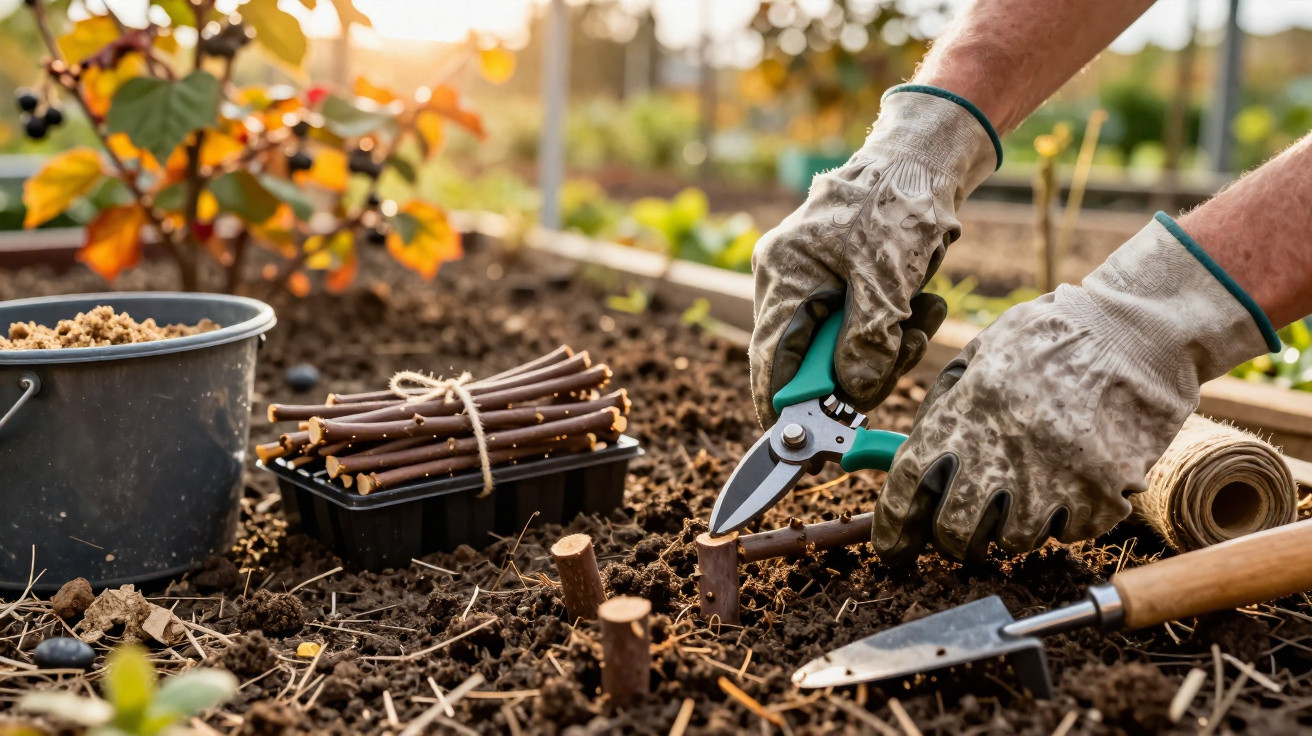
Across smallholdings and back gardens, growers use this transitional month to establish new berry bushes, improve their chances of success and turn one stem into a future fruiting row.
Why October quietly determines next year’s berry harvest
Fruit bushes are commonly associated with spring planting, seed trays and soil beginning to warm. However, many professional growers favour October, particularly for currants and other soft fruit. As plants begin to slow, sap returns towards the roots and above-ground growth comes to a halt. This period provides cuttings with the settled conditions required to establish.
In October, fruit bushes stop spending energy on leaves and start storing it in the wood and roots – exactly what new cuttings need.
When a stem is cut and planted as the parent plant enters dormancy, it puts less effort into producing fresh foliage and more into forming roots. This change can be the difference between a frail plant that struggles through its first summer and a robust bush that fruits early.
The subtle importance of timing and sap flow
Growers who monitor their plants carefully tend to focus on plant signals rather than calendar dates. Leaves begin to change colour and fall, fresh shoots become woody, and plants need less watering. Together, these signs indicate that sap is moving downwards and growth is easing.
Cuttings taken at this point tend to root more consistently because their remaining leaves lose less moisture. They also experience less transplant shock than spring cuttings, when plants are actively reaching for light and warmth.
Why many growers still use the moon calendar
Alongside seasonal timing, plenty of market gardeners continue to follow lunar phases. They favour the “waning” or descending moon, when the moon appears to shrink night after night. Traditional practice associates this phase with improved root development and stronger establishment in woody plants.
Many growers schedule their berry cuttings during a descending moon, aiming to match sap movement and root growth with lunar rhythm.
Scientific support for lunar gardening is still mixed, yet thousands of growers maintain the practice because it encourages close observation of how plants behave. They use the moon calendar as an additional guide rather than a fixed rule, alongside soil inspections, weather forecasts and checks on plant health.
The October method that multiplies fruit bushes for free
The decisive October action is straightforward: take hardwood cuttings from currants, blackcurrants and other cane and bush fruits. A single established plant can yield several vigorous cuttings, each capable of becoming a fully productive bush within a couple of seasons.
Selecting the right stem: the professional approach
Not every shoot will produce a reliable cutting. When inspecting their rows, commercial growers generally follow several simple principles.
- Choose this year’s wood: it should be firm rather than soft, but not grey and aged.
- Look for pencil-thick stems: thin material dries out, while overly thick wood roots more slowly.
- Check for healthy bark: avoid cracks, cankers, marks and insect damage.
- Take stems from the middle section: leave out the extreme tip and the oldest wood at the base.
Clean tools are nearly as important as selecting the stem itself. Wiping blades with alcohol or passing them through a flame reduces the chance of transferring fungal issues between bushes. This practice prevents considerable difficulty when dozens of plants are being propagated in one session.
Preparing a cutting that is ready to root
After selecting a stem, the finer points of preparation influence how well it performs. Growers cut each section to roughly 15–20 centimetres, ensuring several buds remain along its length. The lower cut is made immediately beneath a bud, as this area contains many cells capable of developing into roots.
A cutting that carries a few strong buds and very little extra foliage strikes a better balance between water loss and root formation.
Most professionals remove every leaf apart from one or two close to the tip. These retained leaves help sustain the cutting without demanding more water than its emerging roots can provide. Some growers coat the base with rooting hormone powder to accelerate development, particularly in cooler or drier locations, while others depend on seasonal timing and suitable soil.
Creating the right home for October cuttings
The soil can make the difference between a promising cutting becoming a healthy plant or simply rotting away. Autumn ground is often damp, making drainage and air spaces especially important. Bare, heavy clay can remain waterlogged for weeks, depriving fresh roots of air.
Mixes and methods that encourage roots
Market gardeners often keep an uncomplicated, open-textured cutting mix ready. A basic mixture includes:
| Component | Role for the cutting |
|---|---|
| Fine compost | Supplies nutrients once roots develop |
| Topsoil or garden loam | Provides structure and retains moisture |
| Sharp sand | Enhances drainage and stops compaction |
Growers may either create a dedicated nursery bed containing this lighter mixture or plant into deep containers. In either case, the cutting is inserted at a slight angle, with two-thirds of its length buried and only a few buds left above the surface. Positioning it this way allows water to drain away and promotes rooting along the covered side of the stem.
Watering thoroughly at planting settles the soil around the cutting and removes substantial air pockets. Afterwards, gentle moisture is generally better than continual saturation. Excess watering in cool conditions suffocates developing roots and encourages rot, so many professionals only add water when the surface dries out or rainfall has been absent for some time.
Autumn care that rewards you in spring
Once the cuttings are planted, growers focus on protection rather than frequent intervention. A light layer of mulch around them stabilises soil temperature and reduces evaporation. Straw, shredded leaves and wood chips are all suitable, provided they do not rest directly against the stems.
The aim through winter is simple: keep cuttings upright, roots moist but not soaked, and temperature swings gentle.
In more severe climates, light frost fleece or a windbreak around the bed stops cold winds from lifting unrooted cuttings from the soil. In milder areas, protection from prevailing winds is often enough. Freeze–thaw cycles pose the main risk because they can heave cuttings upwards, so growers inspect the bed after storms and firm soil around any stems that have loosened.
How an October afternoon becomes baskets of fruit
By late winter, most successful cuttings start to develop callus tissue and their first fine roots. The outcome is normally visible a few weeks afterwards, as buds swell and new leaves emerge with noticeable vigour.
What to expect during the first two seasons
New currant and blackcurrant bushes seldom produce heavy crops in their first year, which is usually beneficial. Growers often remove early flowers so that young plants direct their energy into roots and branches rather than fruit.
The main reward begins in the second summer. Plants propagated from on-site cuttings frequently show:
- More even growth throughout the row.
- Greater resilience to local weather changes.
- Fruit clusters distributed evenly along branches.
- Fewer losses than purchased plants.
A single healthy mother bush can shape a whole block of uniform, productive plants that match the soil and microclimate perfectly.
For commercial growers, this consistency makes pruning and harvest scheduling easier. For home gardeners, it means tidier bushes and simpler picking, without the uneven mix of weak and strong plants often found in random shop purchases.
Why professionals repeat the October routine annually
Many market gardeners regard autumn cuttings as a regular task rather than a one-off project. Each year, they replace part of their planting, fill spaces left by bushes that have died back and trial new varieties in limited numbers before planting a larger block.
The practice also distributes risk. Should a harsh winter or disease affect older bushes, young plants raised from the previous year’s cuttings are ready to replace them. Costs remain low, restricted to labour and the basic materials already available on the holding.
Extra factors growers consider when planning berry cuttings
Beyond simply placing a cutting in the ground, attentive growers consider several longer-term matters. Variety selection is particularly important. Growing early, mid-season and late currants extends the harvesting period, while combining disease-tolerant types lowers the risk of losing an entire crop in a poor year.
Spacing matters more than many beginners expect. Close planting may appear productive in the first year, but it commonly creates inadequate airflow, increased fungal problems and difficult pruning later. Allowing at least 1.2–1.5 metres between currant bushes provides sufficient light and room for several years of growth without continual reshaping.
For gardeners with limited space, hardwood cuttings still provide useful possibilities. Young currant plants can be grown in large containers for a couple of seasons if they receive rich compost and regular water. This arrangement suits balconies and paved yards, while allowing growers to test a variety before allocating valuable ground to it.
A final consideration for many professionals is succession. Rather than waiting for bushes to decline with age, they raise replacement plants while the older bushes are still cropping well. This rotation, begun with a few October cuttings each year, maintains steady fruit yields and prevents sudden breaks in production.

Comments
No comments yet. Be the first to comment!
Leave a Comment