
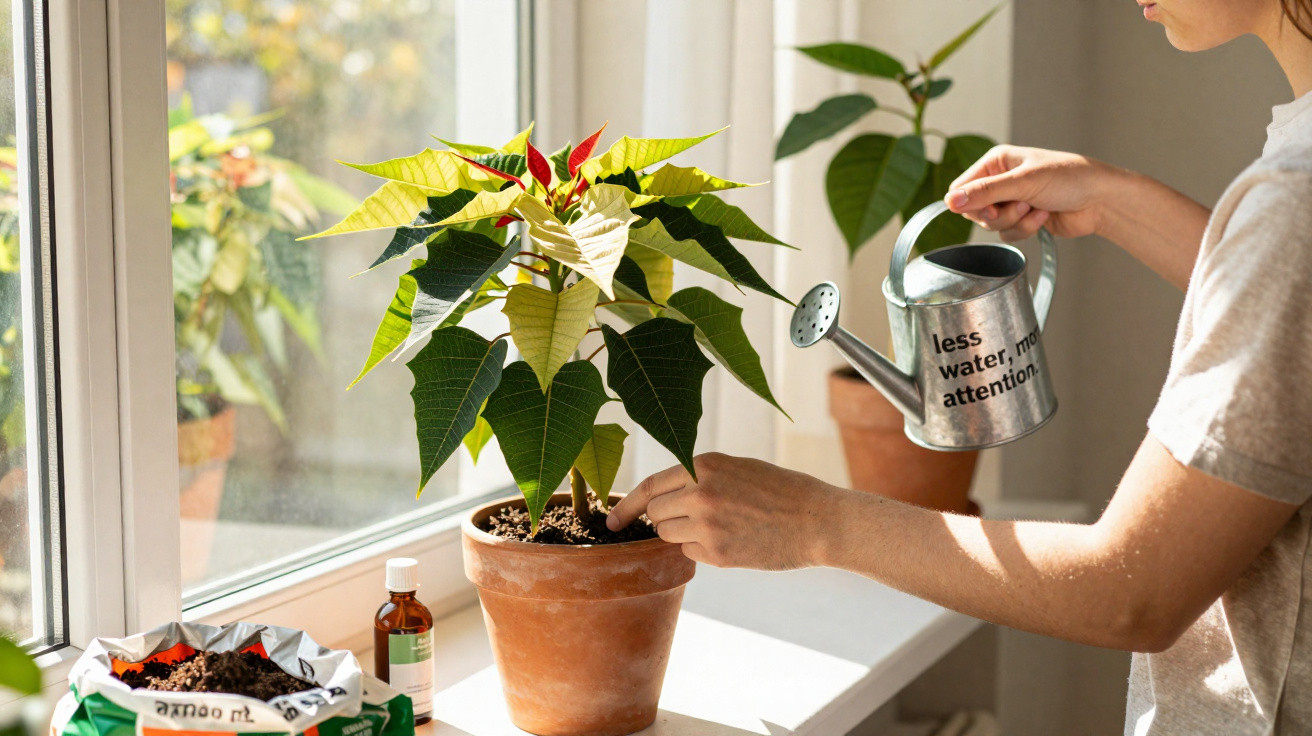
If you avoid one simple care mistake now, you can enjoy a magnificent houseplant all summer.
The familiar story: bought in December, looking miserable in January, dried out by March and binned. Yet the poinsettia, botanically Euphorbia pulcherrima, is capable of far more than being a throwaway festive decoration. Treated properly, it can shift from its post-Christmas slump into a tough, richly green plant that looks good right through to autumn. The decisive window is the weeks between March and April - and it requires a clean break from old habits.
Why the poinsettia often “gives up” after Christmas
By late winter, most poinsettias look pitiful: the red bracts have faded, some leaves have turned yellow and others have already dropped. Many people take this as proof the plant is finished - but that’s a misunderstanding. What you’re seeing is a rest period. In its tropical home, this is a short recovery after flowering before it pushes new growth in spring.
"A sad-looking plant in March usually doesn’t mean death, it means a winter rest. If you respond the wrong way now, you lose the plant - not the other way round."
This is exactly where the big trap sits: either it gets watered as if it’s still Advent, or it gets dumped in frustration. Both choices bring the story to an end.
In March: give it a rest instead of “drowning it”
In March, the poinsettia needs one thing above all: peace and quiet. Its flowering season is over and it’s drawing in its energy reserves. It behaves almost as if it’s half-asleep.
The right position during the rest phase
- a bright spot without direct sun
- a cool temperature, ideally between 13 and 16 °C
- nowhere near a radiator
- no draughts from windows or doors
A cool hallway with a window, a bright bedroom, or an unheated (but frost-free) conservatory can work well. A living-room windowsill above a radiator is no place for a poinsettia at this stage.
Less water, much more checking
Most poinsettias don’t die after the holidays from drought - they die from roots sitting wet for too long. So in March, watering needs a decisive reset:
- only water when the root ball is almost completely dry
- time between waterings: often two to three weeks
- never leave water standing in a cachepot or saucer
A simple test is to push a finger into the compost. If it still feels even slightly damp, wait a few more days. One thorough watering is better than constantly topping up with little splashes.
Dead, brown leaves can be removed carefully by hand or with clean scissors. Wearing gloves is sensible here, because the plant’s milky sap can irritate skin and eyes.
In April: a fresh start in a slightly larger pot
As soon as you see small, fresh shoots appearing on the stems in April, the poinsettia is ready for the next stage. This is when active growth begins - and when the second common mistake happens: repotting badly or changing conditions too abruptly.
How to repot successfully in spring
In spring, the plant only needs a slightly bigger pot. An extra 2–3 cm in diameter is often enough. Key points:
- choose a pot with a drainage hole
- add a layer of expanded clay or gravel at the bottom for drainage
- use a loose, structure-stable houseplant compost
- gently loosen any matted roots with your fingers
After repotting, water sparingly until the compost is evenly moistened, but not saturated. Waterlogging straight after repotting is particularly harmful.
Adjust light and temperature
In April, the poinsettia can be kept a little warmer again - just not in harsh midday sun at a south-facing window.
- room temperature around 18–20 °C
- plenty of light, but filtered (for example a north- or east-facing window, or lightly shaded by a curtain)
- avoid strong direct sun through glass - heat build-up is a risk
"If you treat your poinsettia like a normal houseplant in April - bright but without heat shock, and without constant wet compost - you’re laying the groundwork for a dense summer bush."
When watering, the finger-check remains the most reliable control: if it’s dry on top but still a touch moist deeper down, hold off. Only water again once the top layer is clearly dry - ideally using low-limescale, room-temperature water.
From late April: from throwaway to summer plant
From late April onwards, the plant really gets going. New leaves appear and the shape becomes bushier. Now the routine changes again.
Watering and feeding during the growing season
As temperatures rise, the plant’s water needs increase. The pot should no longer dry out completely, but standing water is still off-limits. A balanced approach looks like this:
- watering rhythm: depending on location, every 4–7 days
- pour away excess water from the saucer after 15 minutes
- add liquid fertiliser for flowering plants every two to three weeks
Fertiliser provides the nutrients the poinsettia needs to build lots of healthy leaves. Strong, vigorous summer growth is the best foundation for coloured bracts the following winter.
Outside it goes - but ease it in
Once temperatures stay reliably above frost conditions, the poinsettia can move outdoors. A sheltered spot on a balcony or terrace is ideal.
- position: partial shade, not blazing midday sun
- for the first few days, leave it outside only for a couple of hours, then increase gradually
- watch for heavy rain that could flood the pot
Outdoors, a poinsettia can look like an exotic foliage plant. It forms dense, deep-green leaves and, depending on the variety, can reach 30–60 cm tall.
How to get red bracts again for the next Advent season
If you’re happy to keep your poinsettia simply as a green houseplant, you can stop here. If you want the classic red bracts back for Advent, you’ll need a more deliberate plan from autumn onwards.
To produce coloured bracts, Euphorbia pulcherrima needs a longer spell of long nights. The technical term is “short-day plant”: it responds to the length of the dark period, not the date on the calendar.
"For strong red bracts, the poinsettia needs about two months in autumn with real darkness for around 14 hours per day."
From around the beginning of October, the following strategy works well:
- Each evening at the same time, move the plant into a dark room or cover it with a lightproof but breathable cardboard box.
- After roughly 14 hours - for example in the morning - put it back by a bright window.
- Keep this routine going for eight to ten weeks, without significant interruptions.
Stray light from street lamps or screens can be enough to disrupt bract formation. If you have a genuinely dark room with no light sources, you’re at a clear advantage.
Typical mistakes - and how to avoid them easily
| Mistake | Result | Better solution |
|---|---|---|
| Root ball kept constantly damp in March | Root rot, leaf drop, plant dies | Watering breaks of two to three weeks; water only after it has dried |
| Placed near a radiator in winter/spring | Dry air, stress, yellow leaves | A cooler, bright spot away from heating |
| Strong sun behind glass in April/May | Leaf scorch, heat stress | Bright but shaded window; acclimatise to sun slowly |
| Potting into a pot that’s too large | Compost stays wet too long; roots rot more easily | Go up only one pot size; provide good drainage |
What many people don’t realise: toxicity, pruning and alternatives
Poinsettias are considered mildly toxic. The milky sap contains substances that can cause skin irritation in sensitive people. Pets - especially cats and dogs - should not chew the leaves or stems. Choose a position where children and animals cannot easily reach the pot.
A regular, gentle prune in late spring can encourage a more compact shape. Only cut back lightly and disinfect your tools beforehand. If you briefly dab the cut surfaces with a damp cloth, the flow of milky sap usually stops more quickly.
If you don’t want the extra effort but still fancy a longer-lasting houseplant with a Christmas connection, sturdier alternatives such as amaryllis or indoor azaleas are worth considering. They follow a similar rhythm of flowering period and rest phase, but often forgive small care mistakes more readily.
With a bit of attention during the critical weeks of March and April, a once-disposable poinsettia can become a genuine long-term plant. If you adjust the watering rhythm, give it a cool resting place and repot at the right moment in spring, you can skip buying a new one each year - and gain a surprisingly decorative green summer plant that hardly resembles its sorry post-festive self.


Comments
No comments yet. Be the first to comment!
Leave a Comment