
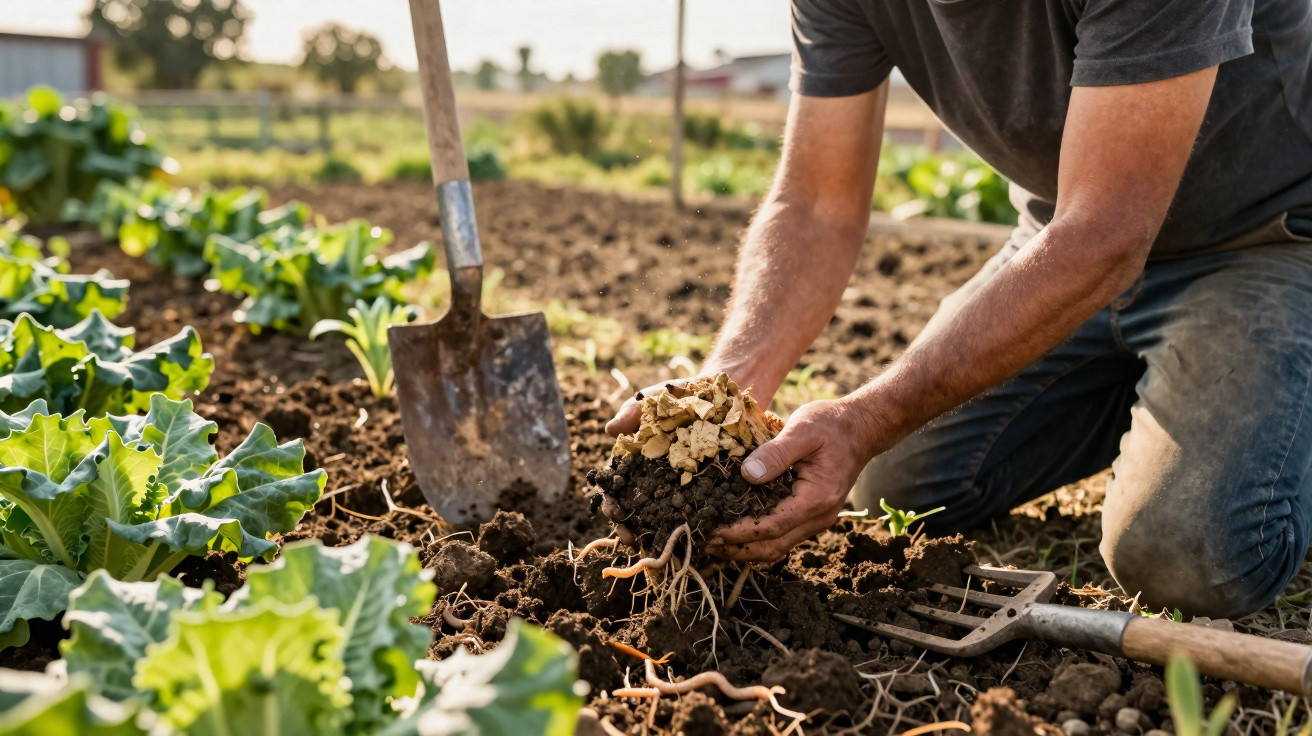
The woman in the next garden leans on her spade, draws one deep breath, and heaves over the next block of earth. Year after year-always in March-the same rhythm: dig, level, sow. Afterwards the soil lies there like a freshly made bed: dark, neat, full of promise for tomatoes, carrots, and courgettes. We glance over, nod with approval, and briefly wonder whether we ought to be doing it just as dutifully. Then a chain of earthworms tumbles out of the bright cut, flickers in the sun, and quickly vanishes again.
In moments like that, the ground gives away a secret: there is far more going on down there than we can guess from above. Beneath that smooth surface lives an entire community of roots, fungi, bacteria, and tiny creatures. And yet, each year, we pull it all apart in one go. What does that actually do to the quiet organism beneath our feet?
When the spade turns everything upside down every year
If you turn over your garden soil every spring without fail, the first thing you notice is your own body. Your back complains, your hands roughen, and the earth smells of damp soil and good intentions. Visually, it looks spot-on: weeds gone, the surface broken up, the beds looking “tidy”. For many people, this is the definition of proper garden care-the way our grandparents did it. A well-driven spade and a cleanly flipped clod feel like control.
What happens under the surface, though, is a quiet landslide. Old roots get torn, worm tunnels collapse, delicate fungal webs snap. Right afterwards the soil may seem light and open, but some of its structure has literally been dismantled. What we experience as “airy” often means upheaval for the organisms that live there.
Ask experienced gardeners on an allotment site and you’ll often hear it said with a hint of pride: “I’ve dug it over every year for 30 years-and look how it grows!” In the early years, that can genuinely look convincing. Freshly turned soil frequently produces impressive harvests, especially while it still contains plenty of organic matter. A hobby gardener from Cologne told me her first tomato seasons after setting up the plot looked “like something out of a catalogue”. Every year: finely dug over, everything clean, everything in order.
After about five or six years, the picture changed. The soil dried out faster, cracks appeared in late summer, watering cans had to be filled more often, and yields became unpredictable. The carrots stayed short; the lettuce shot up. Only when she arranged a soil test did the sober diagnosis arrive: low humus, compacted layers at 20–30 centimetres depth, and hardly any stable crumbs. The result of years of well-meaning digging. The soil had become tired.
The reasoning isn’t especially mysterious. Digging repeatedly brings deeper layers to the top and exposes them to air and light. Organic matter breaks down faster, carbon escapes as CO₂, humus is reduced. Earthworms that create long-lasting tunnels need stability, not an annual major building site. The fine fungal threads that link plants together-an unseen infrastructure in the soil-get ripped apart each time. Let’s be honest: nobody does this every day. But once a year is more than enough to keep disturbing a soil’s “architecture”. What you’re left with is a top layer that may be loose in the short term, but has less structure, less life, and less ability to store water.
How to protect your soil without leaving it entirely alone
The alternative isn’t a rigid rule; it’s a gentle shift in habit. Instead of launching a full spade assault every year, you can gradually move towards shallower work. Use a digging fork rather than a spade: push it in and rock it slightly to loosen the ground without turning it over. Top stays top; bottom stays bottom. As far as possible, leave the previous year’s roots in place-just cut the stems off close to the soil surface. They break down into humus over time and hold the structure together like an invisible framework.
A second, powerful lever is keeping the ground covered as much as you can. After harvesting, add a mulch layer of leaves, grass clippings, or straw; in winter, sow a green manure such as clover, phacelia, or mustard. This cover doesn’t only protect against drought and heavy rain-it also feeds soil life continuously. And each year you intervene less deeply, the soil regains a little more structure. It’s not an overnight miracle, more a quiet process of recovery.
Many gardeners struggle at first with the look of it. A bed that hasn’t been dug can appear messy-especially when plant remains are still standing. We all know that moment after winter when you step into the garden and think, “That has to go; it doesn’t look like a gardening magazine.” That inner voice is strong. A common mistake is then to “tidy up” until nothing living remains except the vegetables you want. The second typical stumbling block is giving up too quickly if the ground initially feels hard or heavy. Soil that has been turned for years needs time to rebuild its own structure.
A helpful mental trick is to reframe the whole thing: you’re not working against disorder-you’re working with a slow but reliable partner. Every mulch layer, every root you don’t destroy, is like a small investment account for future harvests. And if you do need to reach for the spade-because of badly compacted patches or when creating a new bed-do it deliberately, not automatically out of habit.
“Good soil isn’t a product of your muscle power, but the result of time, calm, and organic feeding,” a vegetable grower told me, who has farmed without digging for 15 years.
If you want to check your own habits, a few simple questions can help:
- Am I digging out of routine because that’s “what you do”, or because my soil is clearly showing a problem?
- How often is my soil completely bare and exposed to the sun during the year?
- Do I see earthworms when I take a small sample-or almost none?
- After rain, does water sit on the surface, or does it soak in evenly?
- Have I needed more water for irrigation in recent years than I used to?
What your soil is ultimately trying to tell you
If you garden in the same place for long enough, you eventually notice something: soil reacts like a living housemate. It turns temperamental when it’s constantly disturbed, and surprisingly cooperative when it’s left in peace for a while. Many gardeners describe cutting back on spade work and then suddenly seeing more earthworms again, fewer summer cracks, and less autumn mud. Tomatoes stand more firmly, beds stop drying out so quickly, and watering becomes less of a chore. None of that comes from a secret fertiliser-it comes from an unglamorous shift: turn less, build more.
Maybe this is the moment to look at your garden differently. Not as a surface you must “get into shape” every spring, but as an ecosystem that learns year by year. Sometimes it’s enough to treat one bed as a trial: one year without digging, but with mulch and green manure. The outcome often convinces more than any tip from a handbook. Soil that is rarely flipped starts to whisper what it truly needs. It’s that quiet, slow language that, over the long term, turns your garden into a place that doesn’t drain you-but gives something back.
| Key point | Detail | Benefit for the reader |
|---|---|---|
| Annual digging disrupts soil structure | Tears root systems, fungal networks, and earthworm tunnels | Understands why soil can become “tired” despite hard work |
| Work more gently instead of turning | Digging fork, shallow loosening, leaving roots in the ground | Practical alternatives that protect your back and the soil |
| Keep soil covered as much as possible | Mulch, green manure, and plant remains as a humus source | More moisture, fewer weeds, more stable yields |
FAQ:
- How often am I “allowed” to dig my soil at all? If you’ve been gardening for a while, a single deeper loosening every few years is enough-mainly when creating a new bed or where there is severe compaction. In between, shallow work with a cultivator or digging fork is sufficient.
- Is no-dig suitable for every soil type? Heavy clay soils need more attention at the start. In that case, it’s worth spending one or two years working in plenty of compost, sand, or fine grit, and then gradually switching to less turning.
- What happens to weeds if I stop digging? At first it can look worse, because you’re no longer burying seeds deep down. With mulch, dense planting, and regular shallow hoeing, the pressure often drops noticeably over time.
- Can I grow potatoes without digging? Yes. Many people simply lay the tubers on the soil surface and earth up with straw, grass clippings, or compost. Harvesting then is almost entirely by hand, without a heavy spade.
- How do I know my soil is recovering? More earthworms, a darker crumbly top layer, less dust in summer, and puddles that disappear faster. And very practically: plants that stay a richer green and show less drought stress.
Comments
No comments yet. Be the first to comment!
Leave a Comment