
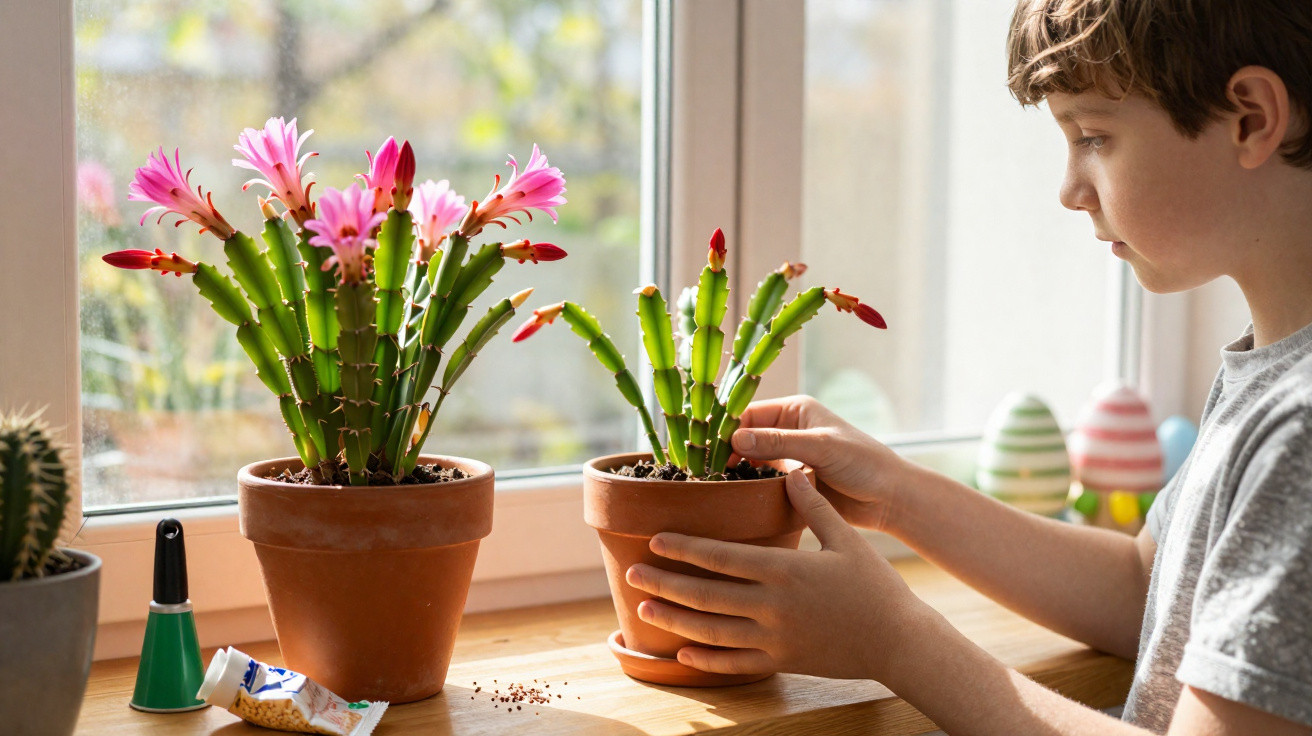
Many Easter cactus owners run into exactly this problem - usually because of one simple mistake made over winter.
At the garden centre the Easter cactus was covered in vivid, star-like flowers; at home it bloomed once more - and the following year: nothing. Just lush green shoots, not a single sign of buds. That’s rarely down to a “black thumb” and almost always comes from a winter period that’s been handled badly. If you understand the rhythm of this distinctive houseplant, you can have it flowering on cue for Easter year after year.
What makes the Easter cactus so special
The Easter cactus (botanical name Rhipsalidopsis, also known as Hatiora) isn’t a desert plant at all, but a tropical epiphyte. In its native habitat - the humid forests of South America - it grows on branches and in branch forks, surrounded by moss, leaf litter and air that stays gently moist.
That background explains why it behaves differently in our homes:
- Position: bright, but out of harsh direct sun; ideally an east- or west-facing window
- Compost: loose, free-draining and lightly humus-rich; not a dense, heavy lump of standard potting compost
- Humidity: moderate; not bone-dry like true desert air
Its natural flowering window is between March and May. Then it produces star-shaped blooms in pink, red, orange or white, emerging from the tips of the flattened segments.
Easter cactus is not Christmas cactus
The Easter cactus is often confused with the Christmas cactus. The differences matter, because their care requirements are noticeably different.
| Feature | Easter cactus | Christmas cactus |
|---|---|---|
| Flowering time | Spring (March–May) | Late autumn/winter |
| Segment shape | More rounded, gently scalloped | Clearly toothed, sharper |
| Flower shape | Star-like, upright | Drooping, tubular |
If you treat an Easter cactus like a Christmas cactus - keeping it warm and actively growing through winter - you remove the exact signal it needs to set buds.
The real sticking point: the winter rest
“Most Easter cacti stay green because they’re kept too warm in winter and get too much light and water.”
In nature, the Easter cactus experiences cooler, slightly darker months. You need to recreate that period indoors; otherwise the plant thinks, “Same as always - no reason to flower.”
What the ideal rest period looks like
The key window runs from late autumn into late winter, roughly November to the end of January. During this time the Easter cactus needs a clear ‘winter switch’:
- Temperature: 10–15 °C - for example a cool spare room, a hallway window, or a bedroom that isn’t constantly heated
- Light: around eight hours of daylight; avoid strong artificial lighting in the evening
- Darkness: at least twelve hours of genuine darkness - no constant light from a television, ceiling lamp, or a brightly lit shop window opposite
- Duration: keep it up for about 8–12 weeks, without constantly moving the plant around
This phase works like a trigger. When temperatures begin to rise again towards the end of winter, the Easter cactus starts to form buds - in time for the holidays.
Watering by season: how much water an Easter cactus needs
Watering should follow the plant’s natural cycle. A simple seasonal schedule helps avoid the most common mistakes.
Spring and summer: growth and a need for nutrients
From March into late summer, the Easter cactus grows actively and uses energy for new segments and flowers.
- Watering: every 7–14 days, once the top layer of compost has dried
- How to water: water thoroughly, then tip away any excess from the saucer after a few minutes
- Feed: every four to six weeks with a lightly diluted cactus feed or a general houseplant feed
Soggy compost quickly leads to soft, glassy segments - a warning sign of root rot. It’s far better to underwater once than to overwater five times.
Autumn and winter: slow things down
From autumn onwards, ease the plant gradually into rest:
- Increase the interval between waterings; only moisten lightly
- Stop feeding from October
- During the actual rest period, a small glass of water every three to four weeks is often enough
The segments can draw in slightly, but shouldn’t shrivel completely. If that balance is right, the watering level is too.
Common mistakes that stop flowering
Winter spots that are too warm
The classic scenario: the pot sits right next to a radiator or spends all winter in a living room at around 20 °C. The plant may keep growing, but it forms few buds because it never receives the ‘cool’ cue.
Better: choose a consistently cool location, such as a north-facing window in the hallway. A brief cold spell won’t do - the plant needs weeks of reliably lower temperatures.
Artificial light at the wrong time
Easter cacti respond to the length of the night. If the ceiling light or a bright floor lamp stays on late into the evening, the plant doesn’t ‘register’ a long dark period.
During the rest period, switch lights off earlier in the evening or move the plant to a room that truly stays dark. Even the constant glow of a nearby aquarium can disrupt its rhythm.
Shock after buds have formed
Once buds appear, they’re very sensitive. Common reasons buds suddenly drop include:
- moving the pot to a different room right after budding begins
- cold draughts at the window, for example from prolonged airing
- sharp temperature swings, such as opening and closing the window repeatedly
- letting the compost dry out completely, or suddenly soaking it
At this stage the rule is: disturb the plant as little as possible, never place it directly by an open window, and water regularly but sparingly.
Compost, repotting and humidity
The compost plays a major role in both health and willingness to flower. Dense potting compost that stays wet for a long time is bad news for the roots.
The right mix for Easter cacti
A suitable mix is typically:
- about two-thirds high-quality, loose potting compost or a specialist epiphyte compost
- about one-third mineral material such as perlite, coarse sand or pumice
- optionally, a little fine pine bark to add structure and airiness
Repot every two to three years, ideally in late spring after flowering. The new pot should only be slightly larger, because too much volume keeps the compost damp for longer.
Raising humidity without drowning the plant
Warm, dry air from radiators can dry the segments and make buds drop more quickly. Instead of constantly misting, use a simple method:
- fill a saucer with expanded clay pellets or gravel
- add water, but not so much that the pot sits in it
- place the pot on top of the stones - the rising moisture improves the microclimate
This keeps the air a little more humid while leaving the root ball dry enough.
A practical year plan for abundant Easter flowers
If you want to guide your Easter cactus deliberately, this rough annual plan is a good reference:
- March–May: flowering period; bright spot with no direct sun; moderate watering; don’t move it during the budding phase.
- June–August: growth period; it can spend time outdoors in a bright, sheltered place (balcony, terrace); water regularly and feed occasionally.
- September–October: gradually reduce watering; bring the plant back indoors; keep it somewhere bright but already a little cooler.
- November–January: rest period at 10–15 °C; little water; limited light; long nights.
- February: move it gradually to a warmer, brighter position; increase watering slightly - the starting signal for new buds.
If you stick to this routine, you’ll bring a small firework of starry flowers into your living room every year - and the frustrating sight of a purely green plant at Easter will be a thing of the past.



Comments
No comments yet. Be the first to comment!
Leave a Comment