
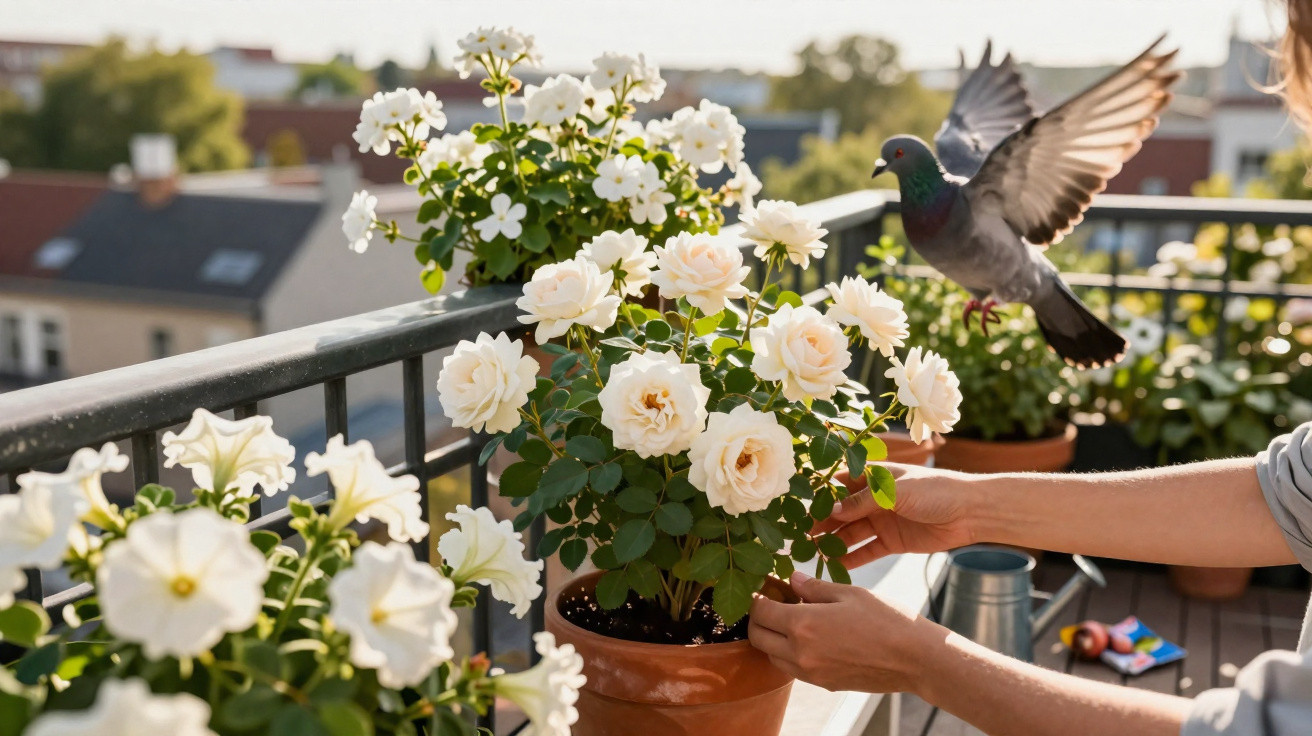
Newly planted lettuces, young cabbage plants, carefully arranged window boxes - and then pigeons drop in, tug at plants, scratch around and leave mess behind. Instead of fiddly netting and spiky deterrents, some gardeners are now trying a surprisingly straightforward approach: white-flowering plants that are said to act like a visual warning signal for birds, encouraging them to keep their distance.
Why pigeons love gardens and balconies so much
Pigeons are classic seed and plant eaters. To them, a vegetable patch is essentially a ready-laid buffet. They peck at:
- freshly sown seeds pulled from the soil,
- delicate sprouts and young plants,
- soft vegetable leaves such as cabbage, broccoli or peas,
- tender new shoots on ornamental plants.
In towns and cities there is another issue: balconies provide perches in sheltered positions, close to food sources and often with suitable spots for nesting. The result is fouled tiles, dirty furniture and unpleasant smells. It is hardly surprising that many people quickly turn to harsher measures - often with very mixed results.
White flowers as a warning signal for birds
Anyone who wants to drive pigeons away needs to understand how they perceive their surroundings. Colour matters more than many realise. Horticultural specialists report that, in particular, the sharp contrast of pure white can function like a warning colour.
"White can act as a kind of visual stop signal for many birds - similar to a warning flash in road traffic."
In nature, many bird species use pale or white patches in their plumage to communicate with one another. Sudden flashes of white feathers can signal agitation, flight or danger. When a section of garden is suddenly dominated by strikingly bright blossoms, some species appear to associate it with these kinds of visual alarm cues.
Gardeners try to turn exactly this effect to their advantage: a clearly defined area of white flowers is intended to unsettle pigeons and suggest that this is not a calm, safe place to feed or rest. Rather than settling in the middle of a veg bed, they are more likely to choose another spot.
The classic among “protective plants”: the Iceberg rose shrub
One name comes up especially often in this context: the “Iceberg” rose shrub. This variety is considered hardy, produces masses of flowers and is very noticeable from above.
- Flower colour: white to creamy white
- Flowering period: all summer, often into autumn
- Height: around 1.2 to 1.5 metres
- Spread: about 0.8 to 1 metre
Placed well, the shrub creates a bright, pale focal patch that stands out immediately from both ground level and the air. Planting several side by side quickly forms a continuous “wall of light” around a vulnerable area.
"A vigorous rose shrub with white flowers can work like a living fence that puts pigeons off flying into the bed."
Other white flowers that can unsettle pigeons
It does not have to be the rose classic. What matters is a clearly visible, continuous block of pale flowers. Options that gardeners commonly find effective include the following.
Cushion plants with white flowers
Compact perennials such as Nierembergia (often sold as cupflower) form small, dense cushions of around 30 centimetres in height. In summer, countless small white flowers cover the foliage - ideal for brightening up low edging around beds.
Large-flowered attention-grabbers such as angel’s trumpets
Plants with big, trumpet-shaped white blooms catch the eye instantly. From a distance they create an unmistakable signal. If kept in pots, they can be positioned precisely where pigeons typically like to land.
Classic balcony plants in white
On balconies, it makes sense to use popular varieties available in white forms, for example:
- petunias,
- white geraniums,
- trailing verbenas,
- hydrangeas in pale shades for larger containers.
They create a continuous, highly visible planting line along the railing. From a pigeon’s perspective, it reads like a bright strip that makes a confident approach and landing more difficult.
How gardeners position plants for maximum effect
A single white flower in the middle of a bed will do very little. The impact only builds when there is a clear, easy-to-read structure. Many hobby gardeners plan their “pigeon deterrent” in much the same way they would plan a hedge.
In the vegetable garden
- Plant white rose shrubs or hydrangeas along the fence,
- create a closed planting band of white perennials as a ring around sensitive crops (for example lettuce, cabbage and young herbs),
- edge beds with white ground cover or low-growing flowering plants.
This produces a kind of pale frame around the area pigeons are meant to avoid. The contrast with the surrounding greenery is crucial. The more continuous the line, the stronger many gardeners find the effect.
On balconies and terraces
Here, there is usually not enough space for large shrubs. Even so, the same principle can be applied:
- Fill long window boxes with purely white flowering plants and hang them directly on the railing,
- place taller pots of white-flowering plants in corners where pigeons tend to settle,
- avoid leaving open, empty areas on the railing or floor - in other words, place plants, furniture or decorations so there is as little “clear space” as possible.
"The less ‘clear runway’ pigeons can see, the less appealing the spot becomes - and the white flowers reinforce that impression."
How to strengthen the effect further
Many gardeners combine white-flowering plants with other, relatively gentle deterrents. Commonly mentioned elements include:
- scented geraniums or strongly aromatic herbs such as rosemary and thyme,
- marigolds in the bed, which also attract insects and benefit helpful species,
- plastic birds of prey placed clearly visible in an elevated position,
- wind chimes or reflective ribbons that move and create flashes of light.
None of these methods is guaranteed to work on its own. Together, however, they can create a setting that feels unsettled, uncertain and visually conspicuous to pigeons. They often opt for calmer places instead - ideally well away from your own garden.
What gardeners should consider before planting
White-flowering plants are not only beneficial. Anyone choosing them specifically to discourage pigeons should keep a few points in mind:
- Some varieties, including certain angel’s trumpets, are poisonous and therefore unsuitable for households with children or pets.
- Shrub roses can reach substantial sizes and will not fit every small garden plot.
- Many white-flowering plants need plenty of sun to bloom profusely.
- Dense planting requires regular maintenance, pruning and watering.
If you are unsure, ask for advice at a garden centre and choose varieties that suit your conditions. The key point remains: without strong growth, you will not achieve a clearly defined bright flowering area - and without that, there is little meaningful deterrent effect.
Why natural methods are in such high demand
Many people do not want to use poisonous sprays or sticky products to keep pigeons away. They are looking for options that blend into the overall look of the garden and do not cause harm. White-flowering plants offer exactly that: they enhance the space, support insects and can reduce pigeon activity at the same time.
It will not usually make a city balcony or an open garden completely pigeon-free. However, anyone who plants consistently and makes the area feel less welcoming to birds often finds pigeons settle less frequently, and sensitive young plants get through the early stages more successfully. For many hobby gardeners, that alone is a significant step towards a more relaxed gardening season.
Comments
No comments yet. Be the first to comment!
Leave a Comment