
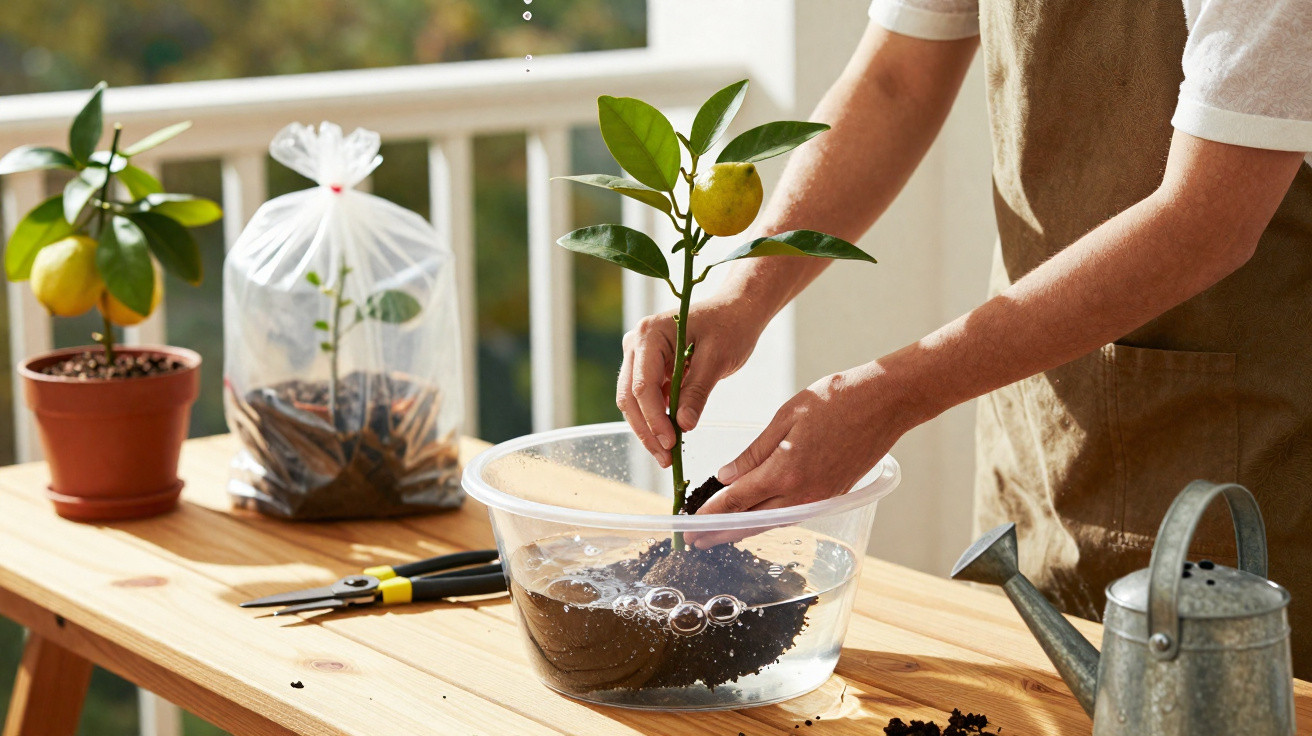
Many keen gardeners throw out a lemon tree too quickly when it’s dropped every leaf and looks completely dried out. Yet a seemingly dead potted citrus can often be brought back within a few days using a straightforward, almost cost-free rescue routine. What matters is judging the plant’s condition accurately, making a bold but precise prune, and then following a specific “water treatment” with a small, practical household trick.
Is the dried-out lemon tree really dead?
A bare lemon tree with rigid twigs and bone-dry compost can trigger instant panic. In most cases, though, it isn’t beyond saving-it’s suffering from severe lack of water. The root ball can dry so much that it shrinks away from the edge of the pot. When you water from above, the water then runs straight down the sides, never reaching the fine roots.
The plant switches into survival mode: it drops its leaves, stops growing and looks lifeless. Before you send it to the compost heap, it’s worth doing a quick vitality check.
- Use a fingernail to scrape away a tiny patch of bark from a twig.
- If the tissue underneath is green to pale, that section is still alive.
- If it’s brown and hard, that part has died back.
If you can find green tissue in several places, your lemon tree has a genuine chance of recovery.
A leafless lemon tree isn’t automatically dead-green vascular tissue beneath the bark is the most important sign of life.
Day 1: hard pruning and a water bath instead of a watering can
Shorten the crown and remove dead sections
To help the tree focus its limited energy on fresh growth, start with a decisive prune. Clean, sharp and disinfected secateurs are essential-otherwise rot and disease become much more likely.
As a rule of thumb, you can remove around a third of the crown. Cut all fully dry, brittle branches back to living wood. Remove thin, desiccated twiglets and any limp, leftover leaves without hesitation. What should remain are sturdy, healthy framework branches where sap flow is still present.
If you want to, you can seal larger cuts with tree wound wax. It can reduce infection risk, but it isn’t essential if your cuts are neat and your tools are clean.
The crucial water bath: letting the root ball rehydrate properly
At this stage, ordinary top-watering often fails because the severely shrunken compost won’t absorb water. This is where the classic “grandma method” comes in: fully soaking the pot.
- Fill a tub, bowl or bath with lukewarm water (about 20 °C).
- Place the entire pot in the water, up to just below the rim.
- Leave it for at least 15–20 minutes; if the compost is extremely dry, allow 1–2 hours.
- Rising air bubbles are a good sign-they show the root ball is taking up water again.
Once the bubbles stop, lift the pot out and leave it to drain thoroughly in a shaded spot-without a saucer-so no waterlogging develops. This drying/draining phase should last at least 24 hours.
Home “mini greenhouse”: a microclimate for a restart
Why high humidity helps the tree recover
After soaking comes the second key factor: a humid microclimate. With few or no leaves and weakened roots, the tree can only transport water to a limited extent. High humidity reduces evaporation stress and makes it easier for new shoots to get going.
In practice, you can do this with a simple transparent plastic bag-such as a garment cover or a large freezer bag:
- Loosely place the bag over the entire crown.
- Secure it around the pot with an elastic band or string.
- Put the tree somewhere bright but out of direct sun, ideally at 15–18 °C.
The plastic cover turns the lemon tree into an improvised mini greenhouse with almost 100% humidity-ideal for new growth.
The bag shouldn’t stay sealed tight for days on end. Every two days, give the plant fresh air for about ten minutes to prevent mould. If the inside of the bag is misted up, you’ll know the humidity is right-just remember to open it briefly and regularly.
Common mistakes: fertiliser and sun arrive too soon
When a plant struggles, many gardeners instinctively reach for fertiliser. With a severely stressed lemon tree, that reflex can do real harm. The roots are already compromised, and mineral-rich feed can even scorch the delicate root tips.
So follow these rules:
- Until buds are clearly swelling, keep fertiliser off the agenda.
- Strong sunshine immediately after the rescue routine is also unhelpful. At first, the tree needs bright, indirect light only.
- Only water again when the well-known “finger test” indicates dryness.
For the finger test, push your index finger about 3 cm into the compost. If that layer still feels noticeably damp, wait. Only when it feels dry at that depth should you water thoroughly-enough that a little water runs out of the drainage holes so the whole root ball is moistened again. Standing water in the saucer remains strictly off-limits, because stagnant wetness deprives roots of oxygen.
The first 15 days: what to do and when
Days 2 to 7: calm, monitoring, no experiments
In the first week after the soak, the real recovery work happens out of sight. The plant tries to reactivate fine root tips and dormant buds. During this period, the best help is minimal interference.
- Keep the plastic bag over the crown, opening it only briefly for ventilation.
- Position the pot in a bright, draught-free place with a steady 15–18 °C.
- Check the compost once a day with the finger test; don’t keep watering “just in case”.
- Avoid changes: no moving it around, no repotting, no long stints on the balcony or patio.
Staying patient at this point improves the odds considerably. Frequent relocations and constant tinkering waste energy the tree needs for recovery.
Days 8 to 15: first buds, gradually more freedom
After roughly a week to 15 days, many rescued lemon trees begin to respond: tiny buds on the wood start to plump up, and sometimes pale green new leaves appear.
Once the buds are clearly swelling, start increasing airflow. Don’t remove the bag in one go-phase it out:
- Loosen the fastening at the bottom first so a little air can circulate.
- After one or two days, open the bag slightly at the top during the day.
- When the young leaves look stable, remove the cover completely.
Temperatures can now rise to about 18–22 °C, and the plant can handle more light gradually. A freshly recovering lemon tree still won’t appreciate direct midday sun; lightly filtered light by a bright window or in a sheltered outdoor spot is a better next step.
When fertiliser, repotting and summering outdoors make sense
Only once the tree has produced a clearly visible flush of new leaves should you move into the rebuilding phase. At that point, you can introduce a specialist liquid fertiliser for citrus plants-at half strength, about every three weeks. The tree needs time to adjust to extra nutrients.
Repotting is only advisable if the old root ball feels heavily compacted or you can see roots circling at the bottom of the pot. Use a loose, free-draining citrus compost mix, ideally with a little coarse sand or expanded clay mixed in. Repotting can support the rescue, but it isn’t the main event.
Putting the plant outside in summer should wait until the lemon tree looks vigorous again, is producing new growth, and night temperatures are reliably above 10 °C. Start with a few days in partial shade before moving it on to brighter positions.
How to prevent another emergency
To stop your lemon tree drying back to a bare skeleton again, it helps to review everyday care. Citrus plants like consistent moisture, but never constant wetness. A useful rule: water generously, then allow the compost to dry out well. Watering by feel rather than by calendar is usually safer.
Choosing a sufficiently large pot and a good-quality compost that doesn’t shrink rapidly also helps prevent the “dried root ball” problem. Terracotta pots look attractive, but they draw more moisture from the compost than plastic pots. If you travel often, factor that in-using saucers only temporarily filled with water, or holiday-watering systems designed for citrus.
If you watch your own lemon tree closely, you’ll spot stress early: drooping leaves, the first yellow tips, or a pot that suddenly feels unusually light. Acting then means you’re unlikely to need the full grandma routine of plastic cover and water bath-though it’s worth knowing, in case the tree ever seems lifeless again.
Comments
No comments yet. Be the first to comment!
Leave a Comment