
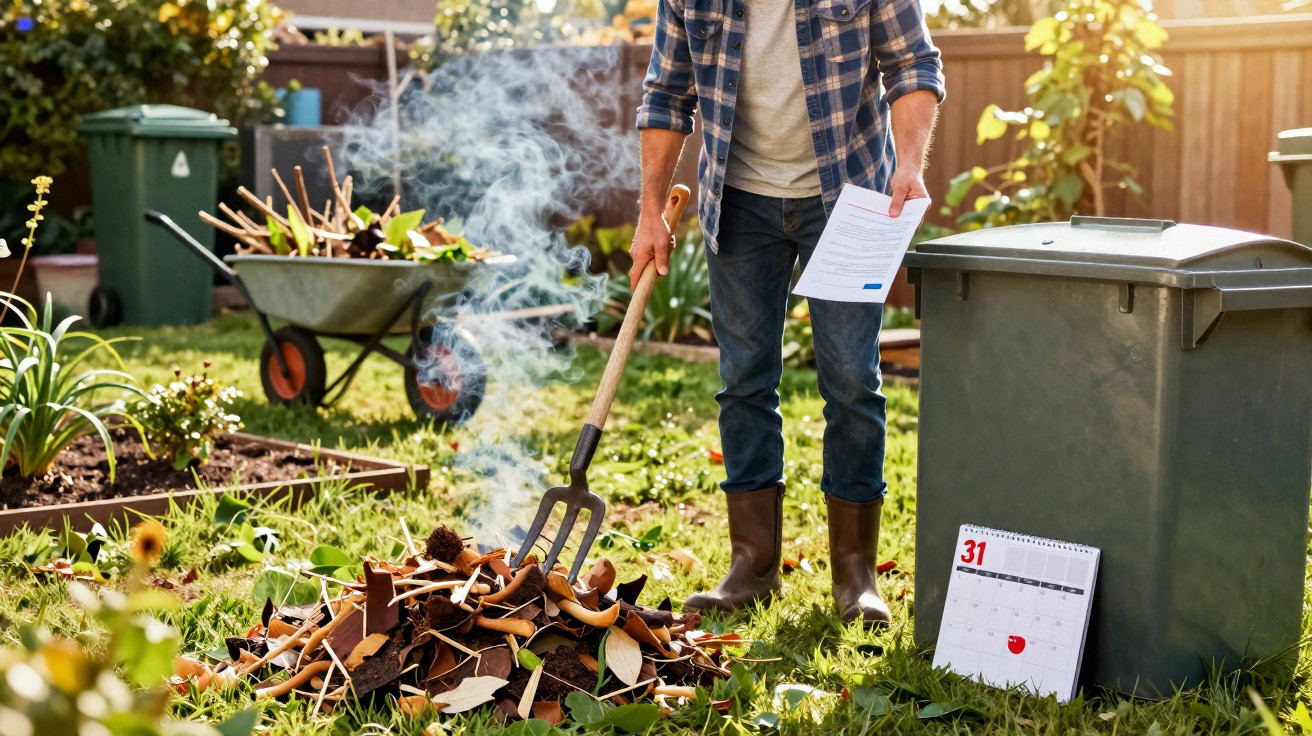
Across many local authorities, 31 March has become an unofficial deadline for a practice that used to be routine: pile up leaves and garden cuttings, set light to them, job done. What some still see as practical garden maintenance is now viewed nationwide with suspicion - as a source of air pollution and a destroyer of useful resources. And each year, policymakers tighten the rules a little further.
Why burning garden waste is actually prohibited
Legally, the position has been settled for years: under the Circular Economy Act (KrWG), burning garden waste is generally forbidden. The thinking is straightforward. In the eyes of the legislator, green cuttings, leaves and branches are valuable raw materials - not rubbish that should simply be turned into smoke.
"Anyone who sets fire to leaves and shrub cuttings creates fine dust, smoke and odours - while also throwing away future humus and nutrients."
Even so, despite the general ban, there are still many exceptions. German federal states can issue their own regulations, and districts and municipalities can in turn adopt their own by-laws. These often spell out precisely when, and under what conditions, garden bonfires may be permitted as an exception - usually only on certain days and only up to a fixed spring cut-off date.
Deadline 31 March: what applies in many municipalities
In many areas, the burning season ends on 31 March. Some places allow it until mid-April, but after that it is effectively over. Anyone who still lights a fire then is breaching waste legislation and could face a fine.
Typical rules used by many councils include:
- Burning is permitted only on specific weekdays and at set times
- Only dry garden waste may be burned - no kitchen waste and no treated wood
- Minimum distances from buildings, hedges and roads are required
- Consideration for neighbours: heavy smoke or strong smells can make burning unlawful
- Usually a strict limit up to 31 March or 15 April
If you ignore these requirements, depending on the federal state you may be looking at fines well into the hundreds of euros. It becomes particularly risky if the fire gets out of control and the fire service or police have to attend - because then call-out costs may be added.
Example Saxony-Anhalt: fines from April
In Saxony-Anhalt, many municipalities can still grant residents exceptions up to the end of March. After that, the general principle applies again: burning is prohibited. Anyone who continues to burn leaves or shrubs is committing an administrative offence.
Authorities justify the approach on several grounds:
- Improving air quality in residential areas
- Protecting residents with respiratory conditions
- Reducing fire risk during dry periods
- Better protection for animals hiding in leaf piles
Especially in spring, many bird species and insects use leaf heaps as shelter. Burning everything destroys that habitat - a factor that is playing an increasingly prominent role in current nature conservation strategies.
Mecklenburg-Vorpommern plans a complete ban from 2029
How clearly policy is shifting can be seen in Mecklenburg-Vorpommern. There, burning garden waste is due to be fully banned from 1 January 2029. The state government aims to implement federal waste law more consistently and to protect both air quality and the climate.
"In future, garden waste should be treated consistently as a recyclable material - not as fuel in the back garden."
Steps like this are widely seen as a signal to other federal states. Many municipalities are already tightening their own by-laws in advance, reducing the number of permitted burning days year after year. In some towns and cities, private garden fires are already completely prohibited.
The better solution: compost, brown bin, recycling centre
If burning is not allowed, there are several legal ways to get rid of garden waste - and they are often far more sensible than setting it alight.
| Option | Advantage | Suitable for |
|---|---|---|
| Home composting | Produces free compost, reduces the need to buy soil improvers and fertiliser | Leaves, grass cuttings, small branches, plant waste |
| Brown bin (garden/food waste bin) | Convenient disposal collected and processed by the council | Leaves, grass cuttings, chopped green waste |
| Recycling centre / green waste drop-off point | Accepts large volumes and thicker branches | Hedge trimmings, tree cuttings, larger amounts of leaves |
| Municipal composting facilities | Professional processing, often low-cost drop-off | Mixed garden waste, including larger quantities |
If you have the space, a compost heap in your own garden is often the best option. Over one to two years it produces valuable humus that feeds beds, lawns and container plants - closing the loop directly on your own property.
What gardeners should do now
To avoid unpleasant surprises from April onwards, it is worth doing a quick check now. Each municipality can set different deadlines and conditions. The details are usually published on the town or district website, and sometimes in official gazettes or public notices.
Key steps at a glance:
- Check the municipal by-law or waste regulation online
- Make a note of the cut-off date: until when is burning still permitted?
- Follow permitted hours and requirements (distances, pile size)
- Tell neighbours in advance to avoid conflict
- Switch long-term to composting or the brown bin
Anyone who moves over to alternative disposal routes now will not have to worry next year about deadlines and bans.
Why garden bonfires cause disputes between neighbours
Beyond the legal wording, the issue has a very practical side: in densely built-up neighbourhoods, few things cause conflict as quickly as smoke drifting from the garden next door. It finds its way into bedrooms and children’s rooms, hangs over balconies, makes washing smell, and can trigger problems for people with asthma.
This is exactly where many councils focus their enforcement. They point to the so-called “duty to be considerate”: even where a fire might be allowed on paper, it can still be unlawful if it significantly affects neighbours. If someone then refuses to cooperate, they risk not only letters from the authorities, but also long-term hostility on the street.
Fine dust, climate, wildlife: the underestimated side effects
What seems small in a single garden adds up at a regional level. Lots of small fires generate fine particulate matter, nitrogen oxides and soot. In some municipalities, readings on typical “burning days” can even exceed levels seen on normal traffic days.
There is also the loss of nutrients. Leaves and plant remains contain potassium, phosphorus and other minerals. If they are burned, these substances are largely lost. If they are composted, they return to the soil and improve its structure.
Another factor is wildlife. Hedgehogs, insects and many other animals spend the winter in piles of leaves and twigs. Anyone burning everything in early spring often catches them at a particularly vulnerable time. Nature conservation organisations therefore recommend leaving leaf piles in place for as long as possible, or carefully turning them over, rather than setting them on fire.
How a modern garden can produce less waste
Many problems only arise because large volumes of green material appear all at once. If you plan your garden slightly differently, you automatically reduce waste - and with it the disposal pressure in March.
Practical approaches include:
- Cut hedges less often, but more deliberately
- Leave leaves under shrubs instead of clearing everything away
- Mulch grass cuttings in a thin layer rather than removing them all
- Create a deadwood corner instead of disposing of every branch
This not only reduces the amount of “waste” that has to go somewhere. It can also make the garden more alive, provide more habitat, and often reduce the need for fertiliser and watering.
Key legal terms explained
When people look into the newer rules, they quickly come across technical language. Two terms appear particularly often:
Circular Economy Act (KrWG): A federal law that sets out how waste must be handled. The goal is to reuse and recycle raw materials as far as possible. Within that framework, burning sits right at the very end of the hierarchy.
Biogenic raw materials: Anything of plant or animal origin that can be returned to natural cycles. In the garden this includes leaves, grass, shrubs, branches, plant remains and similar materials.
Understanding these terms makes one thing clear: from the legislator’s perspective, the garden is not a dumping ground, but a small source of raw materials. Ideally, those materials should be reused on-site or through municipal systems - rather than going up in smoke in March.

Comments
No comments yet. Be the first to comment!
Leave a Comment