
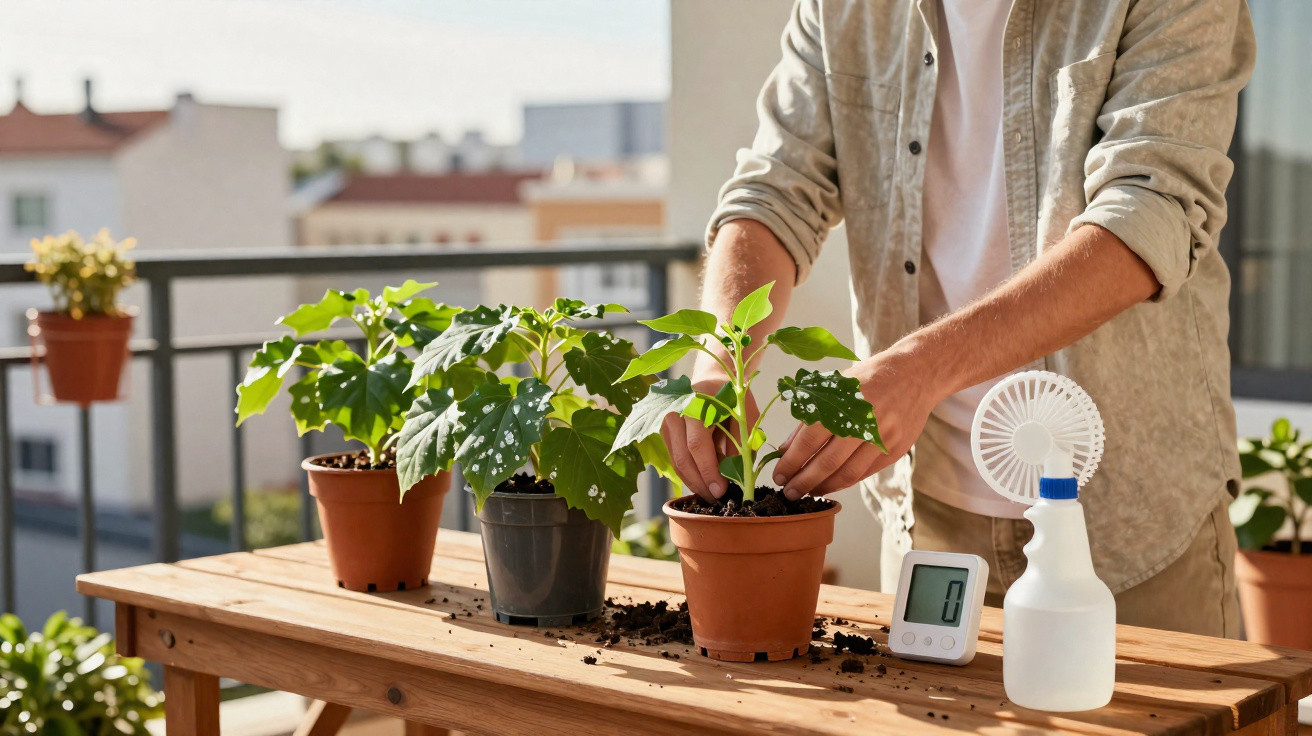
The leaves had looked flawless that morning: green, shiny and without a single crisped edge. Nearby, the watering can still held beads of water, seeming to confirm the attentive care. Terracotta pots stood tightly along the balcony rail, crammed with basil, mint, cherry tomatoes and petunias. It was the sort of thick, thriving display made for Instagram.
Then, seemingly overnight, the picture changed. Yellow patches appeared. One stem developed a furry grey area. Within two days, the soil gave off a sour odour whenever you passed close by. The watering schedule was unchanged, and the owner insisted they were doing “everything right”.
The real issue was sitting in full view: in the gaps between leaves that were packed too tightly together.
When plants seem healthy… until they suddenly are not
When you look at an overcrowded planter, pride is often the immediate reaction. There is so much growth and greenery, all pressed together like a miniature forest on a windowsill. It can feel like proof that you have discovered a clever gardening secret.
Yet the situation shifts quickly when plants are touching, sharing a thin pocket of air and competing for every bit of light. Moisture remains on foliage for longer, air circulation slows, and unseen spores, bacteria and pests gain an ideal place to establish themselves and spread.
What looks like abundance from the outside may be concealing a very different process within the foliage.
Urban gardeners often tell a similar story about their first encounter with mildew. “I was watering so carefully, only at the base, never on the leaves, and still the white powder arrived.” One woman I spoke to watched her balcony cucumbers fail within a week. In one long, narrow planter, she had created an actual wall of vines. It was spectacular in June.
By the beginning of July, the central leaves had become pale and floppy. She changed her watering, applied a copper spray and even cut away several yellow leaves. None of it helped. Beneath that green screen, where foliage constantly rubbed against foliage, humidity never had the chance to fall. Fungal spores needed only that single sheltered, congested area to start an epidemic.
Viewed from the street, her balcony continued to look verdant. At close range, however, it was a disaster unfolding slowly.
Gardening advice often presents “watering properly” as though it were the master key. Water certainly matters, but plants do not exist on water alone: they also depend on air. Once they are squeezed together, the microclimate around them turns from beneficial to hazardous.
Leaves transpire and release water vapour. In a generously spaced bed, moving air carries that moisture away. In a crowded pot, it stays trapped. The result is continually damp leaf surfaces, too little light for inner foliage and poor air movement. These are ideal conditions for powdery mildew, downy mildew, leaf spot and root rot to move from one plant to another.
You may apply water with surgical accuracy, but plants that cannot breathe can still become ill.
Spacing plants like a professional: the unglamorous secret
The easiest action for preventing disease is also one of the least photogenic: allowing plants room. This does not mean the extravagant spacing of a dream garden or magazine cover, only enough room for light and air to pass between the stems.
Begin with the seed packet or plant label. It will normally give a spacing range rather than one fixed, perfect measurement. If it says “20–30 cm apart”, many people using compact urban containers will choose 20 cm. Instead, aim for the upper end of that range. Set out fewer seedlings and give every plant the space it genuinely needs to grow.
Next, try a simple hand test. If you can put your hand between the plants without pushing leaves aside, they are probably receiving sufficient air. If you cannot, they are already competing to survive.
Most of us know the feeling of returning from the garden centre with four times as many plants as intended. A tray can look rather sad when only two or three plants go into each pot. Your heart says, “Squeeze them in, they’ll adapt.” Three weeks later, your future self may be silently cursing at the first blackened stems.
A useful approach is to decide precisely how many plants each container will hold before planting begins. Say, “This box gets three basil, not six.” Then keep to that decision. Spare plants can be moved elsewhere, given away or used for a second planting later in the season. In truth, hardly anyone manages this every single day, but trying it once or twice a year can begin to reshape your habits.
The restraint is painful briefly; the benefit remains for the entire season.
Sometimes the healthiest plant is the one you decide not to plant.
- Thin decisively once – Once seedlings are established, take out the weakest plants early. A single robust plant is better than five spindly ones competing in a restricted pot.
- Use staggered rows – In beds and planters, arrange plants off-set so that leaves neither shade nor touch one another directly. A straightforward zigzag layout improves airflow.
- Raise and separate plants – Keep containers and foliage apart where possible to reduce persistent dampness and contact.
- Rotate crops by family – Avoid repeatedly growing plants from the same family in the same place.
- Monitor the middle – The centre of a packed pot is the risk area. When disease repeatedly begins there, spacing and airflow need improving.
The hidden ecosystem between plant leaves
Once you focus less on each individual plant and more on the space separating plants, the whole view changes. Rather than seeing a pot as simply “full or empty”, you begin to recognise a living ecosystem. It contains air, moisture, microscopic organisms, decomposing leaves, fragments of mulch and slowly spreading roots beneath the surface.
Overcrowding squeezes all of this into a confined, stressful setting. Disease exploits stress like a motorway. If roots cannot extend, leaves cannot dry and one infected leaf touches five healthy ones, one small issue can become a crisis for the whole group. The most troubling aspect is how quietly it starts: a shaded section of soil that never dries, a leaf that remains wet until evening, or a tiny wound where a pest has pierced a stem.
Careful watering cannot make up for poor spacing. It only postpones the point at which the damage becomes obvious.
| Key point | Detail | Value for the reader |
|---|---|---|
| Give plants generous space | Follow the upper end of label spacing guidance and stop leaves from touching constantly | Fewer cases of mildew, rot and leaf spot, even with regular watering |
| Make airflow a priority | Use staggered arrangements, prune crowded centres and avoid foliage forming an unbroken wall | Leaves dry more quickly, the microclimate remains healthier and treatments perform better |
| Observe the microclimate | Identify where dampness lingers and disease repeatedly begins, then alter the planting density | Recognise early warning signs and stop disease before it spreads |
FAQ:
- How can I tell if my plants are overcrowded? Try sliding your hand between them. If you brush or bend leaves every time, they’re likely too close. Repeated disease in the same pot is another strong clue.
- Can good watering compensate for tight spacing? Not really. You can reduce risk a bit by watering at the base in the morning, but poor airflow and constant leaf contact will still favour disease.
- Is overcrowding worse in containers than in the ground? Yes, usually. Containers have limited soil volume and restricted root space, so stress builds faster and diseases spread quicker in tight quarters.
- Should I remove healthy plants to improve spacing? Sometimes that’s the best move. Transplant extras to another pot, share them, or compost the weakest. One thriving plant beats a crowded bunch that all get sick.
- How often should I thin or prune to prevent disease? Do a quick check every couple of weeks in the growing season. If the centre looks dark, damp, or leaf-packed, thin or prune lightly to reopen the airflow.
Comments
No comments yet. Be the first to comment!
Leave a Comment