
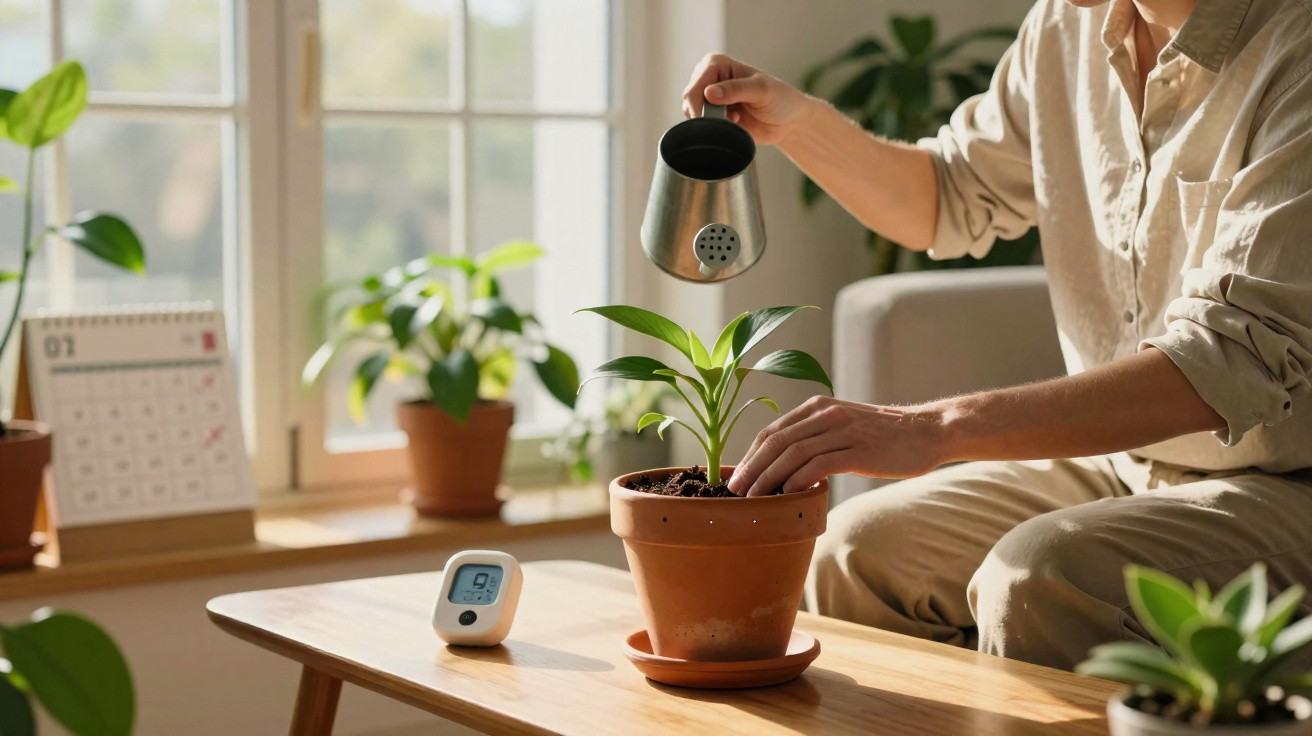
You know that small, guilty look you give your plants as you snatch up your keys and dash out of the door? Maybe you prod the compost with a finger, give a little shrug, and pour in a quick splash “just in case”. Or, worse, you drench the pot until the saucer turns into a miniature bath - then leave feeling oddly proud, as if you’ve done something properly responsible.
A week later, the leaves are turning yellow, sagging, or dropping off one after another for no apparent reason. You chalk it up to your “bad luck with plants” and start browsing plastic ones online.
There’s one behaviour nearly everyone slips into without realising. It feels sensible. It feels kind. And it’s exactly why so many plants fade away on windowsills and kitchen counters.
The habit that’s killing your plants without you noticing
Most people don’t really grow plants. They cultivate a watering routine.
Same day, same time, every week - like a reminder you could practically set and forget. Watering turns into a ritual: Saturday morning, coffee in one hand, watering can in the other, moving from pot to pot like you’re calling the register. It looks neat. It feels predictable.
But plants don’t run on your timetable. They respond to light, temperature, humidity, and the changing seasons. Your life may follow your diary; theirs follows something less tidy and far less accommodating.
Imagine this: Emma has a new flat, a new job, and a new snake plant on the shelf. At the garden centre she asks, “How often do I water it?” The member of staff replies, “About once a week.” That’s the only bit that sticks.
So she waters every Sunday. Some weeks the compost is still damp, but she worries about “forgetting”, so she waters anyway. Two months on, the leaves are soft at the base and slumping over like wet cardboard.
She googles “why is my snake plant dying” and gets hit with the dreaded phrase: root rot. She followed the instruction exactly. And that’s how she discovered that “once a week” can be a plant’s slow-motion death sentence.
Here’s the blunt reality: most plants don’t die from neglect - they die from well-meaning care delivered on a schedule.
When you water by the calendar, you ignore the only thing that matters: whether the plant actually needs water that day. The roots end up sitting in soggy, airless compost. Fungi move in. Leaves start signalling distress - but those signals can be easy to misread.
Yellow leaves? Must be thirsty, right? Drooping? Better add more water. So the cycle continues: the compost never properly dries, and below the surface the roots slowly suffocate.
Watering “once a week” sounds responsible. Listening to the plant sounds vague. But only one of those approaches keeps it alive.
How to unlearn the habit and water like someone plants actually survive with
The small shift is this: stop watering by date and start watering by data. Not app data. Not a Pinterest chart. Real, physical clues from the plant and the compost in front of you.
Before you even reach for the watering can, push your finger into the compost up to your first knuckle. If it feels wet, cool, or clumps together, leave it alone. If it’s dry, dusty, or pulling away from the pot edges, then it’s worth considering.
Next, check the leaves and stems. Do they look firm, upright, and glossy - or limp and weary? This isn’t a ceremony any more. It’s a quick, honest check-in.
A classic mistake is assuming every plant wants the same treatment. That geranium in a bright window drinks like a teenager after sports training. The cactus on your desk? It would prefer you forgot it existed for a while.
When you give all your plants one shared “water day”, you wipe out their individual needs. They might share a shelf, but they don’t share the same thirst. So the basil begs for more while the peace lily sits in a swamp.
Most of us have had the moment you realise the plant you drowned was meant to be “easy-care”. The change comes when you stop asking, “Is it Sunday?” and start asking, “Is this compost actually dry?”
Sometimes the best thing you can do for a plant is nothing at all. Just watch it. Let it tell you what’s going on, instead of forcing what you think should happen.
- Touch test first – Put a finger into the compost before every single watering. No exceptions, no guessing.
- Lift the pot – A light pot usually means dry compost; a heavy pot often means there’s still water lingering.
- Check the top leaves – Pale and crispy often suggests thirst; yellow and soft often suggests too much water.
- Notice the room – Warm, bright rooms dry compost faster; cool corners keep it wet for longer.
- Skip days guilt-free – Let’s be honest: nobody really does this every single day.
Once these tiny checks become habit, watering stops feeling like homework and starts feeling like a conversation.
Let your plants break your routine (and not the other way around)
Oddly, once you drop the fixed watering habit, you usually do less work - not more. You’re no longer racing around every Sunday trying to remember who got what.
Some weeks, only three plants get watered and the rest just get a quick soil check and a gentle “not yet”. Other weeks, a heatwave rolls in and suddenly everyone’s thirsty. You react, they respond, and the room gradually fills with leaves that look… alive, not merely hanging on.
You may still lose a few along the way. There will be experiments that don’t work, pots that dry out too much, and moments when you realise you missed a clue. That isn’t failure. That’s data.
| Key point | Detail | Value for the reader |
|---|---|---|
| Challenge the schedule | Stop watering weekly and start checking real compost moisture | Fewer unexplained plant deaths caused by overwatering |
| Watch the plant, not the app | Use leaf condition, pot weight, and touch as live indicators | Learn to “read” plants and build confidence |
| Accept different needs | Group plants by light and thirst, not by room or day | Stronger growth and less stress from treating them all the same |
FAQ:
- Question 1 How often should I water my plants?
- Answer 1 There’s no universal schedule that works. Use the finger test: if the top 2–3 cm of soil feel dry, it’s usually time to water for most common houseplants.
- Question 2 Are yellow leaves always a sign of overwatering?
- Answer 2 No. Yellow leaves can mean overwatering, underwatering, lack of light, or age. Soft, mushy yellow leaves suggest too much water; crisp, dry yellow leaves often suggest too little.
- Question 3 Can I save a plant with root rot from overwatering?
- Answer 3 Often, yes. Take it out of the pot, cut away brown, mushy roots, repot in fresh, well-draining soil, and water less frequently while it recovers.
- Question 4 Is a moisture meter better than using my finger?
- Answer 4 A moisture meter can help, but it’s not magic. Combine it with touch, leaf observation, and pot weight for a clearer picture.
- Question 5 What’s one simple change I can make today?
- Answer 5 Pause before every watering and do a 10-second check: touch the soil, look at the leaves, and ask, “Does this plant actually need water right now?” Then act on that answer, not the calendar.
Comments
No comments yet. Be the first to comment!
Leave a Comment