
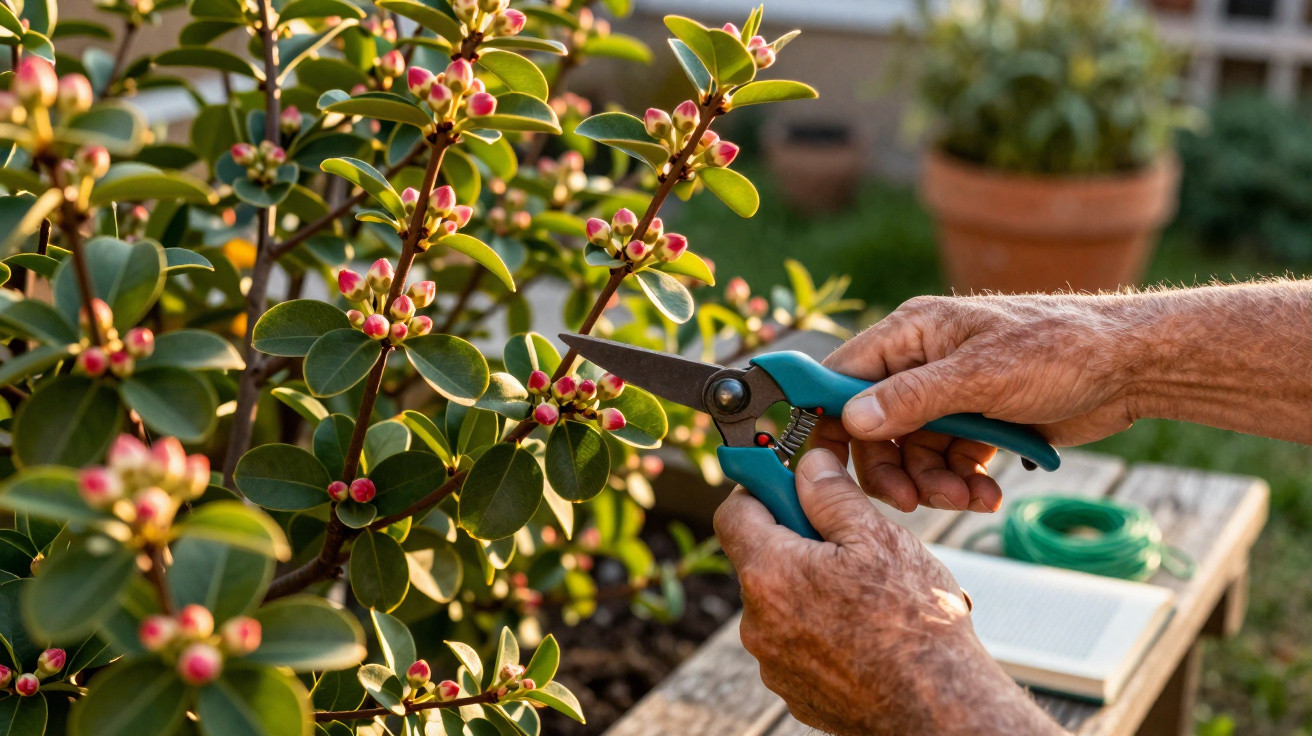
A brief warm patch in February, a pair of itchy pruning hands and a love of neatness are all it takes to reduce a winter showpiece shrub to a few bare, clipped sticks.
In gardens up and down the country, Japanese quince shrubs reach winter without a single flower - not because they are ill or frost-bitten, but because one common, well-intentioned pruning routine quietly removes almost every bud before it can open.
Japanese quince, a winter star with its own timetable
Japanese quince (Chaenomeles japonica) is among the few shrubs that can brighten the garden while most plants are still dormant. In late winter, vivid coral, red or white blooms appear directly from bare stems - sometimes with frost still lingering on the soil.
That display is planned well in advance. Through the previous summer and autumn, the shrub builds its flower buds on strong shoots that are at least a year old. Gardeners usually refer to these as “old wood”. Those small buds then sit through winter, ready to respond to the first mild days of January or February.
Japanese quince flowers on wood that grew the previous year, not on fresh shoots of the current season.
This places Japanese quince squarely among spring-flowering shrubs that bloom on old wood. Forsythia, lilac, flowering currant and ornamental cherries are familiar examples. Prune plants like these at the wrong moment, and next season’s flowers are binned before they ever appear.
A reliable guide used by experienced gardeners is this: if a shrub normally flowers before June, it is very likely to have formed its buds the previous year. Japanese quince follows that rule almost exactly.
The winter pruning reflex that ruins the show
Problems begin when Japanese quince is clipped as though it were a box hedge, or treated like a summer-flowering shrub. On a bright winter afternoon, secateurs come out and the urge to “get everything tidy before spring” takes over. Every shoot is shortened, the outline is evened up, and anything that disrupts the shape is cut away.
When this happens in January or February, the cuts remove the very stems holding the buds prepared months earlier. The plant itself is not usually put at risk, but the coming winter’s floral display is effectively cancelled. Many people only piece it together later, when the shrub stubbornly stays bare.
Pruning Japanese quince during winter dormancy often means cutting away almost all the flower buds formed the previous year.
The pruning style can also be an issue. Some gardeners repeatedly shear Japanese quince into a tight ball, cube or hedge-like block, as if it were box or privet. Heavy trimming year after year achieves two unhelpful things: it strips away flowering wood and, over time, it saps the plant’s strength by forcing constant replacement growth.
Three winter habits that cost you flowers
- Cutting every stem back to the same level to achieve a “smart” outline
- Forcing the shrub into a stiff ball, cube or flat-topped hedge
- Taking out every protruding branch in late winter
On the face of it, these steps look organised and sensible. In reality, they remove most of the bud-bearing wood and leave the shrub dominated by young shoots that are unlikely to flower in the season ahead.
The right moment: when to prune Japanese quince
The solution is mostly about timing: do not prune until the flowering has finished. Once the last blooms have dropped - typically from late winter into early spring, depending on where you live - the plant is moving into active growth and can seal and respond to cuts more readily.
Wait until Japanese quince has finished flowering, then prune lightly while new growth is just starting.
Pruning at that point does not spoil the current show, because those flowers have already opened. Instead, it helps manage the mix of old and new wood so the shrub can set up next year’s buds. This is where a restrained approach makes the biggest difference.
| Pruning time | Effect on flowers | Best practice |
|---|---|---|
| Mid-winter (Dec–Feb) | Removes flower buds, few or no blooms | Avoid unless removing dead or diseased wood |
| Just after flowering | Preserves current show, sets up next year’s buds | Ideal window for shaping and thinning |
| Late summer | Can remove forming buds if too hard | Limit to very light touch-up, if at all |
How to prune Japanese quince without losing flowers
For Japanese quince, the safest method is closer to “light thinning” than a full cut-back. The goal is to keep a natural, gently arching form, while opening the centre so light and air can circulate.
Step-by-step for a healthy, flowering shrub
- Begin by cutting out any dead, diseased or damaged branches right to their point of origin.
- Identify stems that cross or rub; remove one from each pair to reduce wounding and congestion.
- Choose a small number of the oldest, thickest stems and remove them at ground level to prompt fresh replacement shoots.
- Trim back only the longest, most unruly tips - and by no more than a third.
- Keep stepping back to check the overall shape stays relaxed and informal rather than clipped into a geometric outline.
Young Japanese quince plants need very little intervention. For the first few years after planting, they usually do best when left largely alone, apart from removing a stray branch that grows into a path or presses into neighbouring plants.
Older shrubs often respond well to gradual rejuvenation. Instead of cutting everything back in a single year, take out a share of the oldest stems annually over three or four years. This prevents the plant from losing all of its flowering wood at once.
What if you already pruned in winter?
Often the mistake has already happened by the time people come across guidance like this: the shrub has been “shaped” in February, the buds are gone, and the winter bed looks disappointingly empty. The encouraging part is that Japanese quince is generally tough.
If a hard winter trim has removed most of the potential flowers, the shrub will commonly answer by producing new shoots from the base and along the remaining framework. Avoid the urge to cut again to “fix” the shape. Let the regrowth stand and mature throughout the year. By the following summer, those new shoots can begin setting buds for the next winter or early spring.
After a heavy winter cut, patience is your ally: allow at least one full season for Japanese quince to rebuild its flowering wood.
Why Japanese quince behaves differently from summer shrubs
Much of the confusion comes from applying the wrong pruning rules to the wrong type of plant. Many summer and autumn flowering shrubs set buds on the current year’s growth - butterfly bush (Buddleja), Russian sage, and many modern roses are often treated this way. These can be cut back hard in late winter and still flower well, because they quickly push new flowering shoots once spring warmth arrives.
Japanese quince works to a different schedule. Its early display depends on buds that have already experienced winter cold - a process horticulturists call “vernalisation”. That chill triggers internal changes that allow buds to open as soon as the weather softens. If those pre-chilled buds are removed in winter, the shrub cannot create a fresh set in time for the same season.
Practical scenarios for small, busy gardens
Japanese quince is often grown in compact urban gardens or trained near walls, where every centimetre matters. In a tight space, a shrub left unchecked can feel too large. With a bit of planning, it can be kept within bounds without sacrificing flowers.
One approach is to train Japanese quince as a fan against a fence or wall. Pick several strong framework branches and tie them in at an angle along wires. Once flowering is over, shorten any side shoots that jut out too far, leaving several buds on each. This keeps the plant flatter and pathways clearer, while still preserving older wood where buds form.
Another frequent scenario is a mixed hedge, where Japanese quince is planted among evergreens and other flowering shrubs. Instead of shearing the entire hedge to a single height in winter, identify the sections that contain Japanese quince and prune those parts only after they have bloomed. The remaining hedge can still be trimmed at the usual time.
Risks, thorns and children in the garden
Japanese quince carries sharp thorns, so pruning has a practical safety dimension. Thick gloves and sturdy footwear help prevent scratched hands and ankles. Those spines can be useful too: they create a wildlife-friendly barrier that can discourage cats or foxes and offer nesting cover for small birds.
Households with young children sometimes consider removing thorny shrubs entirely. Before doing so, it may be enough to rethink positioning. Moving Japanese quince further from the main play area, or lightly thinning the lowest, most reachable branches, can reduce prickly encounters while keeping the winter flowers and wildlife value.
Combining Japanese quince with other plants for a longer season
Planted well, Japanese quince can support a longer run of interest rather than acting as a short-lived curiosity. Its early blooms sit beautifully alongside hellebores, snowdrops and winter-flowering heathers. As the quince finishes, those companions can keep colour moving into spring.
Because the flowers appear on bare stems, the shrub also stands out strongly against dark evergreens such as yew or holly. Later in the year, perennials like hardy geraniums or ornamental grasses can soften the base and help disguise any bare lower growth created by selective thinning.
A little restraint with the secateurs turns Japanese quince from a frustrating non-performer into a reliable winter highlight.
Comments
No comments yet. Be the first to comment!
Leave a Comment