
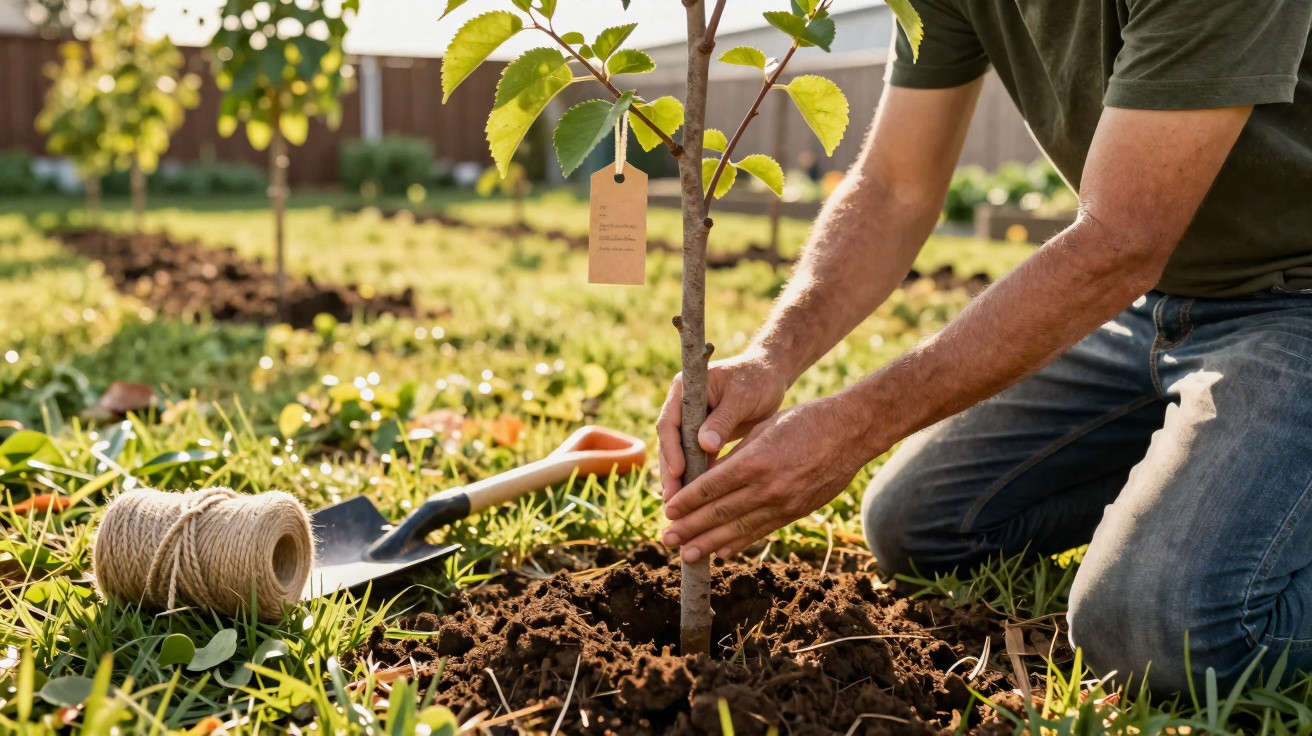
Spring is just around the corner, garden centres are busy, and the idea of growing your own apple, cherry or apricot tree is hugely appealing. Yet there’s a common trap waiting right at the planting hole: pile soil up in the wrong place and you can deprive a young tree of air, vigour and, later on, its crop.
The most common planting trap: planting too deep
Why “more soil” doesn’t give a tree more stability
Many people mean well: they want the tree to stand firmly, so they heap soil up around the base of the trunk and stamp it down hard. The logic sounds convincing-deeper in the ground means better anchored and better protected. In practice, the opposite often happens.
“A fruit tree planted too deeply suffocates at its base-long before it could ever flower abundantly.”
A thick layer of soil around the lower trunk acts like an airtight blanket. The zone where trunk and roots meet needs oxygen and airflow. If it is buried, moisture builds up, the bark deteriorates and the tree starts to struggle.
What permanently damp soil does to the trunk base
Roots are designed to be in contact with soil-the bark on the trunk is not. It can only tolerate wet conditions for a limited time. If this part sits in damp ground continuously, a slow decline sets in:
- constant moisture softens the bark
- fungi and rot organisms colonise the area
- the wood below ground begins to decay
- the transport channels for water and nutrients are damaged
From the outside, the tree may look fine for quite a while. Below the soil line, however, its “lifeline” is being damaged. The result is few flowers (or none at all), weak growth, and often a gradual dieback later on.
The key zone on the trunk: where soil must never sit
Root collar and graft union: how to spot the sensitive area
For almost all nursery fruit trees, you’re dealing with a grafted tree. Two areas matter most:
- Root collar: the transition from root to trunk-where the roots end and the trunk begins.
- Graft union: a small swelling, kink or scar slightly above the root collar. This is where the chosen fruit variety was grafted onto a hardy rootstock.
The graft union is usually easy to identify: the trunk looks slightly thickened at that point, sometimes a little crooked or scarred. This is precisely where the part that determines variety and yield develops.
“The root collar and graft union must remain visible-if they are buried, the tree has a structural problem.”
What happens if the graft union ends up underground
If soil covers the graft union, the whole system is thrown off balance. The grafted variety “realises” it has contact with soil and tries to form its own roots. That might sound like extra strength, but it can be disastrous:
- The rootstock-which provides toughness, growth habit and earlier fruiting-loses its effect.
- The grafted variety roots itself, often more weakly and with greater sensitivity.
- The tree diverts energy into survival rather than flower buds.
The outcome is poor growth, hardly any blossom, and a late harvest-or no harvest at all. Sometimes the tree just puts on lots of wood and never really gets into the swing of fruiting.
How to plant fruit trees correctly in March
The most important rule: keep the graft union clearly above soil level
For bare-root fruit trees, the best planting window is typically around March, as long as the ground is workable but not bone dry. The golden rule is simple:
“The graft union should sit about 5 to 10 centimetres above the final soil level.”
The root collar stays level with the surrounding soil, while the visible graft scar above it remains clearly in the air. No bark that belongs to the trunk (rather than the roots) should disappear into damp ground.
In practical terms:
- Dig a generous hole-at least twice the width of the root spread.
- Shape a small, firm mound of soil in the bottom.
- Spread the roots out like a fan over this mound.
- Hold the tree so the graft union sits clearly above the lawn/soil line.
- Backfill with loose soil and firm in only lightly.
How to stop the tree sinking after planting
Freshly loosened soil settles with rain and watering. That can cause the tree to drop lower, and suddenly the graft union is too close to the ground. A few straightforward steps help prevent this:
- dampen and firm the base of the hole before placing the tree
- make sure the small mound under the roots is properly compacted
- secure the tree to a sturdy stake
- lay a cane or handle across the planting hole to mark the final soil level
After backfilling, you can check at a glance: if the graft union remains above that reference line, your planting depth is right.
Warning signs: how to spot a “live-buried” fruit tree
When the tree simply doesn’t get going
A fruit tree planted too deeply rarely shows the issue immediately. Many gardeners only start wondering in the second or third year. Typical signs include:
- sluggish shoots with short new growth
- yellowing leaves or leaves that drop early
- flower buds that dry out before opening
- long periods when the tree seems to “stall” even as temperatures rise
“If everything is sprouting in spring-except your fruit tree-it’s worth checking the trunk base.”
Rescue job: exposing a buried base
If you realise the trunk is sitting too low, you don’t always need to dig the whole tree out. In many cases, it’s enough to carefully uncover the critical area:
- Use your hands or a small hand trowel to gently remove soil from around the trunk.
- Keep going until the root collar and graft union are clearly visible again.
- Take care not to damage fine roots and avoid scraping the bark.
- Create a shallow watering basin that guides water slightly away from the trunk, so moisture doesn’t sit directly against the wood.
The tree often responds to this “release” the following year. Fresher growth and the first blossoms are a good sign the intervention has paid off.
Practical rules for a vigorous orchard
Checklist while backfilling the planting hole
Running through these points while planting a fruit tree greatly reduces the risk of a costly mistake:
- Graft union clearly above soil level? Visual check.
- Do not press soil directly against the lower trunk.
- Shape a watering ring 20–30 centimetres away from the trunk.
- Firm the soil only lightly with your foot or hand-don’t compact it like concrete.
- Tie the tree to a stake so wind movement doesn’t rock it downwards over time.
Why correct planting can later double the harvest
A fruit tree planted at the right height begins life with far less stress. The root system develops steadily and evenly, and the rootstock can fully deliver its strengths: stability, a suitable mature size and early fruiting. The grafted variety can focus on buds, blossom and fruit set-rather than emergency measures underground.
“If you pay attention to ten centimetres when planting, you’ll benefit from reliable crops for many years.”
This care matters particularly in smaller home gardens. A single apple or plum tree is often expected to provide most of a family’s fruit. It’s frustrating when such a simple planting error leaves it performing “below its potential” for years.
Background knowledge: terms and practical examples
What exactly are rootstock and grafted variety?
With grafted fruit trees, the roots and the above-ground variety do not come from the same plant. The rootstock provides the root system and determines robustness, soil tolerance and vigour. The grafted variety delivers flavour, fruit shape and ripening time.
Examples:
- A moderately vigorous apple tree on a dwarfing rootstock suits small gardens and often crops earlier.
- A strong rootstock for cherries gives excellent stability, but it requires more space.
If the graft union is buried, many benefits of the carefully selected rootstock are lost-one of the classic DIY mistakes with fruit trees in home gardens.
Typical risk situations in everyday gardening
Even years after planting, the sensitive zone can be covered again unintentionally. Common scenarios include:
- bark mulch is piled too high against the trunk
- beds are raised repeatedly over the years with compost
- new turf or paths are added, increasing the surrounding soil level
To keep an orchard healthy long term, make a habit of checking the trunk base from time to time. A visible root collar, a clearly identifiable graft union, and no damp mound of soil against the trunk-these are the simple signs of a properly managed fruit tree.
Comments
No comments yet. Be the first to comment!
Leave a Comment