
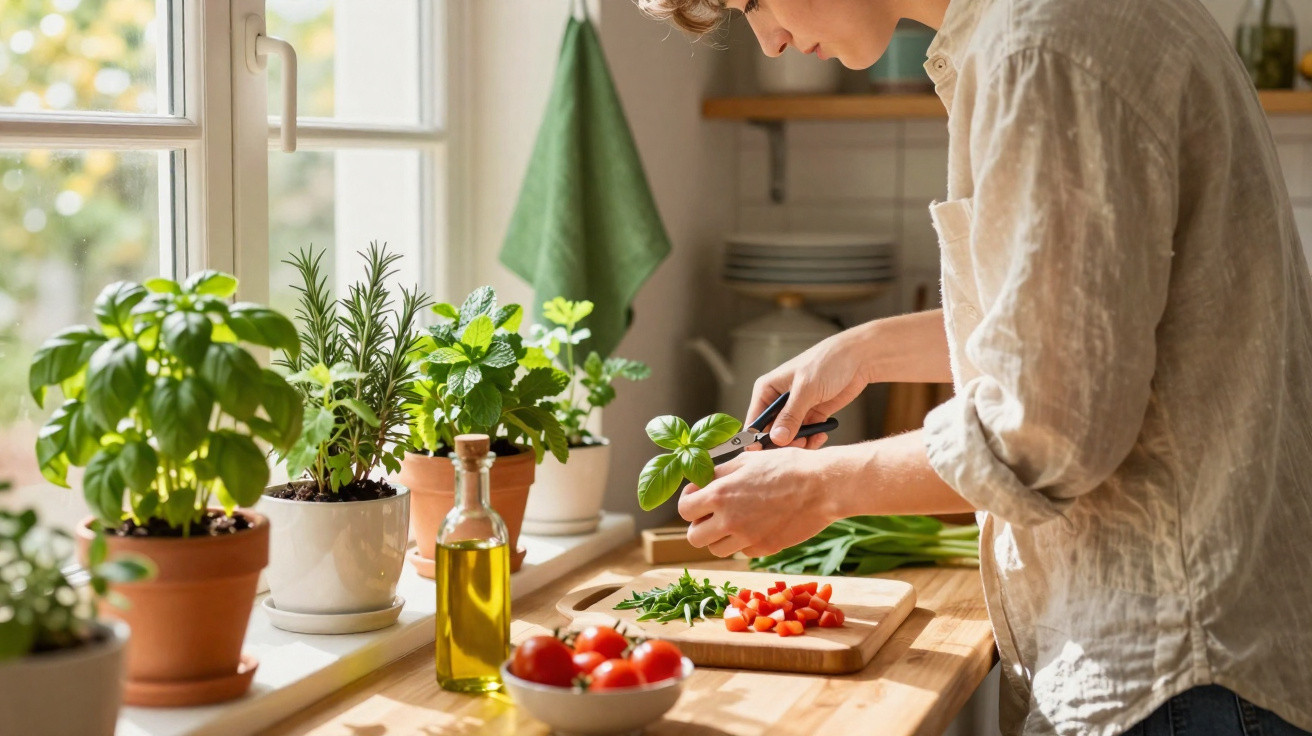
The basil is leaning at an angle. A few leaves have already started to turn slightly yellow, the compost looks dusty-dry, and you’re wondering how supermarket herbs always look so lush and green online. Your kitchen still smells of garlic and fried courgette, and on the windowsill three pots are battling for light. Rosemary, basil, parsley - in theory, a dream. In practice: on the verge of collapse. You rotate the pot, nudge it closer to the window, search your phone for “save herbs in the kitchen”, and realise how ridiculous it is that you can order tomatoes online but can’t keep basil alive.
The good news: it isn’t just you. And a small, slightly wild kitchen herb garden is much closer than it looks right now.
Why a kitchen herb garden is more than decoration
Anyone who’s ever properly crushed fresh mint between their fingers instantly notices how far removed it is from the stuff in a plastic bag. The scent lingers for a moment in the air - like a tiny pause from the day. A kitchen herb garden isn’t an interiors fad; it changes how you cook, smell and taste. Suddenly you’re not seasoning “by the recipe” so much as by instinct, because the herbs are right there in front of you. And yes, at first the windowsill can feel like a chaotic plant shelf - until you realise a small rhythm of life is taking root there.
In many homes, the state of the kitchen herbs tells a quiet story. Either there’s a sad little discount-shop basil pot that looks like the remains of a good intention. Or there’s a mini-plantation: terracotta pots, jars, chopped spring-onion ends growing roots in water. A friend told me that after a stressful patch she threw away her dried-out thyme - and felt as though she were binning part of her good intentions along with it. Since then, she’s kept a photo above her hob from her first real harvest moment: a handful of parsley, still damp from watering, next to a simple plate of pasta.
What makes it so compelling? A kitchen herb garden shrinks the big, abstract idea of self-sufficiency into something you can actually hold. A few small actions, a bit of patience, and you can see progress almost every day. Of course, it’s not some farm-to-table fantasy - it’s more like a miniature upgrade to your everyday routine. The blunt truth: most of us will never own a raised bed, but we do have a windowsill. And that’s exactly where a quiet feeling of control can grow in a loud, fast world. You can’t do much about rising food prices - but you can grow your own parsley.
The practical route: from an empty windowsill to a small herb jungle
The starting point isn’t buying as many seeds as possible; it’s taking an honest look at your kitchen. Where do you genuinely get light - and not just in midsummer? If you put your hand against the window, you’ll quickly sense whether a spot is too hot, too draughty, or simply too dark. For most kitchens, a bright windowsill is enough for basil, chives, parsley and mint to live side by side. Rosemary and thyme prefer it drier and, ideally, sunny, while parsley and chives cope well with a bit of shade.
For the basics, you only need a few simple pots with drainage holes, a saucer, and decent herb compost. You can also rescue supermarket pots by splitting them up: the plants are packed far too tightly. Carefully divide the basil into three or four smaller clumps and pot them on separately. Water lightly, place them in the light, and watch them straighten up over the next few days. Let’s be honest: nobody does this perfectly every single day - but even half-right care saves more herbs than you might think.
The biggest frustration often hits after a fortnight. The herbs look great, you use them enthusiastically - and then something goes wrong. Yellow leaves, mould on the surface, drooping stems. Most of the time the reasons are basic: too much water, too little light, or cutting back too aggressively. A simple rule helps: water less often, but thoroughly, then let things dry down. And when you harvest, don’t chop off everything at once - snip just above a pair of leaves so the plant can branch and regrow. As obvious as it sounds: one small cut in the right place decides whether your basil dies or takes off.
“A kitchen herb garden is like a daily invitation to pause for a moment,” an older neighbour once told me when she gave me a cutting from her mint. “You just have to go over and really look.”
A few straightforward rules of thumb give that “looking” some structure:
- Water herbs when the top layer of compost feels dry - not by the calendar.
- Never put thirsty types like basil and mint directly above a radiator.
- Harvest small amounts regularly rather than stripping a whole plant once a month.
- Don’t mix thirsty herbs and dry-loving ones in the same planter - rosemary and basil don’t make ideal flatmates.
- Let herbs “settle” in one place instead of carrying them around the kitchen every day.
Your garden in your head: what a few pots do to everyday life
If you live with a kitchen herb garden for a few weeks, your view of the day shifts quietly. In the morning you pass the windowsill, half-asleep brush thyme with your hand, and the scent hangs for a second between the coffee machine and the toaster. In the evening, after a long day, you turn the heat down under the pan, reach almost automatically for the scissors, and take a few basil leaves. They’re tiny gestures - barely noteworthy. And yet each one feels like a small counter-proposal to frozen pizza and “whatever, as long as it’s quick”.
These routines aren’t Instagram-perfect; they’re usually just… normal. Sometimes you forget to water, sometimes you harvest too much, sometimes a plant simply dies. It’s part of it - like burnt pancakes and sauces that don’t come together. That’s the quiet honesty of a kitchen herb garden: it forgives a lot. You can replant, divide, repot. No one is grading how neatly your pots line up. Only you can tell whether this small patch of green is doing you good.
Maybe at your next meal you’ll tell friends the parsley on the mashed potatoes came from your windowsill. Maybe you’ll share a photo of your “herb jungle” with a half-folded laundry pile in the background. Or maybe you’ll tell no one - and simply enjoy knowing you’re growing something of your own. A kitchen herb garden isn’t a project with a deadline; it’s more like an ongoing invitation to slow things down for a moment. And who knows - that wonky basil on your windowsill might not be a fail at all, but the start of a genuinely lovely, green habit.
| Key point | Detail | Benefit for the reader |
|---|---|---|
| Light and location | Bright windowsill, not right next to a radiator, group herbs by light needs | Fewer plant losses, steadier growth, less frustration |
| Watering and harvesting | Let compost dry slightly, water thoroughly, cut above pairs of leaves | Herbs live longer, steady harvesting instead of a short-lived burst |
| Choosing plants | Start with robust types like parsley, chives, mint, later rosemary/thyme | Easier beginning, quick wins, motivation to keep going |
FAQ:
- Which herbs are suitable for beginners in the kitchen? Parsley, chives, mint and basil are a solid starting point. They grow fairly quickly, forgive small care mistakes, and are used all the time in cooking.
- How often should I water kitchen herbs? Not by the clock - by feel. If the top layer of compost feels dry, water. Avoid waterlogging in the saucer or the roots will rot.
- Do I need special compost for my herb garden? Herb or vegetable compost is worthwhile because it holds its structure better and retains nutrients more reliably. For Mediterranean herbs like rosemary, you can mix in a little sand.
- Can herbs survive indoors in winter? Yes, if they get enough light and aren’t exposed to cold draughts or radiator heat. In the depths of winter, a small grow light can help.
- Is it really worth it instead of just buying fresh herbs? Financially, often after a few weeks; emotionally, almost immediately. You save packaging and trips, and you’ve always got a handful of fresh green to hand - without a last-minute supermarket dash.

Comments
No comments yet. Be the first to comment!
Leave a Comment