
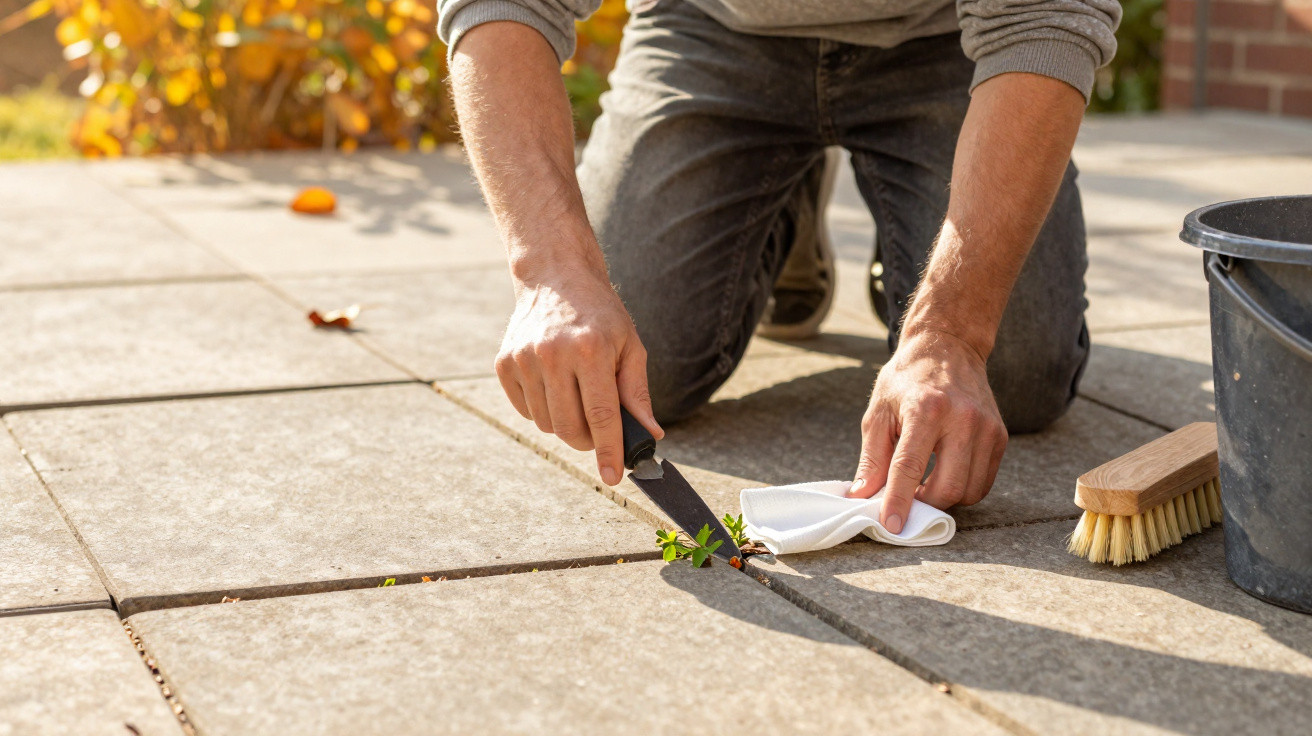
Between paving stones and patio slabs, something always seems to push through again each year. Homeowners scrub, scrape, spray vinegar or pour on boiling water - yet the surface never stays clean for long. The real sticking point is often not the product you use, but the date in the diary and how you deal with the roots.
Why timing matters more than the product when weeding paving joints
If you tackle the joints in March or early April, you are usually working against nature - and against yourself. Most wild plants that colonise the gaps have deep taproots. Dandelions and thistles can reach a good 15 centimetres down into the ground. If you only pull off what you can see, most of the plant remains hidden beneath the stone.
That, in turn, triggers vigorous regrowth. The plant reacts as if it has been hard pruned: it rebounds even more strongly, often producing several new rosettes. If you then scrape again every few weeks, you encourage exactly what you are trying to stop - effectively signing yourself up to never-ending joint weeding.
"If you weed too early and only take what’s on the surface, you strengthen the root instead of weakening it."
Horticultural professionals have been making the same point for years: the root needs to come out as completely as possible. And even with the right tool, that only works properly when soil and weather conditions cooperate.
Spring: why it’s better to wait until mid-May
From March to April, showers, changeable temperatures and damp ground are the norm. Out of frustration, many people reach for supposedly “gentle” options such as vinegar, liquid manure brews or hot water. But these only act on the surface - and only in dry conditions. A downpour within two days can rinse everything away before the leaves are properly damaged.
For an effective spring treatment, several conditions need to line up at the same time:
- a settled dry spell of at least 72 hours
- no rain in the two days after treatment
- joints and leaves fully dried off
- temperatures where sunshine boosts the effect
A simple rule of thumb is to wait until after the so-called Ice Saints - roughly from mid-May - when these conditions become more reliable in Central Europe. If you start earlier, you risk rain washing products out of the joints, making the effort largely pointless.
The simple “tissue test” before you start
A small practical trick can help you decide. Place a dry paper tissue over a joint. If it stays dry after a few minutes, the area has dried sufficiently. If the tissue feels clammy or turns darker, hold off.
A dry morning is ideal. That gives liquid products or hot water time to work, and the sun strengthens the effect as the day goes on. Apply only directly into the joints rather than across the whole surface, so the paving itself is not put under unnecessary strain.
"Mid-May plus three dry days: stick to that, and you’ll save yourself many weeding rounds in summer."
Autumn: the best time to weaken roots for good
The second - and often more important - window for long-lasting clean joints is autumn. Between early September and late October, many plants shift their stored reserves from the leaves back into the roots to get through winter. If you remove the whole plant during this phase, you hit those energy stores right where they matter most.
The result is that far fewer shoots appear the following year, and the gaps between joint-clearing sessions get longer. Many gardeners report that after two consistent autumn clear-outs, the overall maintenance drops noticeably.
The autumn root offensive, step by step
- Choose the right tool: a joint knife, a weed puller, or a narrow asparagus fork work particularly well.
- Prepare the ground: the best moment is the day after rain, or after thorough watering. The soil releases roots more easily.
- Insert right by the stem: drive the blade vertically into the joint close to the plant.
- Use leverage: lift soil and root up as one piece; do not tear sideways.
- Finish off: remove leftovers with a metal joint brush.
- Refill the joints: top up with clean, slightly damp sand and compact it by vibrating, brushing or sweeping it in.
Joints that are properly filled give seeds far less opportunity. Where voids remain, organic matter collects and behaves like a miniature flowerbed - the perfect germination bed for the next crop in the joints.
Methods that do more harm than good
Plenty of “secret tips” for joint weeds circulate online. Some look clever at first glance, but in the long run they damage patios, soil and the wider environment.
Why salt has no place on a patio
Table salt can seem effective initially: the visible plant parts dry out quickly. However, the crystals move with water down into the ground. There they draw moisture not only from weeds, but also from other soil organisms. The knock-on effect is compacted subsoil, crumbling joints, and paving that can even shift.
"Salt doesn’t just dry out the weeds - over time it also dries out the whole ground beneath the patio."
There is also the ecological side. Salt can seep into neighbouring borders, lawn areas or even groundwater. The visible impact is short-lived; the damage lasts far longer.
Pulling in a rush in spring makes growth worse
Another classic is yanking off shoots in spring “just to make things look tidy”. If only the stem comes away and the root stays put, the plant often returns even more strongly. This is especially true for species with a robust rootstock.
A clearer approach works better:
- in late spring, treat only when a sufficiently dry spell is forecast
- in autumn, go after the roots deliberately with the right tools
- afterwards, refill and compact the joints without exception
How often you really need to do it - and what you can combine
Many homeowners overestimate the workload. If you take two time windows seriously - mid- to late May and then autumn - you can manage with surprisingly few sessions. Between those dates, a quick check is usually enough: pull the odd newcomer by hand, loosen moss with a brush, and sprinkle in more sand where joints have thinned.
Choosing the joint material can also help. Specialist joint sands or mineral joint mortars allow fewer seedlings through than loose building sand. If you are laying a new patio or refurbishing one anyway, this is a good point to address - and it can save you a great deal of work in the years that follow.
The surrounding area matters too. Overhanging beds, piles of leaves, or cracks where soil gathers all provide seeds and humus. If you remove leaves carefully in autumn and keep edges clean, you significantly reduce how many new plants establish between the stones.
So it isn’t the “strength” of the remedy that decides the outcome, but the combination of calendar, weather, tools and joint maintenance. If you wait until mid-May, tackle roots properly in autumn, and close up open joints straight away, your patio is far more likely to stay tidy for longer - without reaching for a chemical sledgehammer.
Comments
No comments yet. Be the first to comment!
Leave a Comment