
The winter months are almost over, your lemon tree is putting on fresh growth, everything feels safe - and then an icy night in March still turns up. Many hobby gardeners focus only on the air temperature and miss the cold creeping up from below into the pot. That is exactly where a simple but highly effective trick makes the difference.
Why March is so risky for potted lemon trees
As February moves on, days lengthen, the sun gains strength, and the lemon tree clearly gets going again. New leaves appear, the first buds form, and the crown looks in great shape. That’s when many people place the container more openly on a balcony or terrace - and walk straight into a nasty trap.
Late frosts in March often arrive without warning: 12 to 15 °C during the day, then a clear sky at night and -2 °C. A horticultural fleece is usually enough to protect the crown, but the roots in a pot are a different story. Cold travels through concrete, tiles, or stone directly into the base of the pot and from there into the root ball.
"The real frost killer isn’t in the air, but in the cold ground beneath the pot."
Container-grown lemon trees are particularly sensitive. While trees planted in the ground are buffered by the surrounding soil, a pot offers a small, cramped root space and a direct cold bridge downwards. The result is roots freezing from the bottom up - often with no visible warning signs the day before.
The underestimated cold bridge on balcony flooring
Plant physiology specialists have been pointing this out for years: in containers, heat loss through the base is often a bigger issue than cold air. Materials such as concrete, natural stone, and tiles hold onto night-time chill and release it gradually - straight into the bottom of the pot.
A typical scenario:
- a south-facing balcony
- mild days in early spring
- short overnight frost spells between March and mid-May
In exactly this period, the pot is often sitting directly on the bare surface. With continuous contact, the cold shoots into the root ball. Fine root tips stop working, water uptake collapses, and leaves can turn grey, limp, or black.
"From the outside the tree often still looks stable, while the root zone has already taken serious damage."
An inconspicuous helper: the insulating plate under the pot
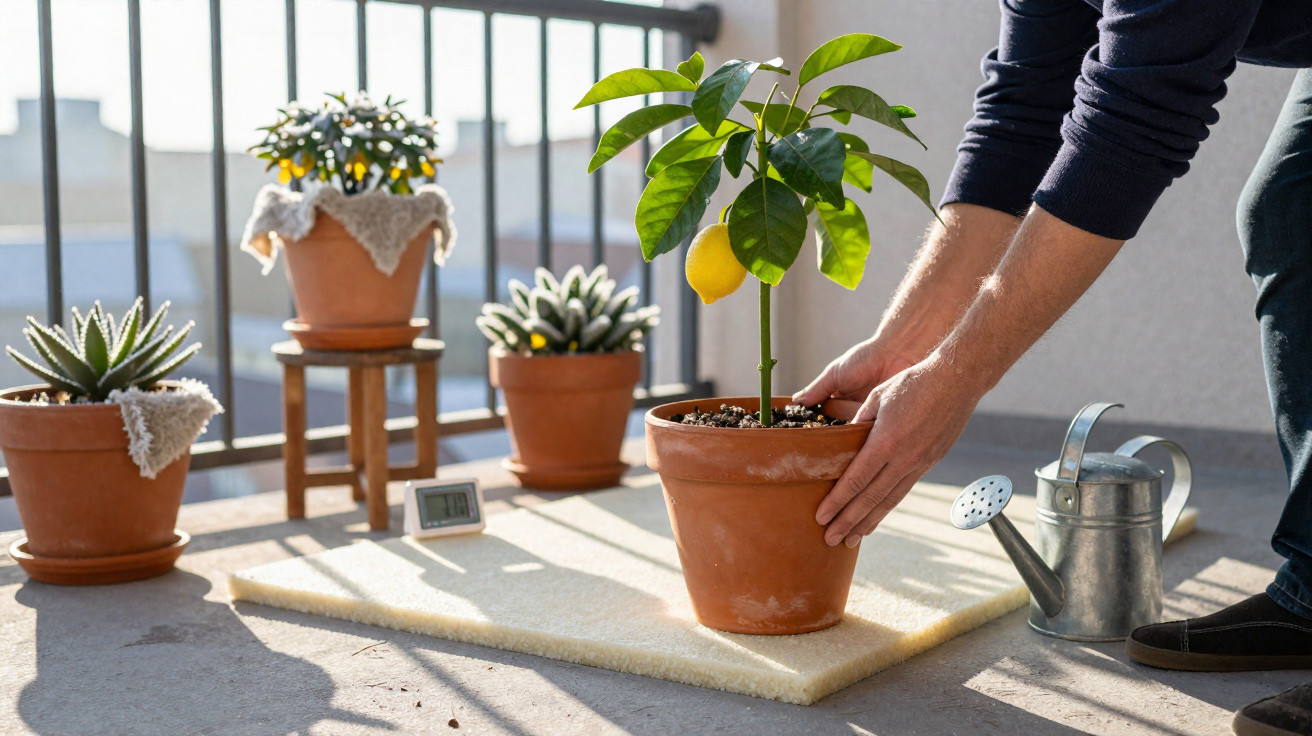
The fix is surprisingly straightforward: place an insulating plate beneath the pot to break the cold bridge to the ground. In many cases, that alone is enough to get a lemon tree safely through March.
Which materials work well
Anything with good insulating properties can do the job:
- a thick piece of polystyrene from packaging
- a sturdy cork board or several cork coasters
- a wooden board combined with a thin insulating mat
- thick felt or a coir mat, folded several times
The plate should:
- be 2 to 5 centimetres thick
- extend 1 to 2 centimetres beyond the pot all the way around
- cover the base fully without blocking drainage
This creates a kind of protective plinth that removes direct contact between the cold balcony surface and the pot base. The temperature around the roots stays far more stable.
How to prevent waterlogging despite the insulating plate
Important: drainage must never be sealed off, or waterlogging becomes a risk. A simple method keeps the drain holes clear while maintaining insulation.
- Split three corks (for example, wine corks) lengthways.
- Arrange the halves in a triangle on top of the plate beneath the pot base.
- Stand the container on the cork halves so it sits slightly raised.
This creates a thin air gap between the pot and the plate. The trapped air adds extra insulation, and excess water can drain freely. It costs virtually nothing and takes only a few minutes.
"Insulation plus an air gap: this double barrier protects the roots without disrupting your watering routine."
How cold lemon trees can really tolerate - and where the limit is
A well-acclimatised lemon tree can cope briefly with temperatures of around -6 to -7 °C, provided the overall position is well sheltered. What matters most is how evenly the cold affects the plant.
From practical experience, a thin winter fleece around the crown provides roughly a 3 °C buffer. If the container also stands on an insulating plate, temperatures at root level drop much more slowly. Without insulation, frost hits the sensitive root collar first.
What’s most dangerous is not a single cold snap, but repeated stress in March and April. Each cold night pushes further into the root zone - especially when the tree is already in active growth during the day and has started to leaf out.
Protection through to the Ice Saints: combining measures sensibly
As a rule of thumb, keep the insulating plinth under the pot until around mid-May. In many areas, the risk of late frost does not truly pass until the so-called Ice Saints period, in the second half of May.
Several layers of protection without "wrapping" the tree
If you want to secure your lemon tree even more, you can combine different levels of protection:
- Insulating plate beneath the container - the basic defence against cold from below
- Position against a south-facing wall - masonry stores daytime warmth and releases it at night
- Roofing or an overhang - reduces direct chilling from wind and precipitation
- Winter fleece held off the leaves - drape fleece over supports so it doesn’t touch foliage
- A "jacket" around the pot - bubble wrap covered with jute so it looks tidy
This builds a step-by-step protective system without making the lemon tree look like a bundled parcel. The pot stays accessible, and the plant can still look decorative.
Watering, placement, risk - what many people miss with late frosts
Alongside insulation, watering habits matter. A completely waterlogged root ball cools down faster than slightly moist compost. So if frost is forecast, avoid a heavy watering and keep things more moderate.
Location also shapes the risk. An exposed top-floor balcony above unheated garages can become noticeably colder than a sheltered, enclosed balcony. If you are unsure, place a simple outdoor thermometer on the floor next to the pot for one frosty night and compare that reading with the official forecast.
| Situation | Risk to roots | Recommended measure |
|---|---|---|
| Container directly on stone flooring | high | insulating plate + cork feet |
| Balcony with wooden decking | medium | a thin insulating mat is often enough |
| Under an overhang, against a house wall | lower, but still present | still use an insulating base |
Why potted lemons react so sensitively
Citrus plants come from regions with mild winters and strong light levels. In a container on a central or northern European balcony, they can quickly become stressed when the roots cool down while the crown is already breaking into growth. That imbalance between leaf activity and root performance weakens the whole plant.
There is another factor: in pots, the growing medium is usually fairly loose and free-draining to prevent standing water. These lighter substrates lose heat faster than heavy garden soils. The root zone therefore cools more sharply - another reason to insulate reliably from below.
If you ever examine the root system of a frost-damaged lemon tree, you will often see a clear boundary: higher up, roots may still look partly intact; lower down, areas turn brown, mushy, or completely dried out. That is where frost tends to hit hardest.
Practical add-ons for all container plants
The insulating-plate approach is not only for lemons. Any frost-sensitive container plant benefits: olives, figs in pots, hibiscus, or Mediterranean herbs in large containers. Once you have cut suitable bases to size, you can reuse them year after year.
Many gardeners now keep a small "frost kit" ready: a few polystyrene boards, cork offcuts, a piece of jute, some fleece, and a thermometer. That way, when temperatures drop suddenly, you can respond within minutes rather than scrambling to improvise.
"That inconspicuous plate under the pot is now one of the most effective protections against late frost - and yet it’s still a hidden tip in many gardens."
If you build this quick step into your spring routine, you greatly reduce the risk of costly frost damage. The lemon tree starts the season with more vigour, produces sturdier new growth, and repays the effort in summer with healthy leaves and noticeably more fruit.


Comments
No comments yet. Be the first to comment!
Leave a Comment