
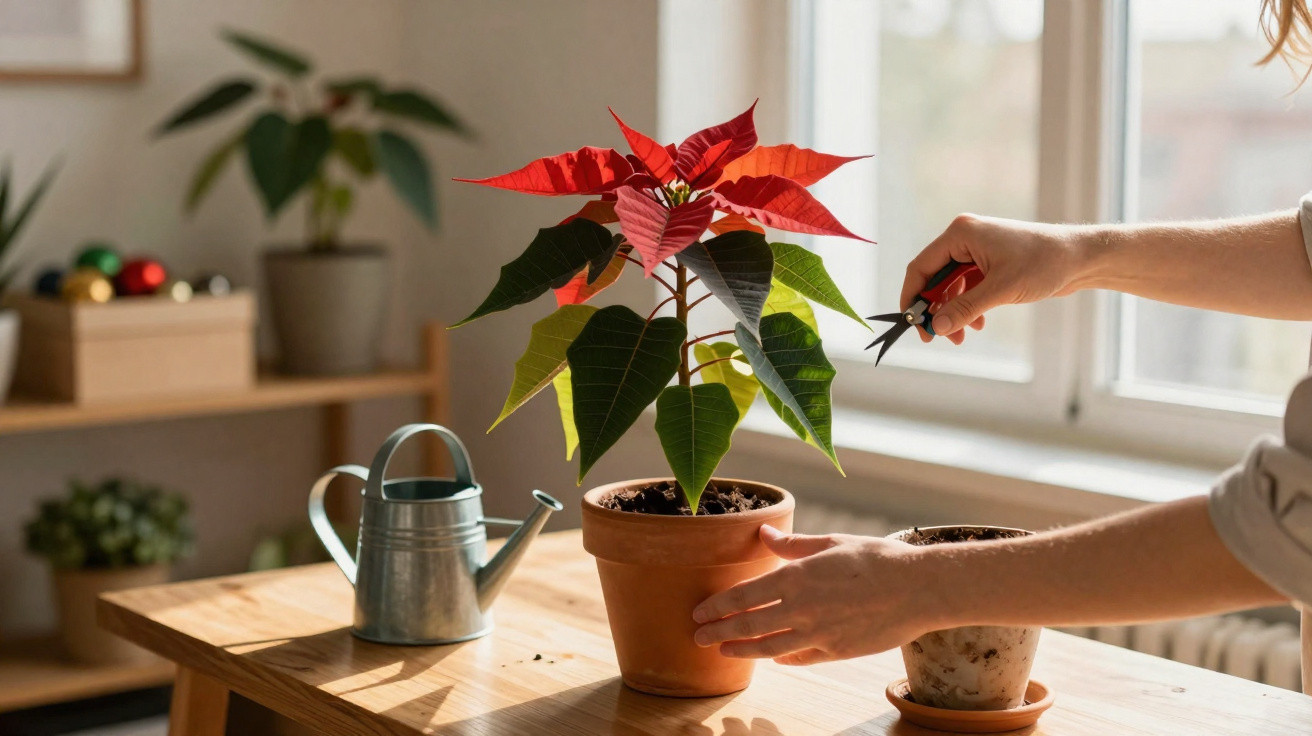
The pot looks miserable: the red bracts have faded, a few leaves have turned yellow, and it’s very tempting to bin the poinsettia (Christmas star) and move on. Yet this is exactly the point-between March and April-when you make the call: does it remain disposable seasonal décor, or does it become a strong, leafy houseplant that can bring colour back next winter?
Poinsettia (Christmas star) at a glance: more than festive décor
The poinsettia (Christmas star) is known botanically as Euphorbia pulcherrima. In shops it’s usually sold as a compact, potted plant around 30–60 cm tall. In its native Latin America it grows as a shrub; here, it’s best kept indoors or on a sheltered balcony.
| Botanical name | Euphorbia pulcherrima |
| Common name | Poinsettia (Christmas star) |
| Size in a pot | approx. 30–60 cm tall, 30–50 cm wide |
| Light | bright, but no direct midday sun; outdoors in summer in partial shade |
| Temperature | dislikes cold; keep consistently above 13 °C |
| Leaves | evergreen indoors; drops leaves when stressed or cared for incorrectly |
The familiar story: it looks flawless in December, then by February it’s bare and ends up in the bin. Often this isn’t about lacking a “green thumb” at all-it comes down to one very specific springtime care mistake.
"The decisive period for a poinsettia’s survival isn’t winter, but March and April."
What happens in March: the poinsettia goes into a pause
As winter finishes, the poinsettia shifts into a kind of resting mode. It stops flowering, reallocates its reserves and prepares for the next burst of growth. Many people simply keep watering and feeding as they did in December-and that’s exactly what can push the plant over the edge.
March rule number one: water far less
After the festive period, a damp pot often still sits on the windowsill. If you keep watering in the same way, you invite root rot and leaf drop. From March onwards:
- only water when the top layer of compost is almost completely dry
- there may be two to three weeks between waterings
- never leave water standing in the cachepot or saucer
- use cool, low-limescale water-not ice-cold straight from the tap
At this time of year, the plant copes much better with short dry spells than with constant wetness. A small amount of leaf loss is normal as it enters its rest phase.
March rule number two: bright and cool, not hot
Right now, the poinsettia does best somewhere bright but on the cooler side. 13–16 °C is ideal-for example, in a light stairwell, a spare room, or a cooler living space away from heat.
- keep it away from radiators and warm air outlets
- avoid cold draughts from a tilted window when it’s chilly outside
- choose a bright spot, but without harsh midday sun through glass
During this phase it uses very little energy for growth; it’s essentially resting. Trying to “help” with extra water or fertiliser will usually do more harm than good.
March rule number three: tidy up gently
Many people reach for the secateurs and cut a poinsettia back hard. In the first weeks of March, that’s typically too drastic. A softer approach works better:
- carefully pinch off only dry, brown leaves
- remove faded bracts gradually
- don’t shorten still-green shoots heavily
Important: poinsettia sap (the milky latex) can irritate skin. If you’re sensitive, it’s best to wear gloves when removing dead material.
"The most common mistake in March is too much care: too wet, too warm, too much action with the scissors."
In April the reset begins: this is when the summer shape is set
From April, many plants show tiny fresh shoots or small green buds along the stems. That’s your sign the poinsettia is coming out of dormancy.
The right time to repot
As soon as new growth appears, repotting can give the poinsettia a real boost. This isn’t about moving it into a huge container-choose a slightly larger pot with excellent drainage.
- pick a pot with drainage holes
- add a layer of expanded clay pellets or small stones at the bottom
- use a loose, good-quality houseplant compost
- if needed, mix in a little perlite or sand so water drains more freely
When removing the plant, gently loosen the roots, tease apart any matted root ball and remove heavily compacted compost. Water in well afterwards-but don’t drown it.
Light, temperature and water: the April balance
Now the poinsettia needs more energy again. A bright place by a window is perfect, provided direct midday sun isn’t blazing through the glass. 18–20 °C encourages growth without putting the plant under unnecessary strain.
"The ‘finger test’ is the best check: only water when the top layer of compost seems dry and feels crumbly."
In April it’s usually enough to check every few days and, depending on the spot, water roughly once a week. Waterlogging remains a strict no, because the new roots are particularly sensitive.
From late April through summer: seasonal décor turns into a leafy houseplant
As nights become milder and there’s no longer any risk of frost, the poinsettia starts to show what it can do. It often puts on strong new growth and develops rich green foliage.
The right routine for a bushy plant
From late April onwards, adjust your care:
- water regularly but in moderation: compost should be lightly moist, not wet
- every two to three weeks, add a liquid flowering-plant feed to the watering can
- if needed, lightly shorten bare shoot tips so the plant branches and grows more densely
If you have a balcony or garden, you can move the poinsettia outdoors in late spring. Do it gradually:
- start it off in a sheltered, shady place
- acclimatise it slowly to brighter light; avoid direct midday sun
- if temperatures drop below 13 °C at night, bring it back indoors
With the right care, what used to be a one-season purchase becomes an attractive, exotic-looking shrub that stays enjoyable well into autumn.
How to get red bracts back for the next Advent season
The key detail with this plant is that the colourful “petals” are actually bracts-and they respond to day length. To make them colour up again in late autumn, the poinsettia needs a period of long, dark nights.
From around October, you can begin this routine:
- for 8–10 weeks, give the plant about 14 hours of complete darkness every day (for example, in a cupboard or covered with a cardboard box)
- for the remaining 10 hours, keep it in normal bright light
- water evenly but sparingly, and stop heavy feeding
Many people shy away from the effort. But if you’ve already kept the poinsettia going through spring and summer, this gives you the best chance of the bracts colouring again.
Typical risks, practical tips and a few extras
Poinsettias are often labelled “fussy”-and often unfairly. Most setbacks can be traced back to a handful of repeat issues.
Common difficulties in spring
- Leaf drop in March: usually caused by moving the plant, cold draughts or overly wet compost
- Brown leaf tips: often due to very dry air from heating or hard tap water
- Droopy shoots after repotting: roots handled too roughly or too much water immediately afterwards
Slightly higher indoor humidity-such as a saucer of water nearby (without the pot standing in it)-can make a difference. Wiping the leaves gently now and then to remove dust also helps the plant capture light.
Toxicity and household safety
Like many spurges, poinsettias produce an irritating milky sap. If you have small children or pets, keep these points in mind:
- place the plant out of reach of cats, dogs and toddlers
- wear gloves for any cutting and wash hands afterwards
- avoid getting sap in the eyes or on mucous membranes
In everyday life, sensible care is enough. There’s no need to banish the plant from your home-it simply doesn’t belong within easy reach in a play area.
If, in March, you choose the watering can-with restraint and good judgement-instead of the wheelie bin, you gain more than a decorative plant. A poinsettia proves just how much potential there can be in so-called throwaway goods, and with a little planning it can deliver two seasonal highlights: a lush green shrub in summer and a colourful centrepiece at Advent.


Comments
No comments yet. Be the first to comment!
Leave a Comment