
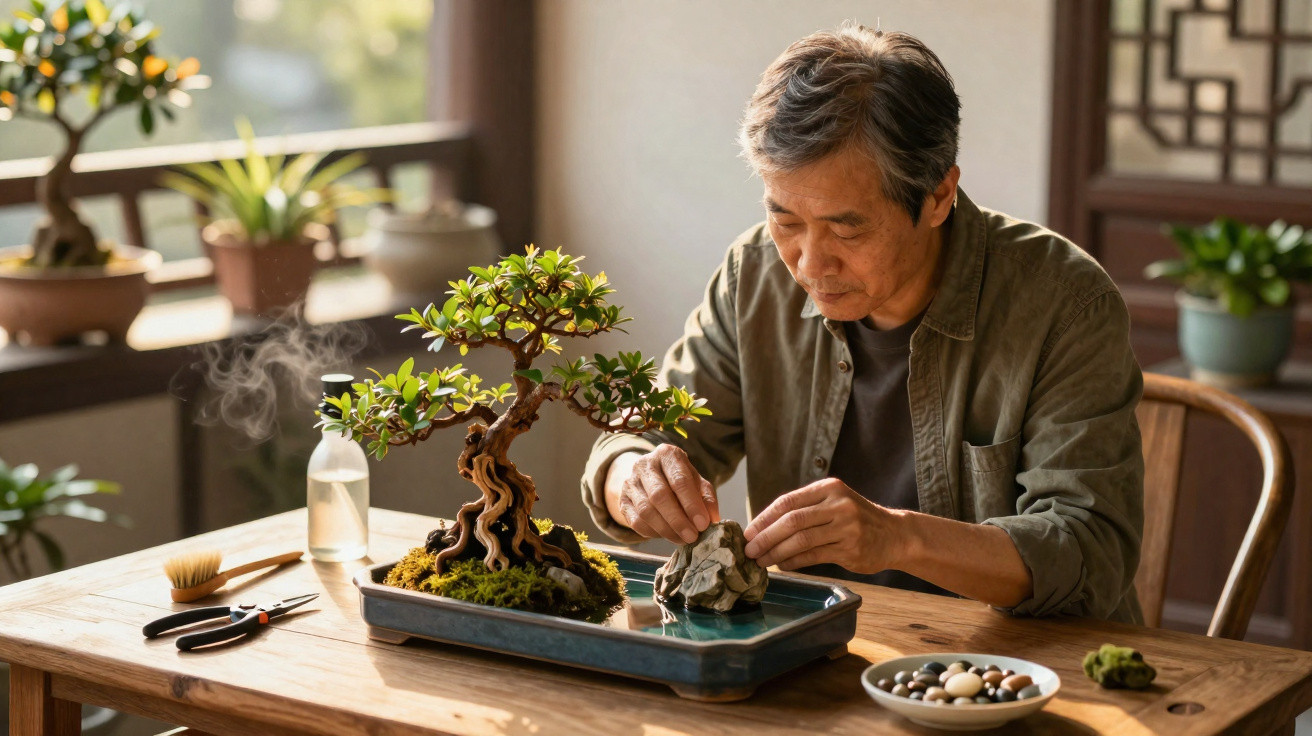
Tiny trees, strangely sculpted rocks, a trickling stream inside a ceramic tray and perhaps a minute little house: Penjing turns an ordinary dish into an entire landscape. This tradition stretches well beyond Japanese Bonsai - and it is quietly finding its way back into living rooms and gardens across the world.
What Penjing really is - and why it is more than “Chinese Bonsai”
Penjing originated in China, and the name translates literally as “landscape in a pot”. Where Bonsai usually spotlights a single tree, Penjing sets out to convey whole narratives. One composition might resemble a mountain range, another a river valley, or a village clinging to a rocky outcrop.
Penjing does not merely copy individual plants; it aims to capture the essence of an entire landscape in miniature.
Common ingredients in this art form include:
- living plants, most often trees or shrubs
- rocks, stones and gravel used as mountains or shorelines
- trays or shallow containers, with or without water
- small figures, houses or animals that add a storytelling layer
Many arrangements feel dreamlike, almost surreal. A lone fisherman in a boat, a solitary walker on a mountain path - scenes like these are meant to bring emotions such as calm, longing or melancholy into view.
Ancient origins: how Penjing emerged
According to historical sources, Penjing can be traced back to the 1st century AD, and possibly earlier. Daoist scholars and mystics sought to distil the power of awe-inspiring landscapes into the smallest possible space. Anyone without the means to reach distant mountains or temples could bring their atmosphere home in a single container.
Stories and legends even tell of masters who supposedly “shrunk” entire landscapes. Over time, the practice spread through monasteries, palaces and the aristocracy. Buddhist monks are often credited with later carrying the idea to Japan, where it developed into what we now recognise as Bonsai.
In China, however, Penjing remained more oriented towards the untamed and the wild. The compositions are more likely to evoke rugged, natural mountain forms or winding waterways than meticulously clipped garden trees.
The difference from Bonsai: two relatives, two philosophies
Bonsai and Penjing share roots, but they prioritise different things:
| Aspect | Penjing | Bonsai |
|---|---|---|
| Focus | complete landscape, often including figures | a single tree as the centrepiece |
| Effect | wild, natural, narrative | highly controlled, focused on form |
| Elements | plants, stones, water, miniature scenes | tree + pot, occasionally stones or moss |
| Philosophy | “seeing the large within the small”, the landscape as a whole | harmony and perfection of the tree |
For that reason, working on Penjing is closer to thinking like a director: what story should this tray tell? Where is the “lead character” - a tree, a rock, a house - and how does the setting frame it?
Regional styles: Penjing is not just one thing
China is vast, and the range of Penjing styles reflects that. Over the centuries, distinct regional traditions formed, including those associated with Guangdong, Taiwan, Shanghai and Yangzhou. Within this wider variety, many specialists group Penjing into three main categories.
Shumu: trees as the stars of the landscape
Shumu Penjing puts trees front and centre, arranging them in shallow trays. Artists prune, wire and shape branches until a specific image emerges - perhaps an aged tree bent by storms, or a small woodland clustered around a clearing.
Visually, this approach can resemble Bonsai, yet it is often less rigid in its design language. Several trees placed together are common, creating a miniature forest rather than a single specimen.
Shanshui: mountains, water and stone
Shanshui means “mountain and water” and is arguably the most poetic form. Here, rocks and water take the lead. A typical piece uses a shallow container where stones rise like a mountain ridge, bordered by water or fine gravel that stands in for a river.
Small plants provide accents - for instance, tufts of grass on a rocky ledge or tiny trees at the foot of an imagined peak. The goal is to echo classical Chinese landscape painting, but in three dimensions.
Shuihan: when all elements work together
Shuihan Penjing brings the two approaches above into one arrangement. Trees, stones, water and figures all meet within a single tray. This is where particularly narrative scenes appear: a village beside a river, a temple on a steep slope, a solitary angler beneath a pine.
Shuihan Penjing often tells small everyday dramas - just on a scale of a few centimetres.
The intricacy can be striking: tiny bridges, boats, animals or pagodas. Each figure shifts the atmosphere of the scene and guides the viewer’s eye.
Living art: Penjing changes day by day
A Penjing arrangement is never truly finished. Plants keep growing, branches thicken, moss spreads, and water levels rise and fall. Anyone who looks after one is continually refining the composition. Many artists describe it as collaborating with nature rather than simply controlling it.
Contemporary Penjing masters increasingly experiment with unusual plant species, new container shapes, or more abstract compositions. Yet the aim remains the same: to open a window from something small onto something vast - nature, landscape and emotion.
Getting started: trying Penjing at home
If you are tempted to create a miniature landscape yourself, you do not need a decade of training in a botanical garden. A handful of basic principles make the first steps easier - and the rest develops through practice.
The basics: container, position, climate
- Shallow tray: a wide, relatively low vessel with drainage holes helps prevent waterlogging and leaves room for a visual “horizon line”.
- Bright spot: most suitable plants need plenty of light, whether on a windowsill or outdoors.
- Stable temperatures: extremes of heat or cold can stress miniatures, particularly in winter.
Next, it helps to plan a little: what mood should the tray convey? A quiet, meditative mountain lake? A stormy coastline? An old village perched on a steep rocky edge?
Choosing plants and materials wisely
Good choices include naturally compact woody plants or species that tolerate heavy pruning, such as:
- small pine or juniper varieties
- dwarf Japanese maple
- privet, elm or other shrubs suitable for Bonsai
- mosses and low, mat-forming ground covers
Many garden centres already stock miniature plants, specialist composts, stones and decorative elements. If you prefer a simpler look, use just a few stones and one tree species - restraint is often more powerful than an overcrowded mix.
Patience matters more than perfection
Penjing does not require a flawless master plan. A straightforward way to begin is to imagine a rough scene, gather plants and stones that fit, plant everything - and then watch how it evolves. Over time, it becomes clear which branches should be shortened, where moss adds beauty, and where it becomes distracting.
Anyone who practises Penjing is mainly training two things: careful observation and perseverance.
It is precisely this slow development that appeals to many people. The tray shifts through the year, reflects the seasons, and can become something like a living diary of your own garden or balcony.
Why Penjing feels so calming - and what it teaches you
Many people say that building and maintaining miniature landscapes reduces stress. The mix of fine motor work, plant care and design thinking pulls attention away from everyday concerns. You have to focus on tiny details: leaves, twigs, the texture of stones.
At the same time, Penjing sharpens how you see full-scale landscapes. Once you have tried to recreate a stream in a tray, you notice currents and riverbanks in nature far more consciously. Trips to mountains or rivers then become a source of fresh ideas for future arrangements.
The overlap with other hobbies is notable, too: model-making enthusiasts often enjoy extending their work with figures and buildings in Penjing trays. Garden lovers use what they learn from Penjing to design larger beds more harmoniously.
Anyone who commits to it can uncover an unexpected range of themes inside a single container: botany, design, craft, philosophy. In that way, Penjing remains not only an ancient Chinese art, but also a distinctly modern answer to the question of how to experience nature more intensely in a small space.
Comments
No comments yet. Be the first to comment!
Leave a Comment