
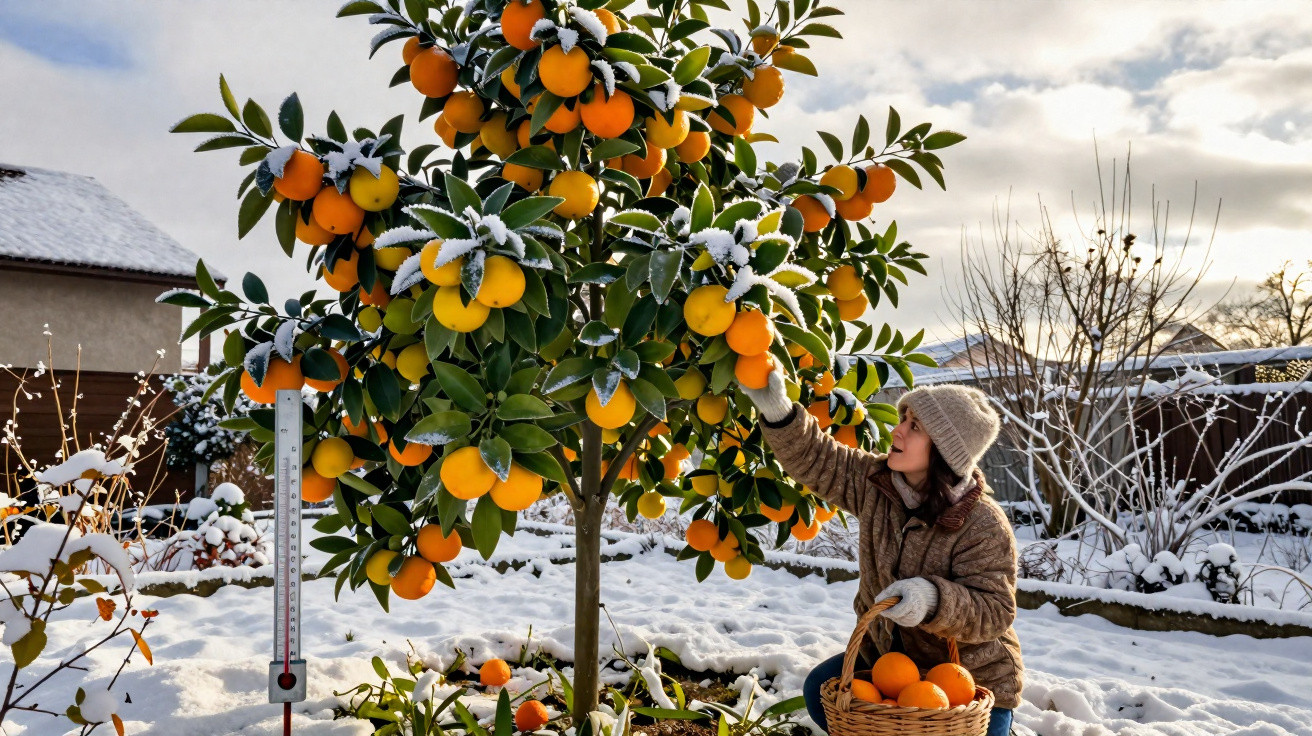
Many home gardeners know the feeling: the tree was still laden with fruit in autumn, yet by January it’s nothing more than a blackened, frost-killed stump. Traditional lemon trees simply do not tolerate frost-full stop. Even so, there are citrus relatives that can cope with properly cold winters in the ground, making them attractive in areas where citrus would otherwise only be realistic as container plants.
Why citrus plants respond so differently to cold
If you see a label saying “frost-hardy down to –12 °C”, it’s easy to assume you’re covered. In reality, it’s rarely that straightforward. That figure usually assumes:
- a mature, well-established plant,
- soil that drains water reliably,
- and a brief frost period rather than prolonged, deep cold.
On top of that, wood, leaves and fruit do not react in the same way. A yuzu tree may survive –12 °C as a plant, while its fruit can be damaged noticeably sooner. With the popular kumquat, fruit often shows clear frost injury from around –5 °C, even when the shrub itself is still coping.
“Frost ratings usually refer to the tree’s survival, not to flawless leaves or harvest-ready fruit.”
Experts tend to place citrus species into three broad categories:
- Very robust species such as Poncirus trifoliata, which tolerate –15 °C and, in favourable spots, even down to –20 °C.
- Moderately frost-hardy species, typically in the region of about –10 to –12 °C.
- Sensitive classics such as standard lemon trees, which start to suffer from roughly –3 °C.
In practical terms for your own garden, this means: if you want citrus permanently planted outdoors inland, you need to be precise about which group a variety belongs to-and how harsh winters usually are where you live.
The quiet star: the extremely frost-hardy “lemon tree” Poncirus trifoliata
The toughest member of the wider citrus family isn’t a true lemon at all. It’s the trifoliate bitter orange relative Poncirus trifoliata, often referred to as a “thorny lemon tree” or “trifoliate bitter orange”.
| Item | Details |
|---|---|
| Latin name | Poncirus trifoliata |
| German common name | Thorny lemon tree / trifoliate bitter orange |
| Size | approx. 3–5 m tall, 2–4 m wide |
| Position | full sun, sheltered site, well-drained soil |
| Frost tolerance | down to about –20 °C with good drainage |
| Foliage | deciduous, very thorny |
Rather than staying evergreen, it drops its leaves in autumn. What remains is a striking, heavily thorned framework that can look surprisingly ornamental in winter. The fruit resembles lemons, but is extremely bitter and not really suitable for eating fresh. It’s better used for marmalade or as a kitchen curiosity.
“Gardeners often use Poncirus trifoliata as rootstock for grafting other citrus-it’s considered a yardstick: if it dies back here, no other citrus has a chance outdoors in this garden.”
Edible citrus that can take an unexpected amount of cold
If you want more than ornamental value and are aiming for fragrant, usable fruit, there are several options that can work in the ground in mild areas-and in colder places can manage with light winter protection.
Yuzu: the fashionable seasoning for cold gardens
The yuzu tree (Citrus junos) comes from East Asia and is often described as a small miracle in terms of cold tolerance. It copes with around –12 °C, provided the soil isn’t waterlogged. It grows more like a shrub, with a fairly open crown. Its yellow, somewhat irregularly shaped fruit ripens in winter and delivers an intensely aromatic, sharp flavour prized in fine dining.
Yuzu is particularly useful for:
- enhancing marinades and dressings,
- scented salts and sugars,
- syrups, lemonades and cocktails.
Ichang lemon: bold fruit, impressively resilient
The Ichang lemon is a cross involving Poncirus, combining good winter hardiness with relatively large, juicy fruit. It comes through severe winters far better than the typical supermarket lemon and is considered suitable for areas prone to late frosts-so long as the root zone is not sitting wet.
Satsuma mandarins: seedless and surprisingly tough
The Satsuma mandarin (Citrus unshiu) is another strong candidate if you want sweet fruit to pick and eat straight from the tree. It can handle temperatures close to –11 °C, particularly once it has been established on site for several years. Harvest often starts as early as autumn, when many other citrus types are still green.
Typical Satsuma traits:
- very few or no seeds,
- thin peel that’s easy to remove,
- early harvest time, which reduces frost risk for the fruit.
Kumquat ‘Meiwa’ and other specialities
The variety kumquat ‘Meiwa’ tolerates roughly –8 to –9 °C, as long as it has been in position for a few years and is sheltered from wind. The small orange fruit is eaten skin and all: the peel tastes pleasantly sweet, while the flesh is more tart.
Some hybrids of so-called citrus caviar (finger lime) are also interesting. A few of them reach values around –10 °C, while others are much more delicate. When buying, it’s worth checking the variety description carefully.
How far you can push mandarins, clementines and lemons
Many gardeners pick up an attractive little citrus tree in a pot-mandarin, clementine or a classic lemon-without thinking twice. The differences in frost tolerance, however, are substantial.
- classic mandarin trees manage down to about –8 °C,
- clementine trees sit around –7 °C,
- lemon, orange and grapefruit trees can suffer obvious damage from around –5 °C.
In mild coastal areas, mandarins and clementines may live outdoors with a sheltered position and winter protection. In most parts of the German-speaking region, you will usually do better keeping these types in large containers that can be moved to a bright, frost-free space over winter.
Protective measures: helping sensitive varieties through winter
Even hardier citrus benefits from a little help. Two things matter most: keeping excess moisture down and reducing wind exposure.
Useful measures for trees planted in the ground include:
- a thick mulch layer of leaves or bark compost around the root area,
- a slight slope in the bed so water runs off rather than sitting against the trunk,
- a fleece cover or winter horticultural fleece during forecast cold snaps,
- no feeding from late summer onwards, so new growth hardens off in time.
For container plants there’s an additional issue: the pot itself must not freeze solid. An insulating stand, a wooden pallet or wrapping made from coir mats helps protect the roots. Ideally, sensitive citrus spend winter in a cool, bright place-such as an unheated guest room, a stairwell or a conservatory.
“More plants die from wet feet than from dry cold. Waterlogging is often even more dangerous for citrus than a brief plunge in temperature.”
Position and soil: half the battle for hardy citrus
To get the most from a citrus plant’s cold tolerance, the site needs to be right. A house wall is ideal because it stores warmth during the day and releases it slowly at night. This often creates a small microclimate that can be several degrees warmer than an exposed part of the garden.
The soil should be:
- loose and free-draining,
- improved with a decent proportion of coarse sand or grit,
- not prone to regular waterlogging, for example in hollows or at the foot of a slope.
If you have heavy clay, it’s best to incorporate plenty of sand and gravel, or create a slightly raised planting bed. Careful soil preparation pays off for years-unstressed roots are a major factor in winter hardiness.
Assessing your own region realistically
The official hardiness zone only tells part of the story. Equally important are:
- cold-air pools in low spots where frost collects,
- wind corridors between buildings that intensify dry cold,
- urban heat islands, for example in a tightly built courtyard.
If you’re unsure, begin with the toughest candidates such as Poncirus trifoliata or yuzu. If these stay healthy without trouble, you can gradually try more sensitive varieties-perhaps starting in a container, and only later planting into the ground.
What “winter-hardy” really means for citrus
The term “winter-hardy” often leads to misunderstandings. With citrus, it rarely means “indestructible”. What it usually means is that a plant can get through normal winters in a given region if the site is suitable-and if it receives a bit of help during extreme weather.
A practical example: a yuzu tree in a sheltered courtyard in the Rhineland will come through a harsh winter largely unscathed. The same variety on an open, windy hill in Upper Bavaria may suffer severe damage during a single polar-air outbreak. In other words, the plant isn’t “mislabelled”-it’s simply being pushed to the limits of what it can withstand.
Keeping these relationships in mind, and choosing varieties wisely with a few autumn precautions, can bring a surprising amount of Mediterranean character into the garden-even when it drops to –15 or even –20 degrees outside.

Comments
No comments yet. Be the first to comment!
Leave a Comment