
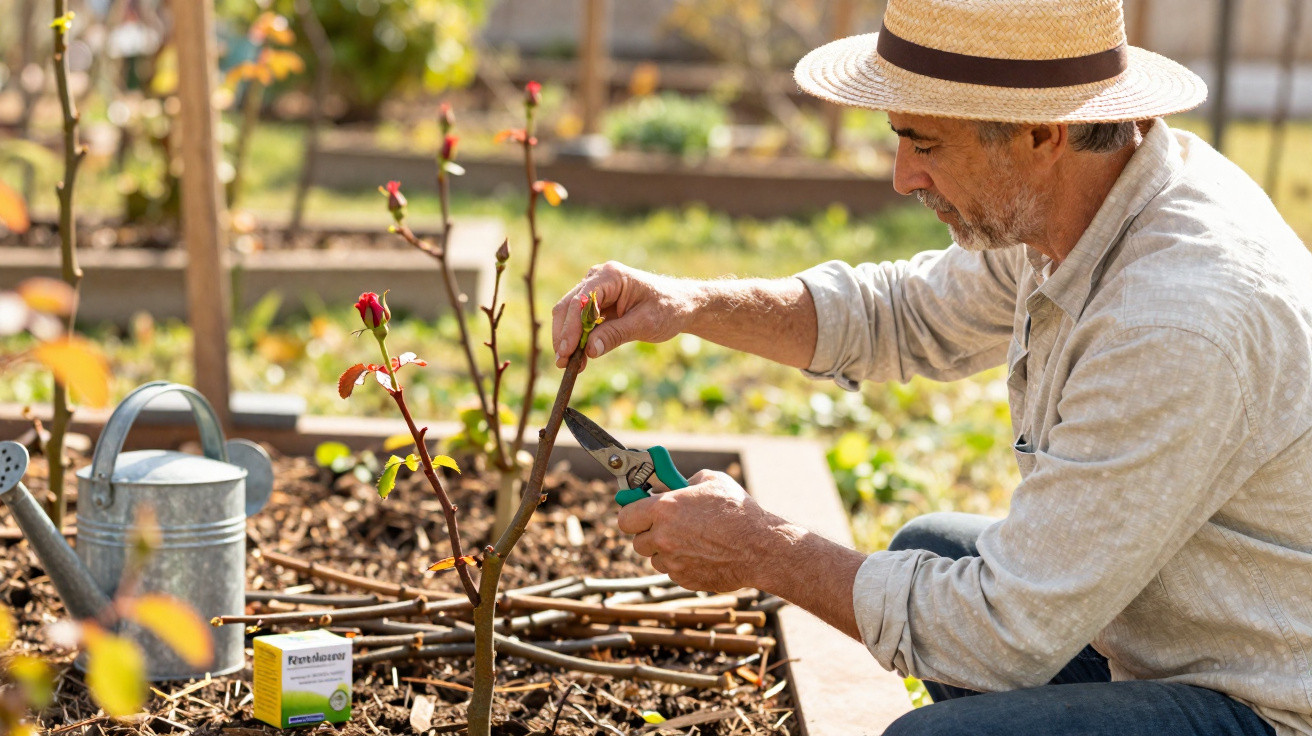
An experienced nursery gardener relies on a surprisingly simple approach instead: less rushing, more looking. If you stop cutting your roses in spring by rigid rulebook and start “reading” the plant, you’ll often see a small transformation in the border: sturdier shrubs, fewer diseases and noticeably more buds.
Why the usual rose pruning so often disappoints
In many gardens it plays out the same way every year: just before spring, the secateurs come out, everything gets chopped back, job done. The shrub looks tidy, expectations for masses of flowers are high - and a few months later comes the let-down.
The reason is almost always one of these:
- Roses are cut back too hard, leaving them effectively drained.
- Weak, spindly shoots are left in place and soak up energy.
- Inner, crossing branches create a dark, damp tangle where fungal diseases thrive.
The outcome: fewer blooms, more powdery mildew, and a shrub that looks neither well-shaped nor truly healthy.
"Anyone who only ‘shortens’ roses, instead of shaping them with intent, gives away a large share of their potential every year."
The professional method: observe first, then cut
Before making the first cut, nursery professionals do something many home gardeners skip: they take time to really study the plant - not just from one angle, but all the way around.
A professional looks especially for:
- thick, vigorous shoots worth keeping
- old, dead wood that does nothing but waste energy
- shoots that touch or rub against each other
- the shrub’s overall structure - is it open, or completely congested?
The aim isn’t to make everything look “neat”; it’s to build a balanced shrub. Air and light need to reach the centre. New growth must have room, and it should develop in a clear direction rather than criss-crossing.
"The simple rule of thumb: encourage strong shoots, and remove weak or troublesome growth without hesitation."
What this method comes down to in practice:
- keep robust main canes
- cut out dead, blackened or grey wood
- remove very thin, “spaghetti-like” shoots
- thin out anything that crosses in the centre
- place every cut just above an outward-facing bud
Done this way, you create a goblet-shaped shrub that can “breathe”, with space for new, stable flowering shoots to form.
The right moment in spring
Timing matters just as much as technique. Prune too early and late frosts can damage newly awakened buds. Leave it far too late and you’ll remove shoots the rose has already invested energy in.
Useful signs in the garden include:
- The buds are clearly swollen, possibly with a slight green tint.
- Severe frosts in double-digit minus temperatures are no longer expected.
- The ground is no longer deeply frozen.
In many areas, that window falls roughly between late February and early April - depending on location and the weather. If tiny new shoots have already appeared, it’s not a disaster. Simply prune a little more cautiously and leave slightly more length.
Step by step: how to prune roses like a professional
Before you begin, give your tools a quick check. Sharp, clean secateurs are essential; blunt blades crush stems and create an easy entry point for fungi.
The key actions at a glance
- Look at the shrub from all sides, not only from the front.
- Remove all dead, blackened or damaged branches right down at the base.
- Cut out very thin shoots (thinner than a pencil) completely.
- Take out inner, crossing branches until the centre feels more open and airy.
- Leave 3 to 5 well-spaced strong main canes as the “framework” (for bushy varieties).
- Shorten each of these to a suitable length, cutting just above an outward-facing bud.
A cut can be slightly angled, but it doesn’t need a steep slant. What matters is a smooth, clean cut surface.
The right height depends on how vigorous the rose is
A common mistake in gardens is to chop every rose to a single “standard height”. It may look uniform, but it ignores the strength and growth habit of individual varieties.
As a rough guide:
| Rose type | Growth habit | Recommended shoot length after pruning |
|---|---|---|
| vigorous bedding roses / hybrid teas | strongly vigorous | 20–30 cm, 3–5 buds per shoot |
| weaker shrub roses | moderately vigorous | 30–50 cm, leave slightly longer |
| old, weakened roses | low vigour | shorten only gently, preserve more length |
If you treat each rose according to its own strength, you’ll end up with plants that look far more harmonious. In nurseries, a saying you’ll often hear is: a good rose is “guided” - not forced.
What you should stop doing in spring
Some habits are widespread, but they harm roses year after year.
- aimless trimming: snipping a bit off everywhere without considering structure and direction
- excessive caution: taking almost nothing off out of fear, leaving tired old shoots in place
- cutting too tight to the bud: cutting right above the bud so it can dry out
- blunt or dirty secateurs: crushed edges, poorer healing and a higher risk of disease
Leaving about 0.5 cm to 1 cm of wood above the bud is enough. That way the bud stays protected, without leaving an unnecessarily long stub.
What roses urgently need after pruning
Pruning is only the starting signal. After that, the plant enters a period when it has to perform: new shoots, new leaves, and later, buds. That’s exactly when a little support pays off.
- Water: if the soil is dry, water the shrub thoroughly - not just a light sprinkle.
- Nutrients: work in a portion of mature compost, horn shavings, or a dedicated rose fertiliser around the root zone.
- Mulch layer: a covering of bark mulch, (dried) grass clippings, or chipped material helps keep moisture levels steady.
If you keep checking in during the weeks after pruning, you’ll quickly see whether the method is working: fresh shoots are sturdy, the shrub looks more open, and the leaves have a rich colour. In wet years in particular, an airy crown is worth its weight in gold because foliage dries faster and fungal problems are less common.
Practical examples for different rose types
The basic rules are similar for all garden roses, but a few types need small adjustments.
Bedding roses and hybrid teas
These are usually cut back more firmly so they produce plenty of young, flower-bearing shoots. You can prune decisively here, as long as enough strong basal canes remain. Thin, poorly flowering twigs should be removed without compromise.
Shrub roses and historic varieties
These roses depend heavily on their natural form. Rather than cutting them “small” every year, focus on removing old wood and thinning. Every few years, an entire old cane can come out at the base to make space for younger growth to take over.
Climbing roses
They are not cut back short every year. More important is tying the long main canes in horizontally or in a fan shape, then shortening the side shoots to 2–4 buds. This creates many flowering points along the length of the stems rather than only at the tip.
Risks you should keep in mind
If you prune very hard too late in spring, you put the plant under stress: it has to produce new shoots using energy it has already “paid for”. In dry springs, that can lead to weak growth. The only remedy is consistent watering and a better-matched approach to pruning in the following season.
Another risk is over-thinning in very sunny locations. If too few shoots are left with little leaf cover, strong summer sun can scorch exposed stems. A slightly denser structure - while still well ventilated - helps prevent that.
How your view of the garden changes
Once you apply this pruning technique consciously, you’ll notice a shift: you work less mechanically and start treating each rose as an individual plant. Many home gardeners report that they prune less, yet end up with shrubs they’re far happier with.
The change is small: before each cut, pause briefly, read the plant, then act. That moment is the difference between “roughly pruned” and a rose pruning that repays you in summer with full clusters of blooms.




Comments
No comments yet. Be the first to comment!
Leave a Comment